Business Analyst Projects: Real Ideas to Build Your Portfolio
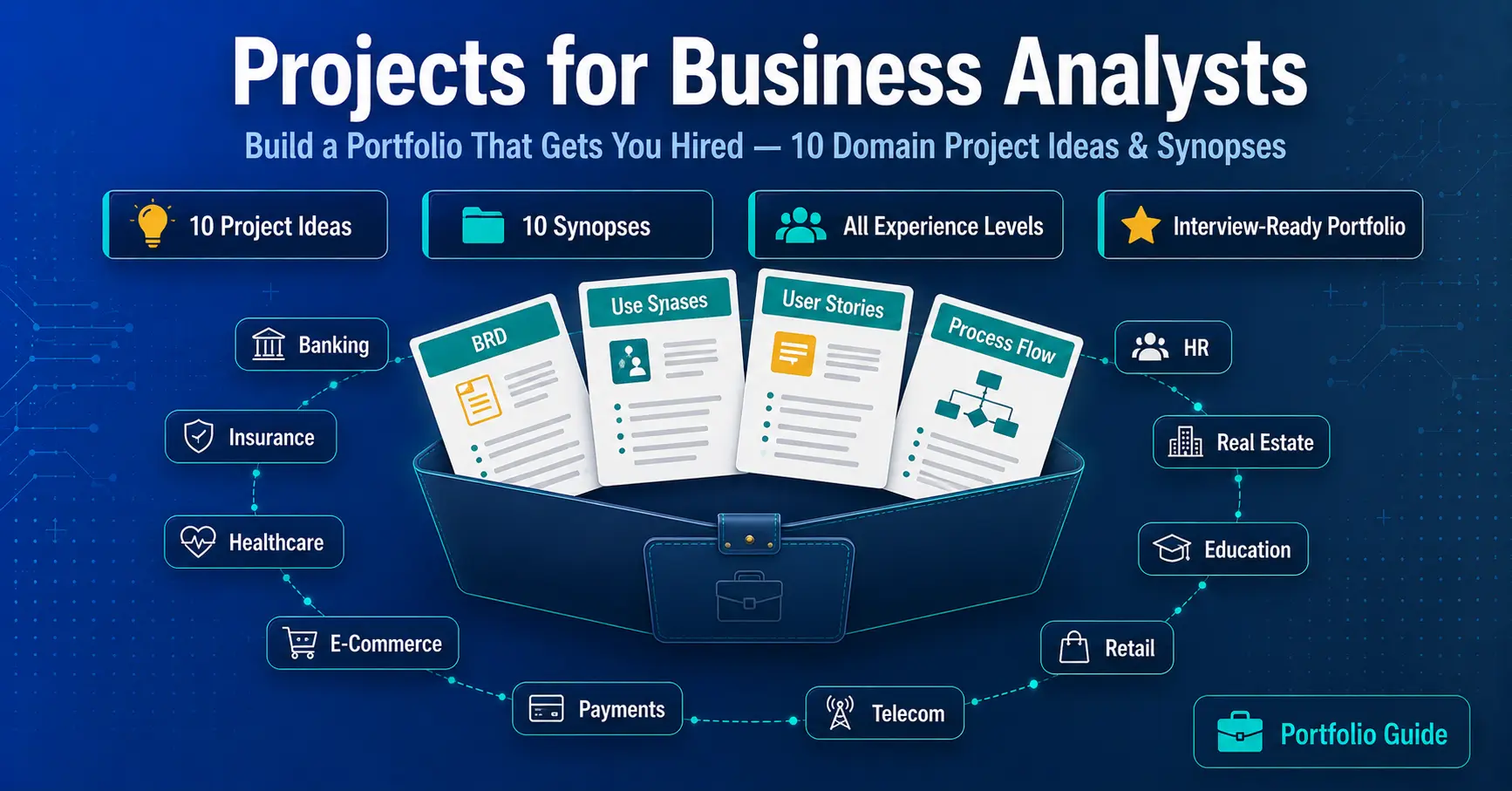
Business analyst projects are how you prove you can do the job. This guide gives you real project ideas across banking, healthcare, retail, and payments, shows you how to build a portfolio from them, and explains how live projects work, so freshers and experienced professionals can both get interview-ready.
- 10 project ideas across 10 in-demand domains
- 10 detailed project synopses you can build from
- A step-by-step way to turn projects into a portfolio
- What live and real-time projects are, and how they help
Quick answer
A Business Analyst project is a real or simulated IT engagement that a BA uses to build skills, create portfolio deliverables, and demonstrate domain expertise to employers. A strong BA project portfolio typically includes 3 to 5 projects across different domains, with complete documentation including BRD, use cases, process flows, and user stories.
Projects can be self-initiated from project ideas, executed through guided live project training, or drawn from real work experience. This guide covers all three, plus the exact documents to create for each.

8+ years in business analysis, requirement gathering, and client management, with a focus on turning complex problems into clear, documented solutions.
Read more articles from Rohit →What is a Business Analyst project?
A Business Analyst project is a structured piece of work, real or simulated, in which a BA practises or demonstrates the core skills of the role: eliciting requirements, documenting business processes, analysing stakeholder needs, and producing BA deliverables such as a Business Requirements Document (BRD), use case diagrams, or user stories.
For portfolio building, a BA project can take three forms. A self-initiated project uses a realistic scenario to create BA documents independently, with no client and no team, just the scenario and your documentation. A guided live project is executed under a mentor with a structured scope, stakeholder simulations, and review feedback. A real-work project comes from actual employment, where with client permission, sanitised deliverables can be included in a portfolio.
| Project type | What it is | Portfolio value | Best for |
|---|---|---|---|
| Self-initiated project | You pick a scenario, write requirements, create deliverables independently | Medium, shows initiative but no mentor validation | Freshers building first portfolio; testing new domains |
| Guided live project | Structured project with mentor, scope, stakeholder role-play, document review | High, mentor-validated, structured, closer to real-world | Career-switchers, freshers needing guidance, anyone serious about portfolio quality |
| Real-work project | Actual project from employment, sanitised for confidentiality | Highest, real stakeholders, real decisions, real constraints | Working professionals with existing BA experience |
| Capstone / training project | Project assigned during a BA training course | Medium-High, depends on course quality and mentor involvement | Students completing BA training programmes |
Top Business Analyst project ideas across domains
The domain you choose for your BA project signals your industry expertise to potential employers. This table covers the most in-demand BA project domains with specific project ideas and the key skills each demonstrates.
| Domain | Project ideas | Key skills demonstrated | Difficulty |
|---|---|---|---|
| Banking | 1. Digital account opening process redesign. 2. Loan origination system requirements | Core banking processes, KYC/AML rules, regulatory compliance | Medium |
| Insurance | 1. Claims management system implementation. 2. Policy underwriting automation | Insurance product knowledge, claims workflow, regulatory requirements | Medium |
| Payments | 1. Payment gateway integration for marketplace. 2. UPI-based payment feature for app | Payment ecosystem, PCI-DSS scope, transaction flow requirements | Medium-High |
| Telecom | 1. BSS billing system transformation. 2. Customer self-service portal | OSS/BSS knowledge, CDR flow, eTOM process mapping | High |
| E-Commerce | 1. Personalised recommendation engine. 2. Multi-seller marketplace platform | Customer journey mapping, product catalog, search and filter requirements | Easy-Medium |
| Healthcare | 1. Patient management system. 2. Hospital billing and insurance claim system | Healthcare workflows, data privacy (HIPAA/DPDP), clinical terminology | Medium |
| Retail / Supply Chain | 1. Inventory management and demand forecasting. 2. Omnichannel order management | Inventory workflows, demand forecasting logic, ERP integration | Medium |
| Education | 1. Student performance analytics platform. 2. Online learning management system | Academic data models, user role analysis, learning outcome metrics | Easy |
| Real Estate | 1. Property management and tenant portal. 2. CRM for real estate agents | Property lifecycle management, tenant workflows, document management | Easy-Medium |
| HR / Payroll | 1. Employee onboarding workflow automation. 2. Payroll processing system | HR process flows, statutory compliance, multi-stakeholder workflows | Medium |
10 detailed Business Analyst project synopses
These project scenarios can be used as the basis for building your BA portfolio. For each project, create the full set of BA documents listed in the documents section below.
Digital Account Opening for Retail Bank
BankingA regional private bank wants to reduce account opening time from 3 days to under 30 minutes through a fully digital onboarding process, cutting customer drop-off to fintech challengers.
E-Commerce Market Expansion Strategy
E-CommerceDubai Electronics Hub, a $140M refurbished electronics company, plans global expansion and needs an operational blueprint covering processes, regional requirements, and barriers to entry.
Supply Chain Optimisation
RetailVertex Retail Solutions operates across electronics, apparel, home goods, and groceries through stores, e-commerce, and distributors, and needs requirements for a supply chain platform upgrade.
Risk Management System
FinanceA financial services firm needs a risk management system to identify, assess, and manage financial exposures across its portfolio, with input from risk, credit, and compliance teams.
Patient Management System
HealthcareA hospital network needs a patient management system covering appointment booking, medical history, prescriptions, and billing, replacing a manual paper-based process.
Inventory Management System
RetailA retail chain needs a system to track inventory, predict demand, and automate replenishment across 50+ stores, replacing manual spreadsheets that cause stock-outs and excess inventory.
Personalised Recommendation Engine
E-CommerceAn e-commerce platform wants a recommendation system based on browsing and purchase history to increase average order value and repeat purchases.
Student Performance Analytics Platform
EducationA university wants a platform to monitor grades, attendance, and participation, and provide early intervention alerts for at-risk students.
Property Management System
Real EstateA property management company needs a system for listings, tenant profiles, lease agreements, maintenance requests, and rent collection across 500+ properties.
Payment Gateway Integration
PaymentsMarketspace, a new pet products marketplace on web and mobile, needs requirements for integrating a payment gateway handling cards, UPI, and wallets with PCI DSS compliance and refunds.
Want these built end-to-end with a mentor?
All 10 projects can be executed with mentor guidance through Techcanvass Live Projects Training, producing an interview-ready portfolio.
BA projects for freshers, students, and experienced professionals
The right project depends on where you are in your career. Use this table to pick projects that match your experience and target the roles you want.
| Audience | Best project types | Recommended domains | Portfolio goal |
|---|---|---|---|
| Fresher (0-1 yr) | Simple transactional systems: online booking, account opening, inventory management | E-commerce, retail, basic banking | 2 to 3 projects showing documentation fundamentals and basic stakeholder analysis |
| Student / MBA | Academic scenarios: performance analytics, market entry, process optimisation | Education, retail, healthcare, FMCG | 2 to 3 projects showing structured problem analysis and recommendations |
| Career-switcher (non-IT) | Projects in your previous domain, combined with one target IT domain | Your previous industry plus one target IT domain | 3 to 4 projects: industry knowledge plus BA methodology equals unique positioning |
| Working professional (1-5 yrs) | Complex multi-system projects: digital transformation, system migration, integration | BFSI, telecom, e-commerce | 3 to 5 projects with increasing complexity, showing career progression |
| Domain specialist (BFSI/Telecom) | Domain-specific IT projects: CBS implementation, OSS/BSS, regulatory compliance | Banking, insurance, payments, telecom | 2 to 3 highly domain-specific projects with regulatory and system-level content |
How to build a Business Analyst portfolio, step by step
A business analyst portfolio is the single most effective way to differentiate yourself in a competitive job market. Business analysis is a communication and documentation discipline, so the only way to prove you can do it is to show that you have done it. Here is how to build one.
Choose 3 to 5 projects across different domains
Select projects that demonstrate range: at least one from a domain where you have worked or trained, and one or two from domains you are targeting. Banking, insurance, healthcare, and e-commerce are the most in-demand domains for BA roles in India. Each project should be distinct enough to demonstrate different types of requirements work.
Create complete documentation for each project
A portfolio project is only as strong as its documentation. For each project, create as many of these as the scope supports: BRD, Functional Requirements Document or System Requirements Specification, use case document with diagrams, user stories with acceptance criteria, As-Is and To-Be process flow, wireframes, and a Requirements Traceability Matrix.
Write a project summary for each entry
For each project write a one-paragraph summary covering the business problem solved, your role as the BA, the key stakeholders you worked with or simulated, the deliverables you produced, and the outcome to the business. This is the summary you adapt into a resume bullet and describe when an interviewer asks you to walk through a project. Business analyst projects for your resume should be written exactly like real work entries, with a clear problem, role, and outcome.
Host your portfolio
A BA portfolio can be hosted several ways. A simple PDF with project summaries and document links works for most interviews. A LinkedIn profile with a portfolio section is visible to recruiters. A personal website or Google Sites page makes it searchable. A GitHub repository with organised folders works for technically-oriented BA roles.
Get your portfolio reviewed
A portfolio reviewed by an experienced BA or mentor is significantly stronger than one built in isolation. A mentor can identify gaps in your requirements, flag where documentation does not match industry standards, and advise which projects suit specific job targets.
Match your portfolio to the skills employers want
See which business analyst skills to demonstrate, and the resume phrasing that gets interviews.
Why build a Business Analyst portfolio?
Unlike technical roles where coding tests or GitHub profiles demonstrate skill objectively, a BA portfolio is the clearest proof of ability. Here is the difference it makes.
| Without a BA portfolio | With a BA portfolio |
|---|---|
| Recruiters have only your job title and company name to evaluate you | Recruiters can see actual deliverables (BRD, use cases, process flows) before the interview |
| Interview relies entirely on verbal answers to hypothetical questions | Interview is a discussion of real work you have already done, much stronger credibility |
| Domain knowledge claims are unverifiable | Domain-specific projects demonstrate banking, healthcare, or telecom knowledge concretely |
| Freshers and career-switchers cannot differentiate from other applicants | A portfolio with 3 to 5 projects shows initiative and ability regardless of work history |
| Each interview starts from zero | Portfolio compounds over time, each project makes the next interview stronger |
What BA documents to create for each project
A project synopsis is only the starting point. The value of a BA project to your portfolio comes from the documents you create. Here is what to produce.
| Document | What it is | Which projects need it |
|---|---|---|
| Business Requirements Document (BRD) | High-level document defining what the business needs: scope, objectives, stakeholders, key requirements, constraints | All projects, this is the core BA deliverable |
| Functional Requirements Document (FRD) | Detailed document defining how the system must function: features, business rules, system behaviours | System implementation projects: account opening, inventory, patient management |
| Use Case Document | Describes how users interact with the system: actors, use cases, main flow, alternate flows, exceptions | Any project with a system component, most projects qualify |
| User Stories (Agile) | Short requirement statements in As a [user], I want [feature], so that [benefit] format with acceptance criteria | Agile-framed projects: e-commerce, recommendation engine, mobile apps |
| Process Flow Diagram | Visual diagram of a business process: As-Is (current state) and To-Be (future state) | Process improvement projects: supply chain, account opening, inventory |
| Wireframes / UI Mockups | Low-fidelity screen sketches showing proposed UI layout, just structure | Projects with significant UI: patient portal, customer app, self-service portal |
| Requirements Traceability Matrix (RTM) | Table linking business requirements to functional requirements to test cases, shows complete coverage | Any project where you want to demonstrate end-to-end requirements management |
| Stakeholder Analysis | Matrix identifying all stakeholders: their interest, influence, role, and communication needs | All projects, stakeholder analysis is the first step of any BA engagement |
Real-time and live projects for Business Analysts
A live or real-time project for a Business Analyst is a structured, real-world project executed under the guidance of an experienced BA mentor, simulating the conditions of an actual professional engagement with defined scope, stakeholder interactions, review cycles, and deliverable standards. Here is how it compares to working alone.
| Self-study project (DIY) | Live project (mentor-guided) |
|---|---|
| You interpret the scope yourself, often too narrow or too broad | Scope is defined with mentor input, realistic and appropriate for your level |
| No stakeholder interaction, you make all assumptions | Stakeholder interviews are simulated with the mentor playing business roles |
| Documents reviewed by nobody, you do not know if your BRD is good or poor | Documents reviewed by the mentor, with specific feedback on gaps and standards |
| No benchmark, you cannot tell if deliverables are interview-ready | Mentor validates deliverables against industry standards, you know they are ready |
| No accountability, easy to abandon mid-project | Scheduled reviews create structure and commitment, completion rate is much higher |
A live project differs from a training course in a critical way: the output is not a certificate, it is a completed project portfolio. The skills built are not theoretical but demonstrated through actual deliverables that can be shown to employers directly.
Build a real portfolio with Live Projects Training
Techcanvass Live Projects Training gives you a real project to execute end-to-end as a Business Analyst, with a defined scope, mentor guidance through every phase, stakeholder simulation, and document review. The output is a complete portfolio of BA deliverables ready for interview.
What you walk away with
- A complete, mentor-validated project
- BRD, use cases, process flows, user stories
- Stakeholder simulation experience
- A project certificate
- An interview-ready portfolio
Frequently asked questions: Business Analyst projects
What are the best business analyst projects for freshers?
For freshers, the best BA projects have clearly defined scope, straightforward business rules, and realistic stakeholder scenarios. Good starting projects: a digital account opening process for a bank (KYC, process flows, regulatory requirements), an e-commerce order management system (clear business rules), a patient appointment booking system (multiple user roles), and a retail inventory management system (demand forecasting logic). Each produces a complete set of BA documents (BRD, use cases, user stories, process flow) without requiring domain expertise a fresher would not credibly have.
How do I build a business analyst portfolio?
Build a BA portfolio in five steps: choose 3 to 5 projects across different domains, create complete documentation for each (BRD, use cases, user stories, process flows), write a one-paragraph summary per project, host it as a PDF, LinkedIn section, personal website, or GitHub repository, and get it reviewed by an experienced BA or mentor. Quality matters more than quantity, so one fully documented project beats five thin synopses.
How many projects should be in a business analyst portfolio?
A BA portfolio should have 3 to 5 projects, enough to demonstrate range without overwhelming a reviewer. Three is the minimum: it shows you can execute more than one type of requirement across more than one domain. Five is a comfortable maximum. More than five dilutes the quality signal, so it is better to have 3 excellent projects than 8 mediocre ones. Each project should have at minimum a BRD, one process flow, and either use cases or user stories.
What is a live or real-time project for a business analyst?
A live or real-time project for a Business Analyst is a structured project executed under mentor guidance, simulating a real professional engagement with defined scope, stakeholder interactions, document review cycles, and deliverable standards. Unlike a self-study project where you work alone without feedback, a live project gives you a mentor who plays stakeholder roles and reviews your documents. The output is a complete portfolio of validated BA deliverables ready to present in interviews.
What documents should a BA create for a portfolio project?
The core documents are a Business Requirements Document (BRD) covering scope, objectives, stakeholders, and key requirements, a use case document or user stories with acceptance criteria, and at least one process flow diagram showing the As-Is and To-Be state. For stronger portfolios, add a Functional Requirements Document (FRD), wireframes, a Requirements Traceability Matrix (RTM), and a stakeholder analysis matrix. The BRD is non-negotiable, it is the primary BA deliverable.
How do I choose the right domain for my BA portfolio projects?
Choose domains that match the roles you are targeting. For banking and BFSI roles, include a banking or payments project such as digital account opening or payment gateway integration. For healthcare IT, include a patient management or hospital billing project. As a rule, include at least one domain-specific project in your target industry and one or two generic IT projects (e-commerce, inventory, HR) to demonstrate transferable BA skills.
Can I add a business analyst project to my resume without real work experience?
Yes, self-initiated and mentor-guided BA projects are legitimate portfolio items for a resume. Describe them accurately: company name (use the fictional company from the scenario), your role as BA, the project scope, the deliverables you produced, and the outcome. Do not describe it vaguely as a personal project, be specific about the problem you solved and the domain knowledge you applied. Hiring managers reviewing a junior BA portfolio expect self-initiated or training projects and evaluate them on document quality, not employment status.