Business Analyst Skills: Top Skills Required in 2026
Business analyst skills fall into three groups: core business analysis skills, technical skills, and human or soft skills. This guide explains each group in plain language and shows every skill at work with a real-life example.
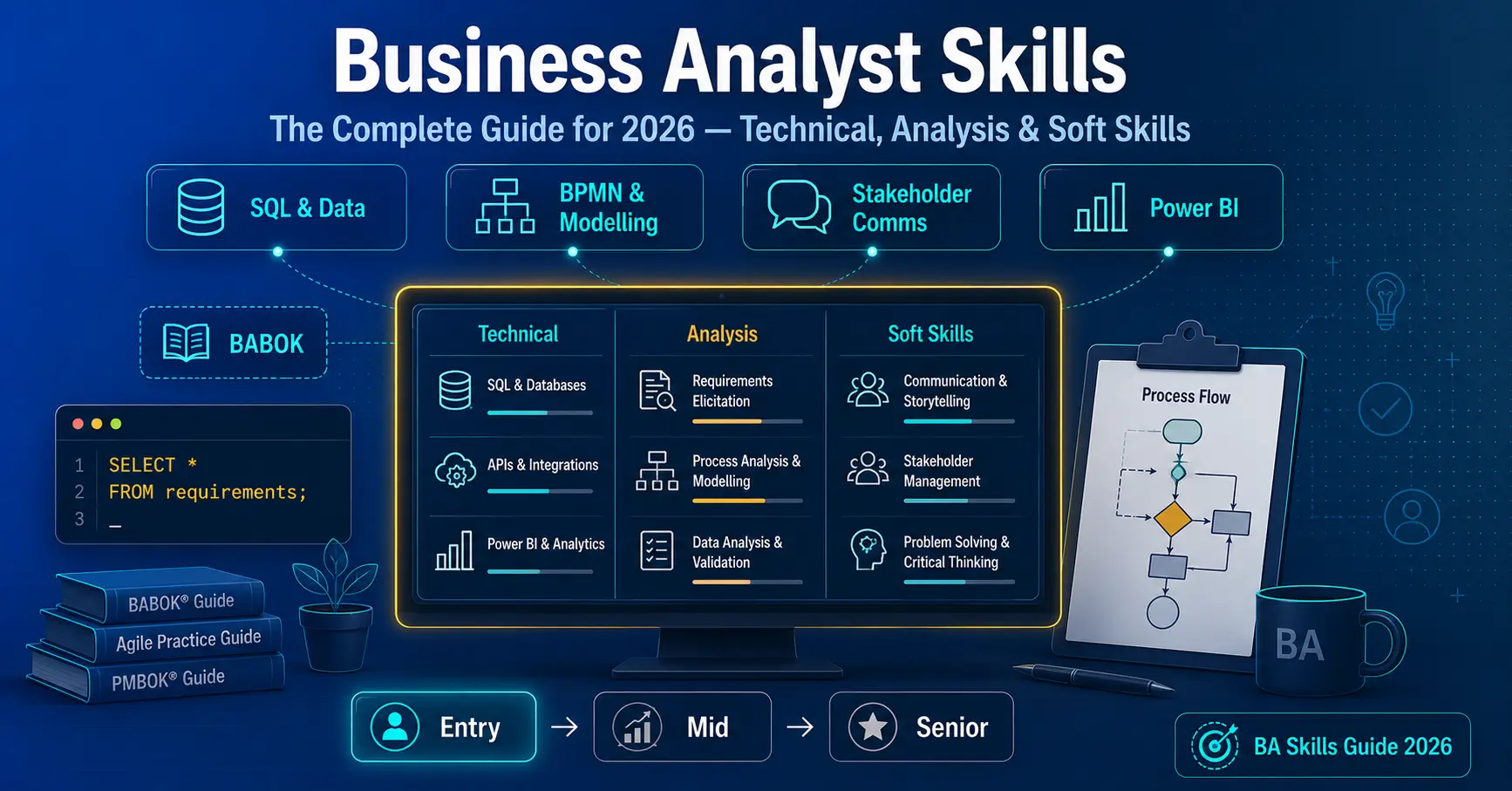
Business Analyst skills explained with real-life examples
Every skill in this guide is explained with a real-life example, so you can see how it plays out on an actual project and understand it better than a plain definition would allow. Look for the highlighted Real-life example box under each skill.
A business analyst sits between the people who run the business and the teams who build the technology. Doing that well takes three groups of skills: core business analysis skills, technical skills, and human or soft skills. We start with the core skills, because they are the heart of the role.
Understanding the three BA skills group
Let us explain each of the business analyst skill groups. The three BA skills groups, Core Business Analysis Skills, Technical Skills and Human/Soft Skills, are covered in this guide. Each card below connects to its sub-sections, so you can jump straight to the skill you want to understand.
Core Business Analysis Skills
The craft of business analysis itself: finding out what the business needs, mapping how work flows, and documenting it clearly.
Technical Skills
The data and system know-how that lets you work closely with technology teams. A short overview here, with a full guide on its own page.
Human/Soft Skills
The people skills that decide whether good analysis actually gets used: thinking clearly, communicating well, and understanding the people involved.
Core Business Analysis Skills
These are the skills at the heart of the role. Technical and people skills support them, but this is the actual craft of business analysis. Each skill below is explained in simple terms and followed by a real-life example.
Requirements discovery
Requirements discovery is the work of finding out what people actually need, which is often different from what they first ask for. You do it through interviews, workshops, watching people do their jobs, and reading existing documents. The skill lies in asking “why” and “what happens today” until the real need is clear.
Store managers at a retail chain asked for a daily sales report by product. The business analyst spent a morning with two of them and noticed they exported that report and then compared it against stock counts in a separate spreadsheet to decide what to reorder. The report was never the goal. The real need was knowing what to reorder, so the team built a low-stock alert instead, and the managers stopped doing the comparison by hand.
Process analysis and modelling
Process analysis means understanding how work really flows today: who does what, in which order, and where it slows down. Modelling means drawing that flow, and the improved version, as a simple diagram such as a flowchart, a swimlane diagram or BPMN, that everyone can read.
A good diagram shows delays, repeated work and unclear hand-offs that are hard to spot in a long discussion.
A bank’s home loan applications were taking much longer than customers expected. The analyst mapped the journey step by step and found two problems: the same applicant data was typed into two different systems, and the credit team kept emailing customers for missing documents after the application had been submitted. A document checklist at the time of application and a single point of data entry removed both delays.
Prototyping
A prototype is a quick, low-cost mock-up of a screen or a journey, drawn on paper or built in a tool such as Figma, Balsamiq or Pencil. When people can look at something instead of reading a page of text, missing details come out early, when a change costs minutes instead of weeks of development.
An insurance company wanted an online claim form. The written requirement simply said the customer enters the claim details. The analyst sketched three screens in an hour and showed them to the claims team. A claims officer spotted straight away that there was no place to upload hospital bills and no way to choose which family member the claim was for. Fixing a sketch took minutes. Fixing a built form would have meant days of rework.
Creating artifacts (like BRD, SRS and more)
Artifacts are the documents that record what has been agreed: the Business Requirements Document (BRD), the Software Requirements Specification (SRS), user stories, use cases, process models and traceability matrices. They give developers, testers and stakeholders one shared reference, and they protect the project when people remember a meeting differently.
Different projects need different artifacts. Our guide to the documents a business analyst prepares explains each of them.
On an e-commerce project, the SRS had one clear line: if a payment fails, the customer must be able to retry in the same session without losing the cart. During testing, a tester reported that retrying emptied the cart. The developer thought it was a minor issue and the product owner thought it was serious. The written line settled the discussion in minutes, and the fix went in the same day.
Domain knowledge
Domain knowledge is your understanding of the industry you work in: its terms, rules and ways of working. It matters because an analyst who knows the domain asks sharper questions, speaks the stakeholders’ language, notices missing rules (such as regulatory ones) and earns trust faster.
You do not need to know every domain. Pick one or two and go deep. Some of the domains where business analysts are commonly hired:
In a health insurance project, stakeholders kept saying “pre-auth” and “co-pay”. An analyst who knew the domain understood that pre-authorisation is approval taken before treatment and co-pay is the share of the bill the patient pays. Without being told, she asked what should happen to a claim when the pre-authorisation has expired. Nobody on the project team had thought about that case.
BA tools: Jira, MS Visio and Confluence
Jira is used to manage the backlog, user stories and sprints. MS Visio is used to draw process flows and diagrams. Confluence is where requirements and meeting notes are kept so the whole team can find them. Learn them, because most job descriptions mention them.
A business analyst who had always worked in Jira joined a company that tracked work in Azure DevOps. Because she understood what a backlog is for, how to split a story and how to prioritise, she was productive within a week. The new tool changed where things were typed, not how she thought about the work.
Technical Skills for Business Analysts
Technical skills help you work closely with data and technology teams: querying data with SQL, understanding how systems talk to each other through APIs, and reading reports built in tools like Power BI. You do not need to be a developer to be a business analyst, but a little technical fluency saves time and earns respect. This topic is big enough for its own page, so we cover it in detail in our guide to technical business analyst skills.
What technical skills look like in practice
A business analyst at an online retailer was told that returns were rising. Instead of waiting for the data team, she ran a simple SQL query on the orders table herself and found that most returns came from one product category with a wrong size chart. The fix was a content change that took a day, not a new feature.
Want the complete list of technical skills?
Our dedicated guide explains each technical skill a business analyst needs, one by one.
Human/Soft Skills for Business Analysts
Technical skills help you get the interview. People skills decide how far the project, and your career, go. A business analyst spends most of the day with people, so these four skills matter as much as any tool.
Problem solving
Problem solving is the habit of defining the problem clearly, finding its cause, listing the possible solutions and choosing the one that fits the time, budget and people involved. Jumping straight to a solution is the most common mistake.
A company’s support team was flooded with “where is my order?” calls. Hiring more agents was one option, but an expensive one. The analyst listed three options, more agents, proactive SMS updates and a new tracking page, and compared the effort and impact of each. SMS updates were quick and cheap, so they went first, with the tracking page planned for later. Call volume came down without adding a single agent.
Analytical skills
Analytical skills are about breaking information down, whether it is a process, a set of numbers or a long list of complaints, to see what is really going on. It means comparing, spotting patterns and questioning whether the numbers say what people think they say.
An online learning company saw sign-ups fall, and the first guess was that marketing had stopped working. The analyst split the data by device and by step in the sign-up journey. Desktop sign-ups were steady. On mobile, people were leaving at the payment step, right after a design change had pushed the pay button below the fold. Marketing was fine. The button was the problem.
Communication skills (with the team and with stakeholders)
Communication is how you move information between business people and technical people, in meetings and in writing. It means speaking at the right level for your audience, listening properly, and checking that what you understood is what was meant.
With stakeholders you explain, align and manage expectations. With the team you make requirements clear enough to build and test.
The sales director asked for a “faster dashboard”. The developers took that to mean a two-second load time. In a ten-minute call, the analyst found out what he really meant: he wanted yesterday’s numbers on his screen by 9 am every day, because the old report arrived at noon. She wrote that down as a testable requirement, and the team set up a nightly data refresh instead of spending weeks tuning page speed.
Empathy
Empathy means understanding why people feel and act the way they do about a change. People resist new systems for real reasons, such as fear of being measured, extra work or loss of control. An analyst who understands those concerns can design a solution people will actually use.
Warehouse staff pushed back on a new scanning app. The analyst spent a full shift on the floor and learned two things: the scanners lost connection in the cold storage area, and staff were judged on speed, so any delay counted against them. The team added an offline mode and ran training during working hours. When the app rolled out, people used it, because it finally worked the way their day worked.
How to build these skills
You cannot learn all of this in a weekend, and you should not try. Build your toolkit month by month with deliberate practice, structured learning, and a recognised certification that matches your stage.
Practise on real projects
Skills stick when you use them. Map a simple process at your current job in BPMN, build two or three practice dashboards in Power BI, and write user stories for a feature you use every day. Hiring managers want hands-on evidence, not just theory.
Take a structured course
A good course shortcuts months of trial and error by teaching the frameworks analysts actually use, applied to real scenarios. It also gives you the structure to learn the harder skills, like DAX or BABOK techniques, in the right order.
Get certified for your stage
IIBA certifications signal verified competence to employers across India, the US, and Canada. Match the certification to your experience level.
Get the training to back up your skills
Techcanvass is an IIBA-endorsed training provider. Whether you are just starting out or choosing the right certification path, there is a course built for your stage.
Match the path to your stage
- New to BA: ECBA plus SQL and Excel foundations
- Working BA: CCBA plus Power BI and BPMN
- Senior BA: CBAP plus strategy and negotiation
Business analyst skills: frequently asked questions
The questions aspiring and working analysts ask most about the skills the role requires.
What are the top 5 skills for a business analyst?
The top five business analyst skills are requirement elicitation, SQL and data analysis, stakeholder communication, process modelling with BPMN, and critical thinking. Together they let you gather the right requirements, work with data directly, and keep business and technical teams aligned throughout a project.
What technical skills does a business analyst need in 2026?
In 2026 a business analyst needs SQL for querying data, advanced Excel, a BI tool such as Power BI or Tableau, and familiarity with Jira and Confluence. Basic Python and AI literacy are increasingly expected, especially in data-heavy and tech-driven roles.
Do business analysts need to know SQL or coding?
Most business analyst roles expect working SQL knowledge so you can query data yourself rather than wait on engineers. Full programming is not usually required, though basic Python helps in data-focused roles. For deeper coding and systems work, see the technical business analyst path.
What soft skills do business analysts need?
Core soft skills for business analysts are communication, stakeholder management, critical thinking, and negotiation. You translate between business and technical teams, facilitate workshops, resolve competing priorities, and make objective decisions under pressure. These skills often decide whether a project succeeds more than technical ability alone.
What skills do entry-level business analysts need?
Entry-level business analysts need SQL basics, strong Excel, clear requirement documentation, user-story writing, and solid communication. You do not need every advanced tool on day one. Focus on documenting requirements accurately and asking good questions, then add BI and modelling skills as you grow.
Which business analyst skills matter most in tech-driven industries?
In tech-driven industries, data skills matter most: SQL, BI tools like Power BI, API and systems awareness, and AI literacy, alongside Agile and Scrum fluency. If you want to specialise, the technical business analyst route goes deeper into systems, integrations, and technical documentation.
How do I list business analyst skills on a resume?
List business analyst skills in a dedicated section grouped as technical, analysis, and soft skills, then prove them in your experience bullets with outcomes. Name specific tools such as SQL, Power BI, and Jira and techniques such as BPMN and user stories that match the job description rather than generic labels.