How to Become a Business Analyst in Canada: Skills, Certifications & Career Path
Learn how to become a Business Analyst in Canada with practical steps for building core BA skills, earning IIBA certification, preparing a Canadian resume, and navigating the local job market.

Business Analyst Career in Canada: Video Guide
Watch this video alongside the Canada-focused roadmap for additional guidance on the Business Analyst career path, skills, and practical next steps.

How to Become a Business Analyst
Can you launch a Business Analyst career in Canada without prior BA experience?
Yes, absolutely. Business analysis is one of the most accessible roles in Canada for professionals transitioning from sales, operations, customer support, retail banking, or QA. Since the core of a BA’s work is identifying business problems and acting as a bridge, you can successfully leverage your domain experience to position yourself as an asset to Canadian employers.
Under the Canadian National Occupational Classification (NOC 21220), Business Analysts are classified among the most in-demand professionals. You do not need a background in software coding. Instead, you need to develop structured requirements gather practices, gain familiarity with Agile delivery models, and secure internationally recognized training.
Use this page for the Canada-specific execution path. For broader Business Analyst fundamentals, tools, portfolio, resume, and interview preparation, continue to the Global Business Analyst Roadmap. If your target market changes to the United States, use the Business Analyst Career in USA page for U.S.-specific market context.
Key Business Analyst skills valued by Canadian employers
No matter what career path you come from, you likely already utilize transferable skills that form the foundation of a successful Business Analyst. Aligning these skills with business requirements is key.
Communication Skills
Crucial for collaborating with stakeholders, team leads, and development teams in Canada. Translating business pain points into functional specifications clearly is key.
Problem Solving
Identifying actual business problems, conducting root-cause investigations, and proposing structured process enhancements that directly benefit stakeholders.
Analytical Abilities
Engaging in basic data analysis, asking target questions, and analyzing stakeholder requirements to map operational and software solutions.
Negotiation Skills
Resolving stakeholder conflicts, establishing transparent scope limitations, and helping diverse business groups agree on solution priorities.
Process Modelling
Creating functional process maps, swimlane diagrams, current (As-Is) and future-state (To-Be) workflows to clarify project vision.
Agile Documentation
Writing structured Business Requirements Documents (BRDs), Use Cases, and clear Agile User Stories with precise acceptance criteria.
Explore our localized Business Analyst roadmaps
Choose the target geography that aligns with your professional aspirations. Navigate specialized guides for major recruitment hubs.
Global Business Analyst Roadmap
The standard global framework covering baseline analysis standards, frameworks, and core tools used worldwide.
Explore Global RoadmapBA Career Roadmap for India
Guidance on Indian recruitment sectors, technology roles, hiring trends, and regional certifications.
Coming SoonBusiness Analyst Career in USA
Understand the U.S. BA market, specialized industry domains, salary outlooks, and corporate alignment standards.
Explore USABusiness Analyst Career in Canada
Leverage transferability paths, explore IIBA ECBA training courses, and learn resume tactics to get hired in Canada.
Currently ViewingHow to Become a Business Analyst in Canada
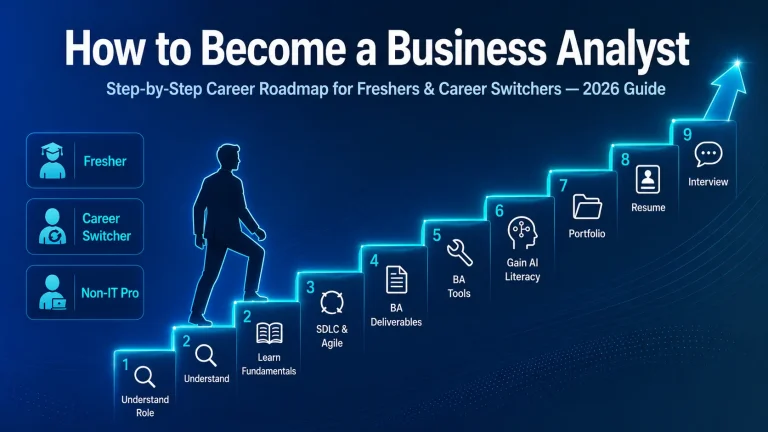
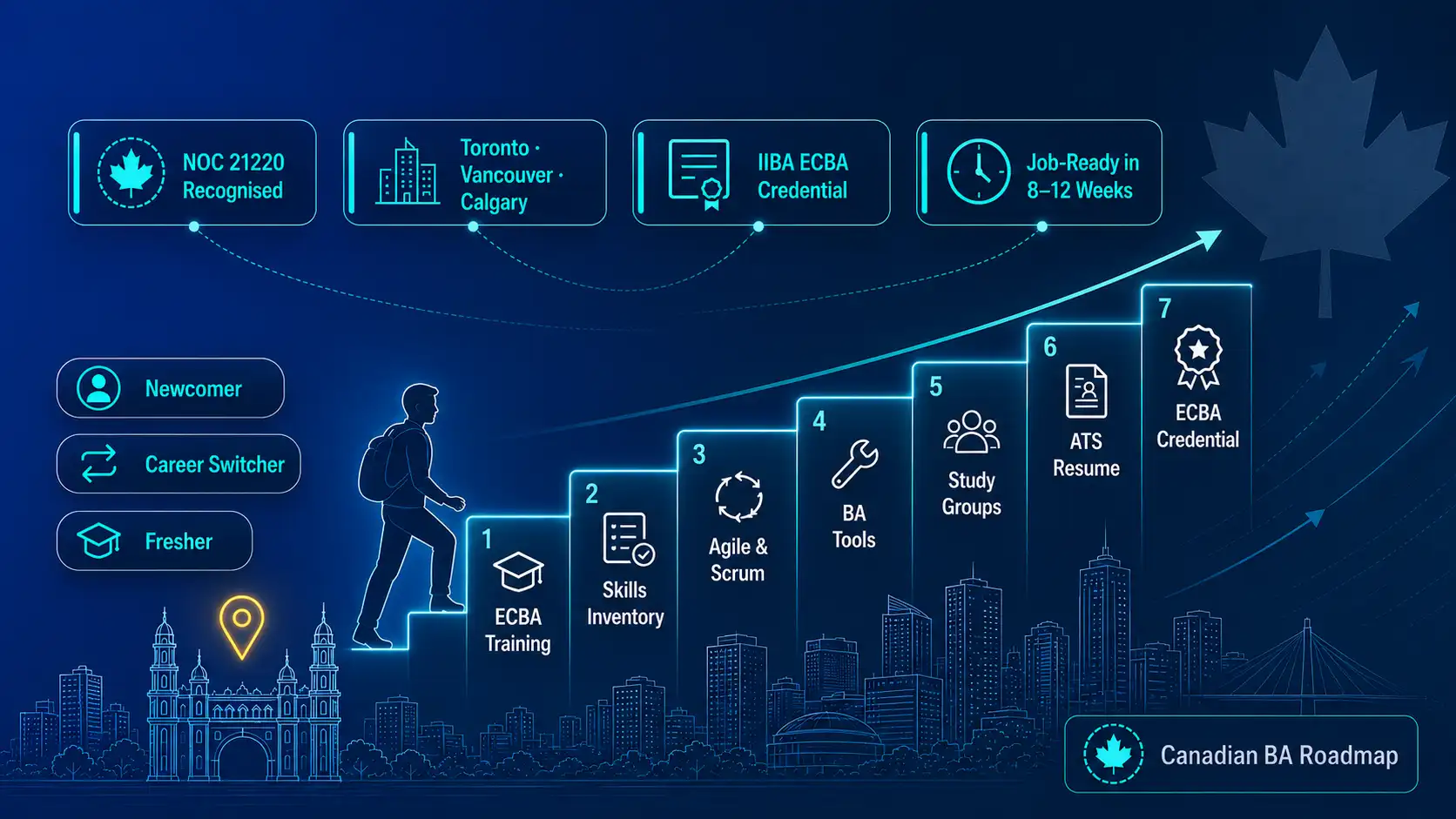
A structured approach tailored specifically for the Canadian hiring landscape. Follow these actionable steps to prepare yourself for success.
Enroll in IIBA Authorized Training
Canadian hiring managers strongly favor formal credentials. Enrolling in an authorized course like the TechCanvass ECBA Course helps newcomers and freshers gain foundational business analysis skills.
Inventory Your Transferable Skills
Create a detailed catalog of the skills you already possess from your previous backgrounds—such as client engagement, process improvements, or domain knowledge—and align them with Business Analysis competencies.
Master Project Methodologies
Canadian companies heavily utilize modern development cycles. Make yourself deeply familiar with methodologies like Agile, Scrum, Kanban, DevOps, and traditional Waterfall models.
Learn Key BA Techniques and Tools
Gain hands-on experience using industry-standard applications. Learn process mapping in draw.io or Visio, management of product backlogs in Jira, and database querying basics with SQL.
Participate in Collaborative Study Groups
Learning in isolation is tough. Join dedicated study circles and peer groups to review the BABOK Guide, debate real-world scenario answers, and expand your professional community in Canada.
Optimize Your Resume for Canadian ATS
Adapt your portfolio into a localized resume format. Eliminate non-standard details (such as photographs or personal demographics) and highlight domain expertise, technical tools, and certified knowledge.
Secure Entry-Level Certification
Register and pass your ECBA certification exam. Having an IIBA credential immediately boosts your profile’s weight, helping you crack junior BA, associate BA, or systems analyst positions.
Use the Global Business Analyst Roadmap for Broader BA Fundamentals
This Canada-specific page focuses on Canadian hiring context, certification positioning, resume expectations, and practical transition steps. Use the Global Business Analyst Roadmap for the broader BA framework, tools, portfolio, resume, and interview fundamentals.
Chart Your Transition with Confidence
Transitioning from a non-technical role into Business Analysis in Canada is fully within your reach. With a clear roadmap, targeted IIBA training, and appropriate professional support, you can close the skills gap and stand out to hiring recruiters.
Our structured ECBA course online gives you the theoretical frameworks, hands-on document practices, and certification security to apply with absolute confidence in Toronto, Vancouver, Montreal, Calgary, or anywhere across the provinces.
All the Best!
Frequently Asked Questions on Becoming a BA in Canada
Common inquiries from newcomers, career switchers, and freshers looking to break into the Canadian market.
Can I become a Business Analyst in Canada without prior BA experience?
Yes. You can enter the field by showcasing transferable competencies from other areas—like customer service, project coordination, operations, or retail sales—coupled with specialized IIBA training courses like the ECBA.
Is it possible to switch to a Business Analyst role from sales, service, or operations?
Absolutely. Many successful Canadian BAs come from banking, business development, retail management, or operations. The key is translating your previous domain experience into BA-relevant language on your resume.
What are the essential skills needed to become a Business Analyst in Canada?
Canadian employers heavily prioritize strong stakeholders communication, structured problem-solving, analytical assessment capabilities, and collaborative negotiation skills. Knowledge of basic tools (Jira, Visio) and Agile methodologies is also standard.
Which project management methodologies should I learn as an aspiring Business Analyst?
Agile is the dominant delivery framework in the Canadian tech landscape. You should understand Scrum, Kanban, traditional Waterfall, and hybrid development lifecycles.
What documents and techniques should I know to become a Business Analyst in Canada?
You should practice creating process flows (flowcharts), product roadmaps, Business Requirements Documents (BRDs), Use Cases, and Agile User Stories with precise acceptance criteria.
How long does it take to transition to a Business Analyst role from a non-technical background?
With structured study and systematic prep, most candidates can achieve industry job readiness within 8 to 12 weeks of committed learning.
Where can I find ECBA training in Canada to become a Business Analyst?
TechCanvass offers premier, flexible online ECBA courses specifically aligned with the needs of Canadian candidates. The curriculum features mock exams, direct mentorship, and study circle support.