Applied for Many Business Analyst Jobs but Getting No Calls? Here’s What Needs to Change
Not getting business analyst interview calls? Follow our practical guide to select the right BA roles, improving resume alignment and increasing interview opportunities.
For aspiring, transitioning and experienced Business Analysts
- Why the same “Business Analyst” title can mean five different jobs
- How to make your strongest points visible in the first half of page one
- A 6-step method for choosing the right openings before you apply

The goal is not to apply for more Business Analyst jobs. It is to identify the right roles and make your suitability immediately visible.
You find a Business Analyst opening, read the title, and feel that the role is relevant. You submit your resume and move to the next opening.
After doing this repeatedly, the frustration begins: “I have applied for so many Business Analyst jobs. Why am I not getting any calls?”
I hear this frequently from aspiring as well as experienced Business Analysts. The natural response is often to increase the number of applications. If 50 applications did not work, perhaps 100 will.
But more applications do not necessarily produce more interview calls, especially when the underlying problem is a mismatch between the job, your experience and the way your profile is presented.
The better question is not: How can I apply for more Business Analyst jobs?
The real question should be: How can I identify the right Business Analyst jobs and present my suitability clearly?
This article explains why many BA applications fail and what you can change to improve your chances of getting shortlisted.
Top Reasons Business Analysts Are Not Getting Interview Calls
1 You Are Applying to the Title, Not the Actual Role
One of the biggest problems in the Business Analyst job market is that the title does not always tell you what the employer actually needs.
It is possible that two openings may both be titled “Business Analyst”, but the work and eligibility criteria can be completely different.
Most BA openings fall into one of these broad categories:
| Type of Role | What the Employer Is Usually Looking For |
|---|---|
| Functional Business Analyst | Requirements elicitation, stakeholder interaction, process analysis, user stories and documentation |
| Functional BA with domain knowledge | BA skills plus experience in banking, insurance, healthcare, payments, capital markets or another domain |
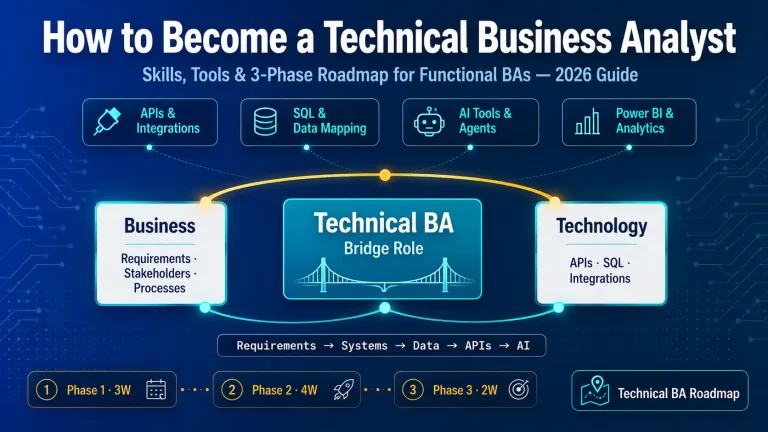
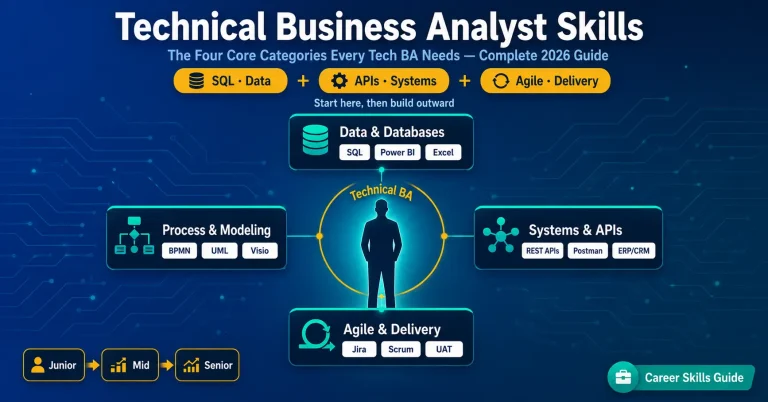
| Technical Business Analyst | BA skills plus APIs, integrations, databases, SQL, systems or other technical knowledge |
| Domain and Technical BA | A combination of functional BA skills, domain understanding and technical competence |
| Product-based BA | BA skills plus knowledge of a product or platform such as Salesforce, an ERP or a CRM system |
Some organizations even use the Business Analyst title for roles that are primarily focused on data analysis, testing, product ownership or reporting.
This is why you must read the complete job description. Do not decide that a role is suitable merely because the title says “Business Analyst”.
Look at the responsibilities, mandatory experience, domain expectations, tools, platforms and technical requirements. These details reveal what the company is really hiring for. If a “Business Analyst” opening is actually asking for API knowledge, databases and system architecture, it is worth understanding how a Functional BA and a Technical BA genuinely differ before you decide whether to apply.
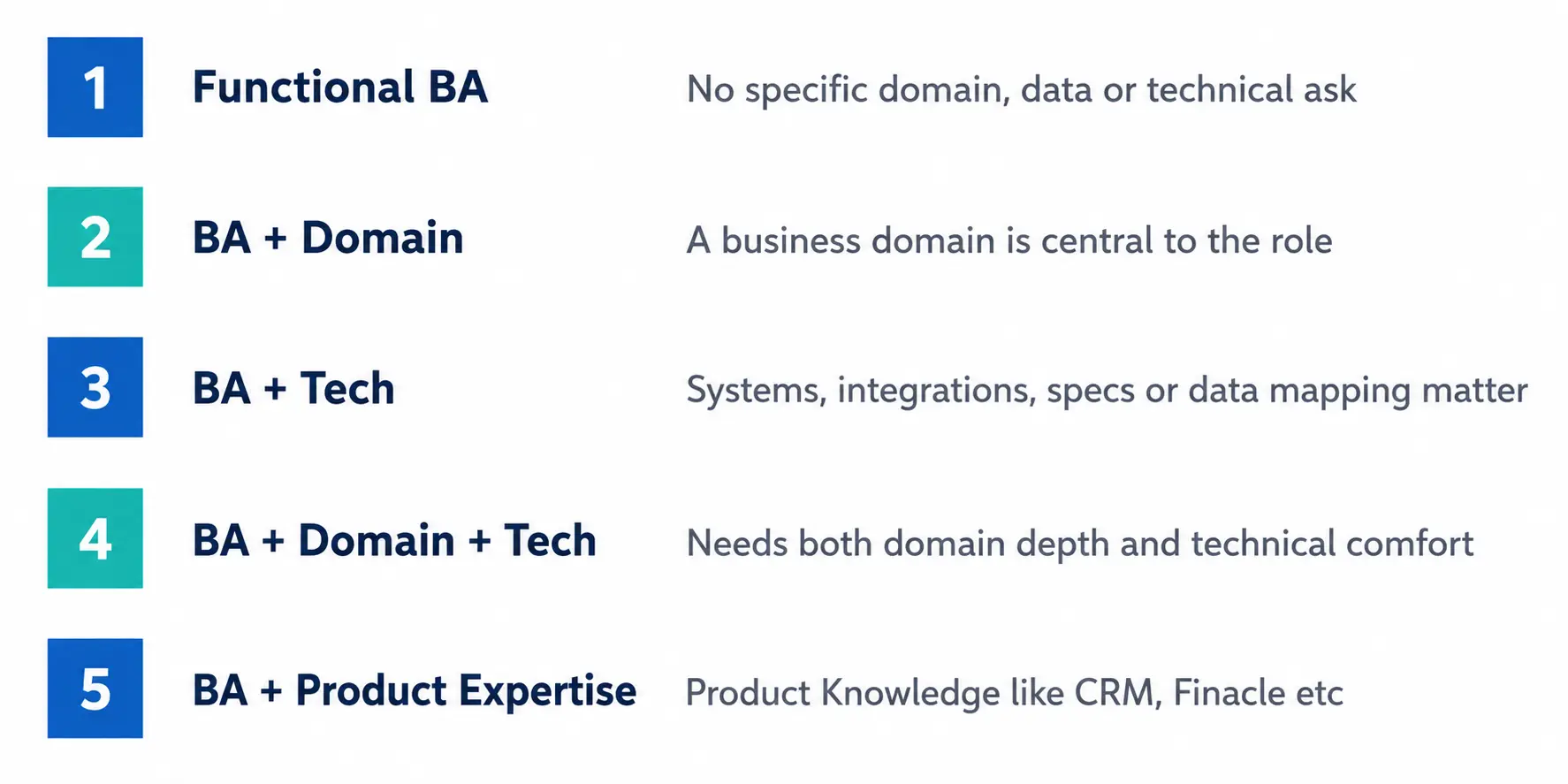
The Business Analyst title can represent several very different profiles.
2 You Are Using One Resume for Every Opening
Many candidates create one resume and send it to every BA vacancy. This saves time, but it also weakens the application.
Suppose you have functional BA experience, knowledge of the insurance domain and working knowledge of SQL and APIs. You may be eligible for three different types of roles:
- A Functional Business Analyst role
- An Insurance Business Analyst role
- A Technical Business Analyst role
The same experience is relevant in all three cases, but the emphasis should change. For a functional role, requirements elicitation, process modelling and stakeholder management should be prominent. For an insurance role, your understanding of claims, underwriting or policy administration may deserve greater visibility. For a technical role, integrations, APIs, databases and system interactions should appear much earlier.
Tailoring a resume does not mean adding keywords for skills you do not possess. It means giving the most relevant and genuine parts of your experience the visibility they deserve.
If a recruiter has to study four pages to discover why you are suitable, your resume has already made the recruiter’s job difficult.
3 You Are Targeting Roles That Are Too Far From Your Current Strengths
This is especially important for professionals trying to move into business analysis from QA, software development, sales, operations, customer service or another function.
Consider someone with five years of QA experience who is applying for a Senior Business Analyst role requiring five years of direct BA experience.
From the candidate’s perspective, the application feels reasonable: “I have five years of professional experience.” The employer, however, is comparing that profile with candidates who have spent five years performing BA responsibilities. Total work experience and direct BA experience are not always treated as equivalent.
That does not mean the QA professional cannot become a Business Analyst. It means the first move should make intelligent use of existing strengths. A QA professional may already have experience with:
- Understanding requirements
- Identifying gaps and ambiguities
- Working with Business Analysts and stakeholders
- Creating test scenarios from business requirements
- Using Jira or similar tools
- Developing knowledge of a particular product or domain
These are valuable transferable skills. They may make a functional BA, Business Systems Analyst or a role combining testing and analysis a more realistic first step than a senior, purely functional BA role.
The same principle applies to other transitions. A sales professional may bring customer interaction, problem discovery, negotiation and CRM knowledge. An operations professional may bring process understanding, exception handling and domain expertise. A developer may be well positioned for a Technical Business Analyst role. A banking or insurance professional may have an advantage in a domain-specific BA role.
I call this finding the path of least resistance. Start with the role that is closest to your demonstrable strengths, establish direct BA experience, and then progress towards your longer-term goal.
Career growth is usually a series of steps, not one large jump.
4 Your Strongest Points Are Hidden Inside the Resume
Recruiters and hiring managers review many applications. They should not have to work hard to understand your positioning.
The first half of the first page should answer four questions quickly:
- What type of BA role are you targeting?
- What are your strongest relevant skills?
- What domain, product or technical knowledge do you possess?
- What evidence shows that you have applied these capabilities?
A vague summary such as this does not help much:
“Experienced professional seeking a challenging Business Analyst opportunity in a growth-oriented organization.”
“QA professional transitioning into a Business Systems Analyst role, with experience in requirements analysis, stakeholder coordination, Jira, UAT and the banking domain.”
The second version gives the recruiter a clearer reason to continue reading.
Immediately after the summary, highlight the skills that are both relevant to the role and supported by your experience. Then provide project or work examples that demonstrate those skills.
5 You List Skills but Do Not Prove Them
Writing “requirements gathering”, “stakeholder management” or “process analysis” in a skills section is easy. The employer still needs evidence.
For every major strength in your resume, ask yourself:
- Where did I use this skill?
- What problem was I helping to solve?
- Which stakeholders or teams were involved?
- What did I produce or contribute?
- What improved because of my work?
“Worked with stakeholders and documented requirements.”
“Conducted requirement discussions with operations and technology teams, documented the current claims process, identified exception scenarios and converted the agreed requirements into user stories and acceptance criteria.”
The second statement is more credible because it shows the context and the work performed.
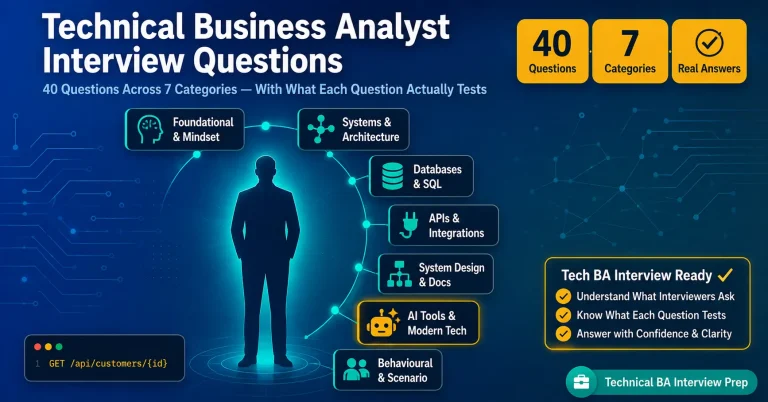
Your skills may help you reach the interview stage. During the interview, however, the panel will test whether you can explain how you used them, a pattern that shows up constantly in real technical BA interview questions too. Never add experience that you cannot defend with a genuine example.
If you are new to business analysis, include a well-executed academic, training or independent project. Clearly label it as such. A genuine project that you can explain confidently is far more useful than fabricated professional experience, which an experienced interviewer can uncover very quickly.
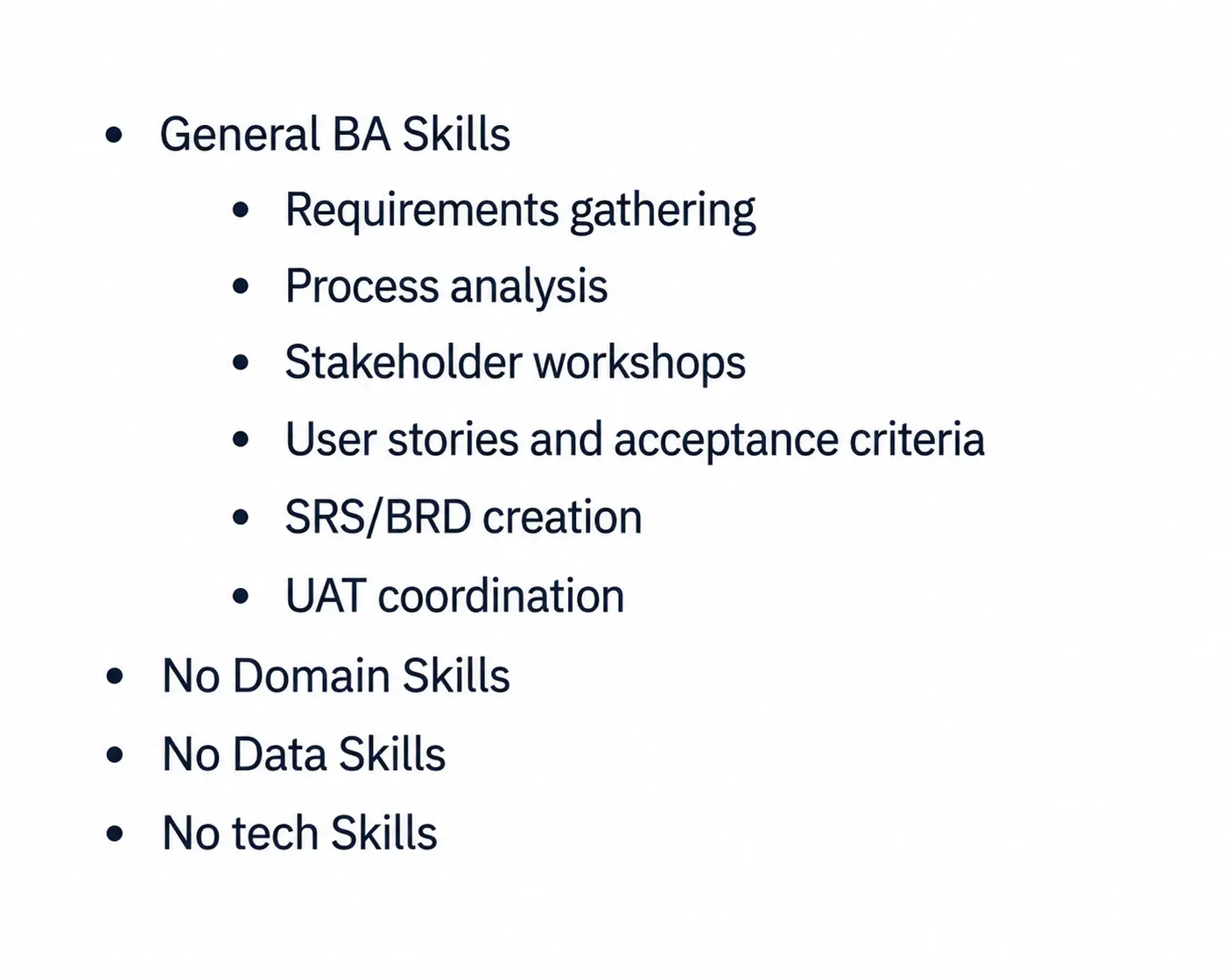
A functional BA opening typically emphasizes requirements, processes, stakeholders and documentation without demanding a specific domain or technical stack.
Once you know which strengths you can prove, organize them so a recruiter can see both your core BA skills and your domain skills at a glance:
Functional Business Analysis Skills
Domain Skills
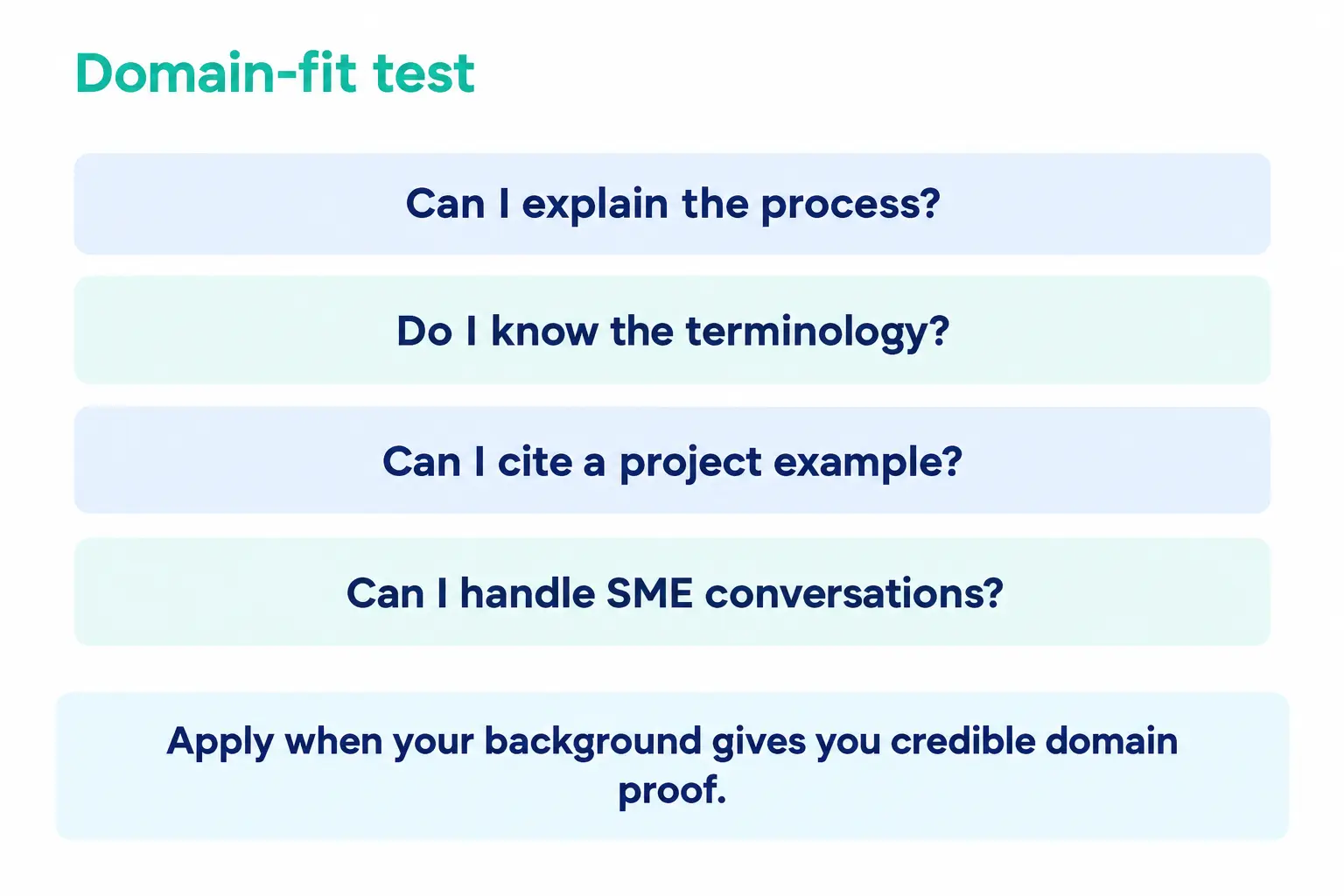
The same Business Analyst title may conceal mandatory domain and technical requirements.
6 Your Resume Is Not Aligned With the Language of the Job Description
Applicant tracking systems and recruiters look for evidence that your profile matches the vacancy. If the job description repeatedly mentions process mapping, user stories, UAT and Jira, while your resume describes the same work using vague or unrelated language, the match may not be visible.
Read the job description and identify:
- Core BA responsibilities
- Mandatory domain knowledge
- Required tools and platforms
- Technical expectations
- Experience level
- Deliverables such as BRDs, user stories, process models or test plans
- Words that are repeated or presented as essential
Use the employer’s terminology where it truthfully describes your experience. Do not copy the complete job description and do not insert keywords without evidence. ATS alignment works best when the relevant terminology is naturally supported by your project and work history.
7 Your LinkedIn Profile Does Not Support Your Resume
Your LinkedIn profile is no longer an optional online summary. Recruiters frequently use it to validate the positioning and experience shown in a resume.
If your resume presents you as a Business Analyst but LinkedIn contains an incomplete headline, outdated responsibilities and no relevant skills or projects, the inconsistency can reduce confidence in your application.
Your LinkedIn profile should reinforce the same professional story as your resume:
- Use a clear headline that reflects your current strength and target direction.
- Rewrite the About section to explain your positioning without sounding generic.
- Add relevant responsibilities and achievements under each role.
- Highlight genuine BA, domain, technical and transferable skills.
- Add relevant projects, certifications and learning.
- Seek authentic recommendations from managers, clients, project leads and colleagues.
Even achievements outside a formal BA role can provide useful evidence. Organizing an event, leading a cross-functional activity, winning a debating competition or coordinating multiple stakeholders may demonstrate communication, facilitation, leadership or organizational ability.
The achievement should not replace professional experience, but it can add credibility to the capabilities you claim.
A Practical Method for Selecting the Right BA Openings
Before submitting your next application, use the following process.
Create an inventory of your strengths
List your experience under five headings, and only capture what you can already demonstrate, not what you hope to learn:
- Business analysis activities
- Domain knowledge
- Technical knowledge
- Product or platform knowledge
- Transferable skills
Identify your most realistic BA profile
Based on that inventory, decide where your strongest current fit lies: Functional BA, Domain BA, Technical BA, Domain plus Technical BA, or Product-based BA. You can target more than one profile, but each may require a differently positioned resume.
Decode every job description
Ask yourself:
- What will this person spend most of the week doing?
- Is the domain mandatory or merely preferred?
- Does the employer require direct BA experience?
- Are the technical requirements central to the role?
- Is this actually a BA position, or primarily a data, testing, product or reporting role?
- Can I provide real examples for the most important requirements?
If you cannot answer these questions, you have not yet understood the opening well enough to apply.
Choose the correct resume version
You do not need a completely new resume for every vacancy. Create a small number of strong base versions, for example a Functional BA resume, a Domain BA resume and a Technical BA resume, then make smaller adjustments to the summary, skill order, project emphasis and terminology for each application.
Check the first half of page one
Confirm that your target role, strengths and relevant evidence are visible without searching through the document.
Compare your resume with the job description
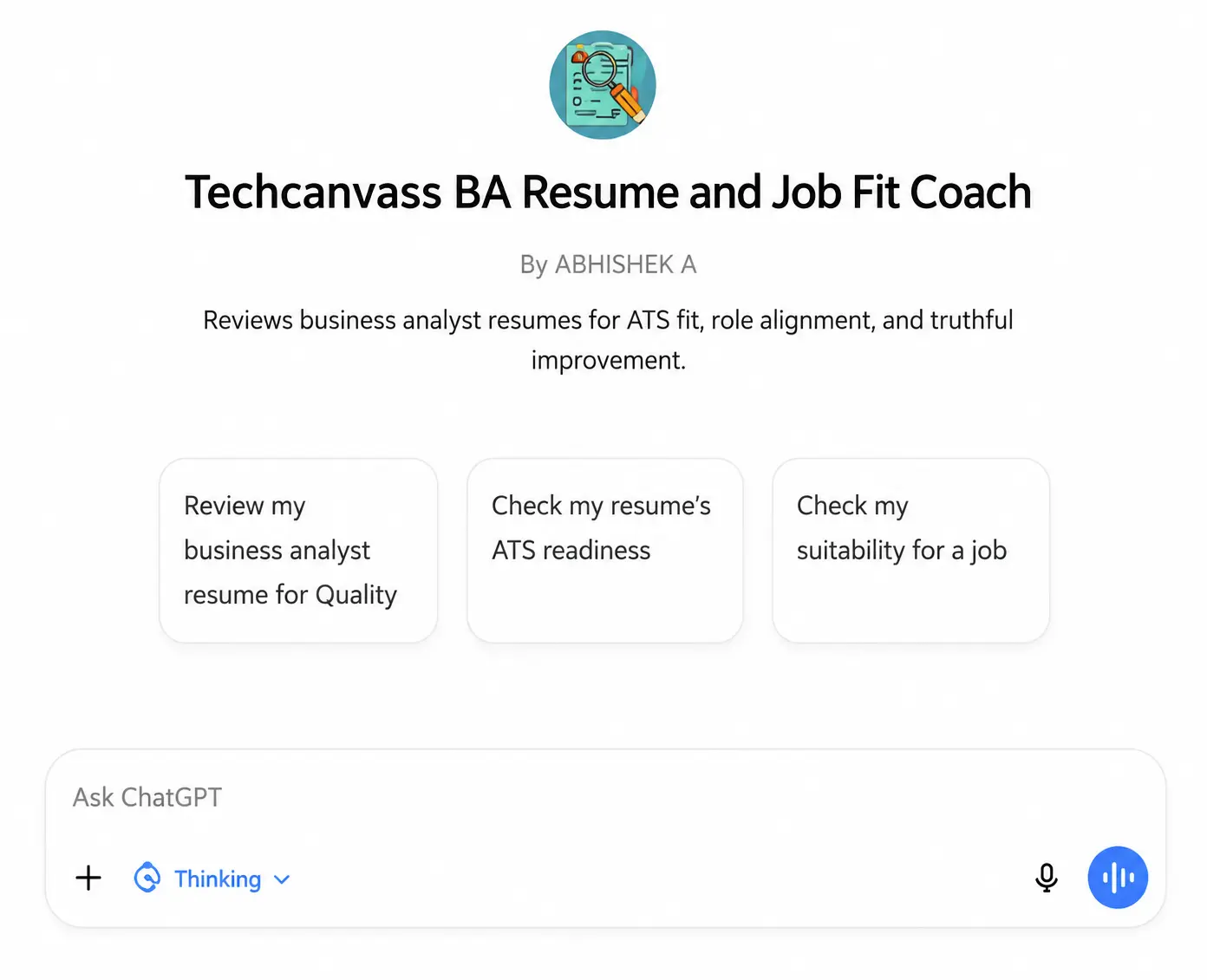
AI can make this review faster. It can help you assess the overall quality of the resume, check ATS readiness, compare your experience with a specific job description, identify important missing terms, distinguish between a genuine skill gap and a presentation gap, and recommend whether the position is a strong, moderate or weak fit. However, AI should review and clarify your experience, not invent it.
“Review my resume against this Business Analyst job description. First identify the actual type of BA role. Then separate mandatory requirements from preferred requirements. Rate my suitability, show which requirements are supported by evidence in my resume, identify genuine gaps, and recommend truthful changes to improve alignment. Do not add any skill or experience that I have not provided.”
Positioning Only Works If the Substance Is Real
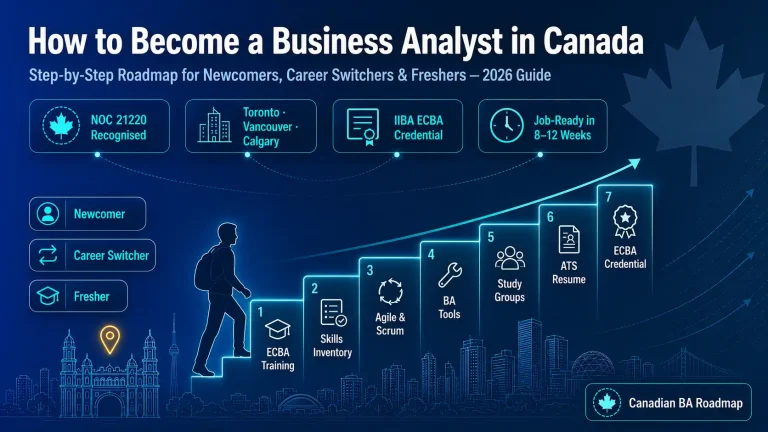
A sharper resume gets you noticed, but it is your actual BA foundation that gets you through the interview. Techcanvass’s IIBA-Endorsed ECBA Training builds the core requirements, process modelling and stakeholder skills that every strong BA resume is backed by.
Apply Less, But Apply With Greater Precision
Applying to 100 openings and receiving one call may feel like hard work, but it is not an efficient job-search strategy.
A better objective is to apply to fewer, better-matched openings and improve the percentage that result in recruiter conversations. For example, 25 carefully selected applications producing five relevant calls would be far more valuable than 100 generic applications producing one. The exact conversion rate will vary by experience, location and market conditions, but the principle remains the same.
Track your own results:
| Metric | What to Monitor |
|---|---|
| Applications submitted | Only completed, relevant applications |
| Strong-fit applications | Roles where you meet most essential requirements |
| Recruiter calls | Initial conversations received |
| Interviews | Applications progressing beyond screening |
| Rejection patterns | Repeated gaps involving experience, domain, technology or positioning |
If applications are not generating calls, review role selection, resume positioning and ATS alignment. If recruiter calls are not converting into interviews, the problem may be how you explain your experience. If interviews are not converting into offers, you need to examine interview preparation and the strength of your examples.
These are different problems and should not be treated as one.
Final Thought
Not receiving calls does not automatically mean that you are unsuitable for a Business Analyst career. It may mean that you are applying for the wrong type of BA role, presenting the same resume everywhere or expecting the recruiter to discover strengths that you have not made visible.
Start with what you can genuinely demonstrate. Identify the BA roles closest to those strengths. Read the complete job description, tailor your resume, prove your skills through projects and ensure that LinkedIn tells the same story.
The goal is not to appear suitable for every Business Analyst vacancy. The goal is to make your suitability unmistakable for the right ones.
Watch the Complete Video
In this video, I explain how to identify the right BA openings, interpret different job descriptions and use AI to review your resume and job suitability.
Watch on YouTube
Note: the video title and description above are based on the topic summary provided for this article. Please confirm the exact on-platform title before publishing, since it could not be independently verified.
If You’re Considering the Technical BA Path
Several of the reasons above point to the same fork in the road: functional, domain, or technical. If a technical pivot is on your mind, these guides go deeper.