How to Become a Business Analyst in 2026: Step-by-Step Career Roadmap
A practical guide for freshers, non-IT professionals, and career switchers who want to enter business analysis. Learn the role, skills, tools, certifications, portfolio projects, resume strategy, and interview roadmap in one place.
How do you become a Business Analyst?
To become a Business Analyst, you need to learn how to understand business problems, identify stakeholders, gather requirements, document processes, support Agile teams, and translate business needs into clear solution requirements.
You do not need to become a programmer. However, you should understand software project basics, Agile/Scrum, databases and SQL fundamentals, common BA tools, and how business requirements become software or process solutions.
What does a Business Analyst do?
A Business Analyst acts as a bridge between business stakeholders and technology or process teams. The BA helps convert business needs into clear, testable, and implementable requirements.
Understand the business problem
Clarify what problem the business wants to solve, why it matters, who is affected, and what success should look like.
Work with stakeholders
Conduct interviews, workshops, and discussions with users, managers, subject matter experts, and technology teams.
Document requirements
Create BRDs, SRS/FRD documents, user stories, use cases, acceptance criteria, business rules, and process flows.
Model processes
Map current and future processes using flowcharts, BPMN, swimlane diagrams, or simple process maps.
Support solution delivery
Help product, design, development, and testing teams understand what needs to be built and why.
Support UAT and adoption
Help validate whether the solution meets business needs and support users during acceptance and rollout.
Is Business Analysis the right career for you?
Business analysis is not only about documentation. It is about structured thinking, communication, problem solving, and helping teams build the right solution.
You may enjoy a BA role if you like:
- Talking to people and understanding their needs
- Breaking vague problems into clear requirements
- Organizing information into documents, flows, and stories
- Working with both business and technology teams
- Asking questions, facilitating discussions, and resolving ambiguity
- Improving processes and customer experiences
You may need more preparation if you struggle with:
- Communicating clearly with different types of stakeholders
- Writing structured documents and summaries
- Handling unclear or changing requirements
- Understanding basic software project terminology
- Thinking from both user and business perspectives
- Facilitating decisions when stakeholders disagree
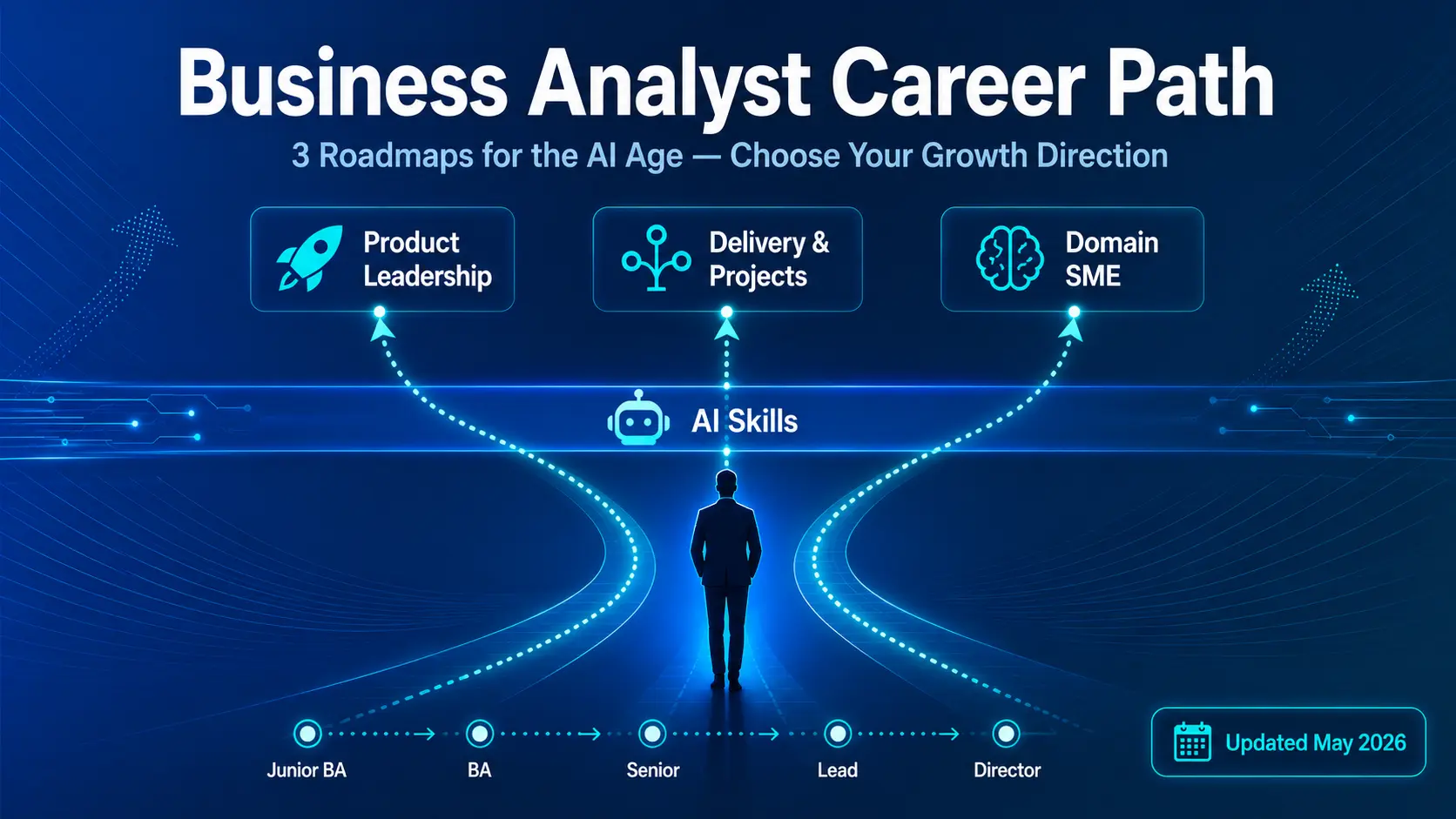
Business Analyst Career Path: 3 Roadmaps for the AI Age
A complete career guide for Business Analysts showing the three practical growth paths: Strategic Product Leadership, Project & Delivery Ladder, and Domain / Product SME.
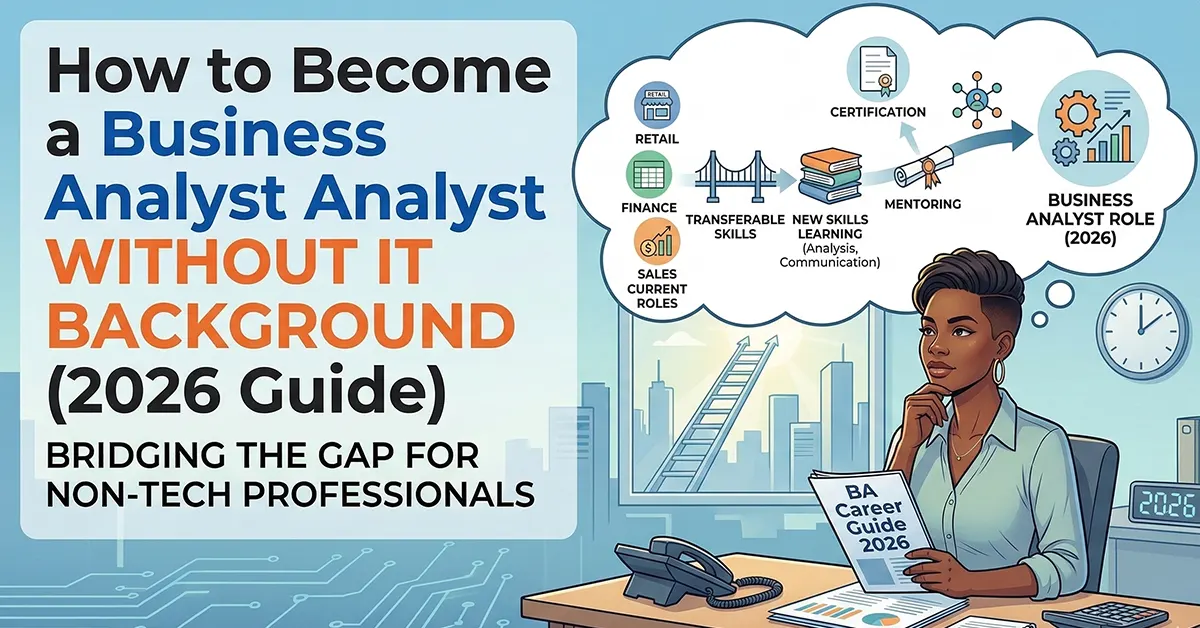
Can non-IT professionals become Business Analysts?
Yes. Many successful BAs come from banking, operations, sales, customer support, QA, development, and domain roles. The key is to convert your existing experience into BA-relevant strengths.
| Background | Strengths you already have | What to learn next | Suggested positioning |
|---|---|---|---|
| Banking / Finance | Domain knowledge, process understanding, compliance awareness, customer journeys. | Requirements, Agile, BRD/SRS, user stories, process modelling, UAT. | Banking BA, payments BA, lending BA, core banking BA. |
| Sales / Business Development | Customer conversations, objection handling, business communication, market awareness. | Process modelling, stakeholder analysis, documentation, software lifecycle basics. | CRM BA, sales automation BA, customer experience BA. |
| Operations / Support | Workflow knowledge, issue resolution, process improvement, service delivery understanding. | Requirement elicitation, use cases, user stories, tools, Agile project exposure. | Operations BA, process BA, service improvement BA. |
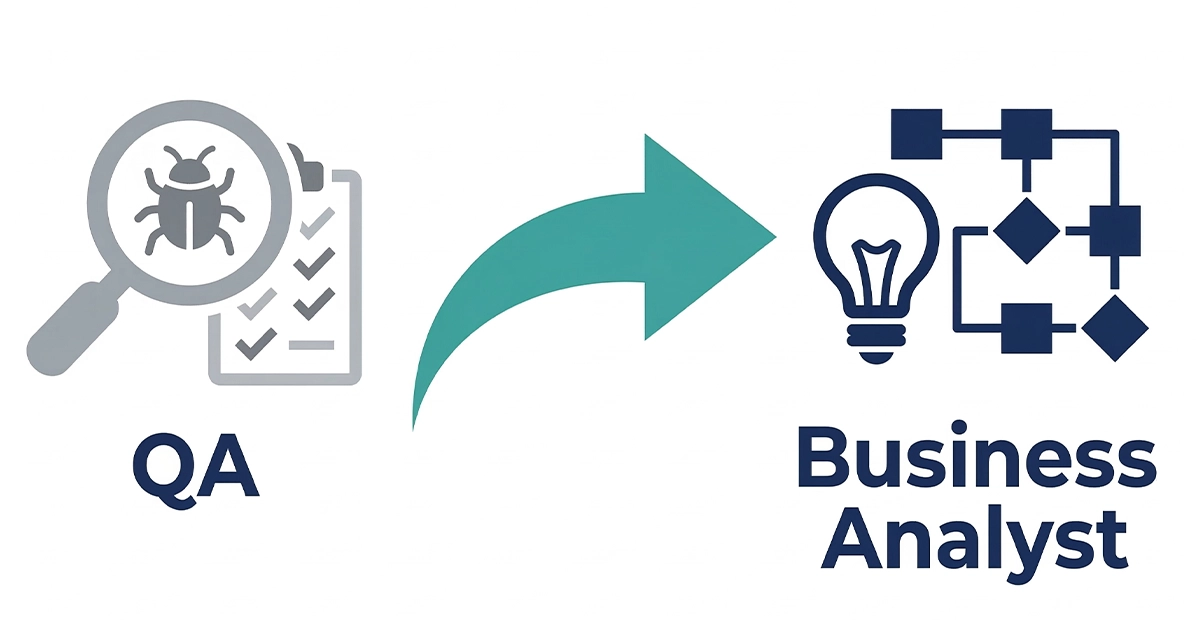
| QA / Testing | Testing mindset, defect analysis, acceptance criteria, system behaviour understanding. | Elicitation, stakeholder communication, upstream requirements analysis, BRD writing. | Agile BA, business systems analyst, QA-to-BA transition. |
| Developer / Technical Role | System knowledge, SDLC understanding, technical feasibility awareness. | Business communication, problem framing, stakeholder management, business documentation. | Technical BA, systems analyst, product analyst. |
| Fresher | Learning agility, academic projects, openness to structured training. | BA fundamentals, domain basics, tools, portfolio projects, interview preparation. | Junior BA, trainee BA, associate BA, business analyst intern. |
Choose the right Business Analyst roadmap for your target market
Take advantage of our target roadmaps. We offer country-specific execution roadmaps for localized job requirements, certification alignment, and salary standards.
You are viewing Global roadmap
The standard global framework covering baseline analysis standards, frameworks, and core tools used worldwide.
Currently ViewingBusiness Analyst Career Roadmap for India
For India-based learners who want local guidance on BA roles, skills, certifications, fresher opportunities and job readiness.
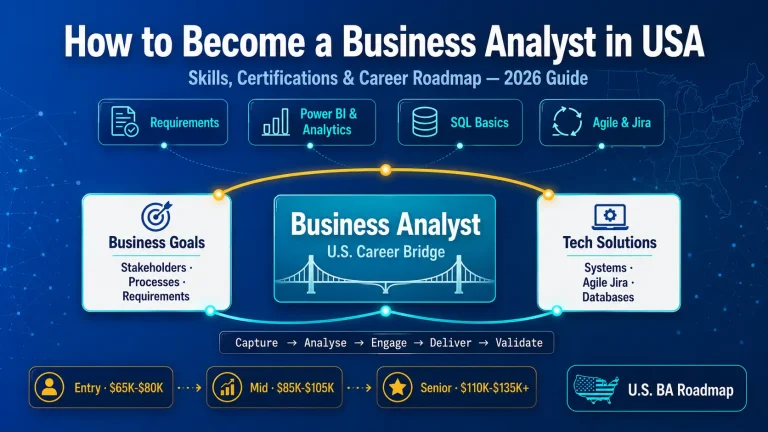
Coming SoonBusiness Analyst Career in USA
Understand the U.S. BA market, demand, localized certifications, compensation guidelines, and recruiter-specific expectations.
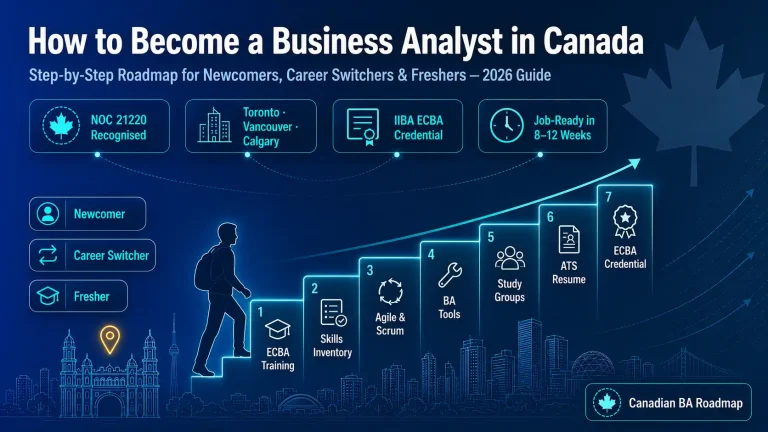
Explore USABecome a Business Analyst in Canada
Use this guide if you plan to launch or switch to a Business Analyst career in Canada, particularly for non-tech professionals.
Explore CanadaDo you need coding to become a Business Analyst?
No, coding is not mandatory for most BA roles. A BA is not expected to become a software developer. However, you should be technically aware enough to communicate with technology teams and understand how business requirements are implemented.
Watch: 9-Step AI-Era Business Analyst Roadmap
Traditional transition roadmaps are outdated. In this high-impact, 23-minute video guide, Techcanvass breaks down the exact 9-step strategy customized for the AI era. Learn how to transform your background, leverage AI co-pilot tools, and build a career without writing production code.
- Transition checklists suited for freshers & switchers
- Practical step-by-step breakdown (90-day transition timeline)
- How to study effectively in just 10-12 hours per week
- Essential transition dos and don’ts from industry experts

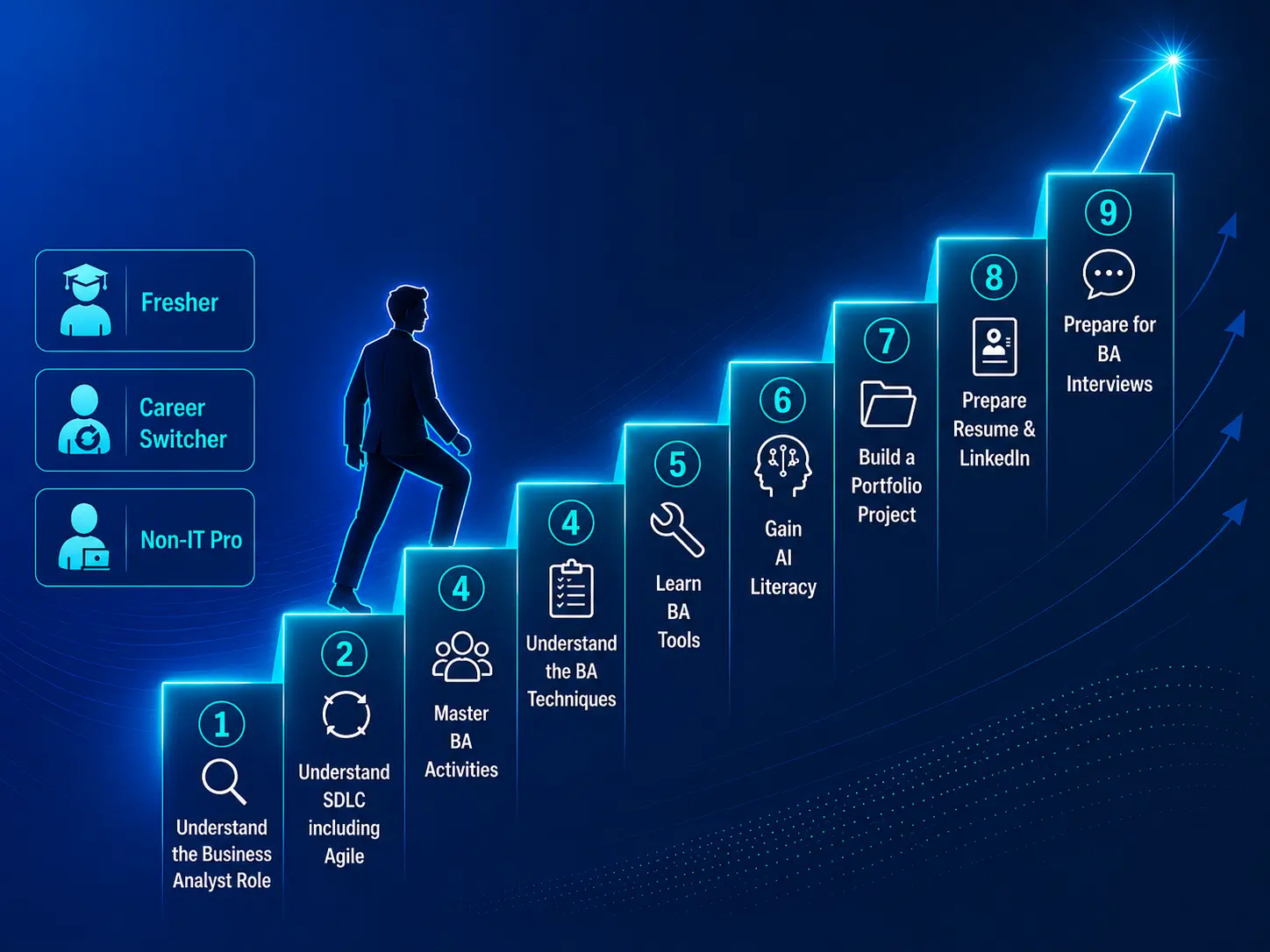
9 steps to become a Business Analyst
Use this roadmap to move from career interest to practical job readiness. Each step should produce a visible output: a concept learned, a document created, a tool practiced, or a portfolio item completed.
Understand the Business Analyst role
Learn what BAs do day-to-day, core competencies, career paths, and how they map within Agile and product teams.
Understand SDLC including Agile
Learn how business needs move through Waterfall, Agile, and Hybrid models, and master Scrum roles, events, and artifacts.
Master BA activities
Study requirements elicitation, analysis, gap assessment, prioritisation, and structured documentation like BRD, FRD, and SRS.
Understand the BA techniques
Practice creating user stories with acceptance criteria, use cases, BPMN process maps, and low-fidelity wireframes.
Learn BA tools
Practice hands-on workflows with Jira, Confluence, MS Visio, draw.io, Figma, and relational database SQL basics.
Gain AI literacy and tools
Learn to leverage generative AI for faster requirement elicitation, automated documentation, test scenario drafting, and diagram generation.
Build a portfolio project
Choose a realistic business scenario and create an end-to-end, shareable capstone case study to demonstrate practical readiness.
Prepare resume and LinkedIn
Translate your past experience into BA language, align your LinkedIn profile, and feature your project artifacts for recruiters.
Prepare for BA interviews
Practice knowledge-based, situational, and behavioral questions using the STAR format through structured mock interview sessions.
Download the 90 Days BA Transition Roadmap Guide
Get the complete weekly execution checklist to plan your transition. Learn exactly what concepts to study, which tools to practice, and how to structure your portfolio to secure your first BA role.
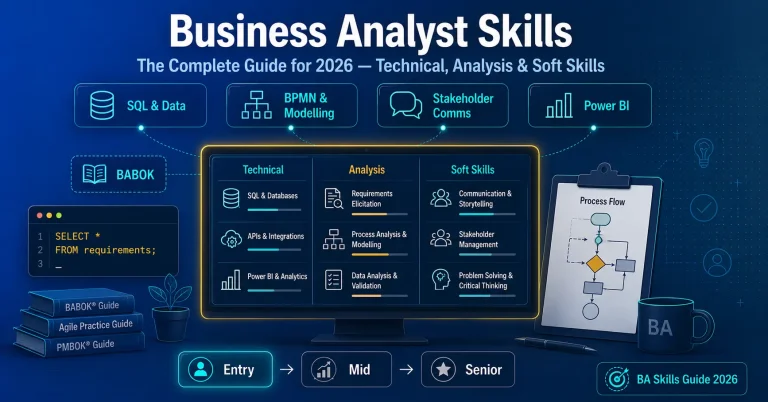
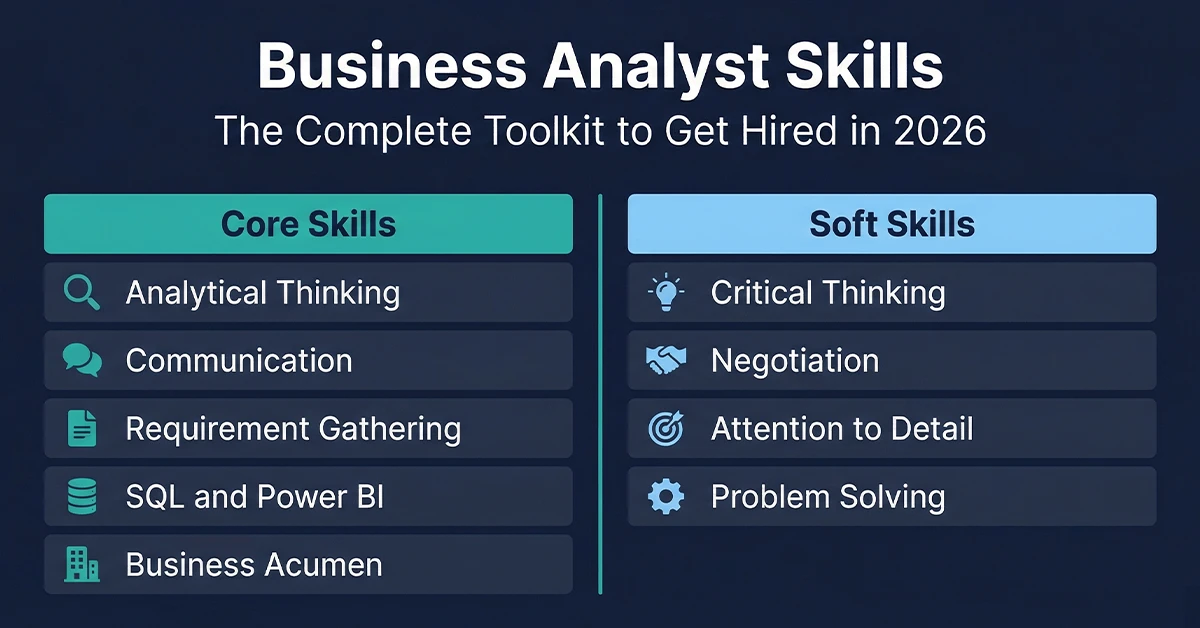
Business Analyst skills you should learn
Aspiring BAs should build a practical mix of business, communication, analysis, documentation, Agile, and technical awareness skills.
Problem framing
Define the real business problem, root causes, constraints, assumptions, stakeholders, and success criteria.
Elicitation
Use interviews, workshops, observation, document analysis, surveys, and brainstorming to discover needs.
Requirements writing
Write clear business requirements, functional requirements, user stories, acceptance criteria, and business rules.
Process modelling
Create current-state and future-state process flows, swimlane diagrams, decision flows, and journey maps.
Agile BA skills
Understand product backlog, sprint planning, story refinement, MVP, prioritization, and collaboration with product owners.
AI-era BA skills
Use AI to summarize inputs, draft requirements, analyze feedback, create first-cut stories, and validate outputs responsibly.
Which certification is best for aspiring Business Analysts?
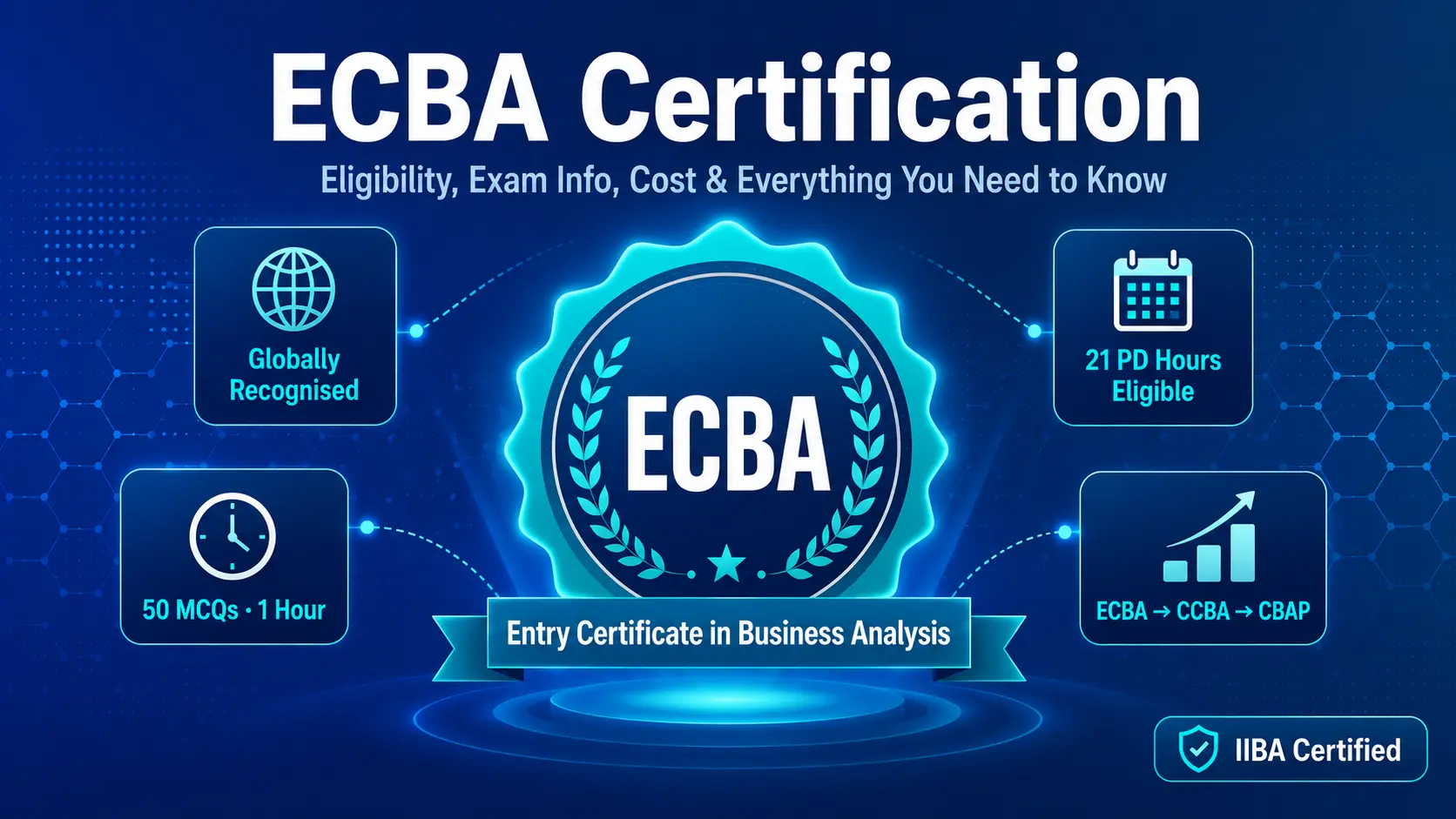
For beginners, ECBA is a common starting point because it is designed for individuals who want to develop and validate foundational business analysis knowledge. Certification is useful, but it should be combined with practical deliverables and portfolio work.
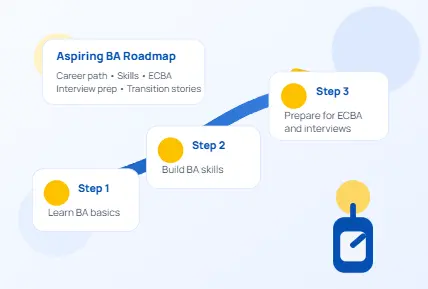
If you are new to business analysis, focus on three things together: learn the fundamentals, practice BA deliverables, and prepare for a beginner-friendly certification.
Build proof before your first BA job
A portfolio helps aspiring BAs show practical capability, especially when they do not yet have a Business Analyst job title.
Loan Application System
Map the journey from eligibility check to application submission and document verification.
Expense Reimbursement
Design an employee reimbursement flow with policy checks, approvals, and payment tracking.
Insurance Claims Process
Improve the claim submission, validation, triage, and settlement journey.
CRM Lead Management
Create a CRM process for capturing, qualifying, assigning, and tracking leads.
Appointment Booking
Build requirements for scheduling, rescheduling, cancellation, reminders, and notifications.
Resume, LinkedIn, and interview preparation
Getting a BA job is not only about learning concepts. You must present your past experience and projects in a way that recruiters can connect to BA responsibilities.
Resume and LinkedIn checklist
- Use a BA-focused headline and summary
- Convert past work into process, stakeholder, and problem-solving language
- Add tools: Jira, Confluence, Excel, draw.io, SQL basics
- Add portfolio projects with clear deliverables
- Include domain strengths such as banking, insurance, operations, sales, or QA
- Use keywords like requirements, stakeholders, user stories, UAT, Agile, BRD, process mapping
Interview preparation checklist
- Explain the BA role in simple terms
- Practice requirement gathering scenarios
- Prepare examples of stakeholder conflict and ambiguity
- Practice user stories and acceptance criteria
- Understand Agile ceremonies and backlog refinement
- Prepare one end-to-end portfolio case study
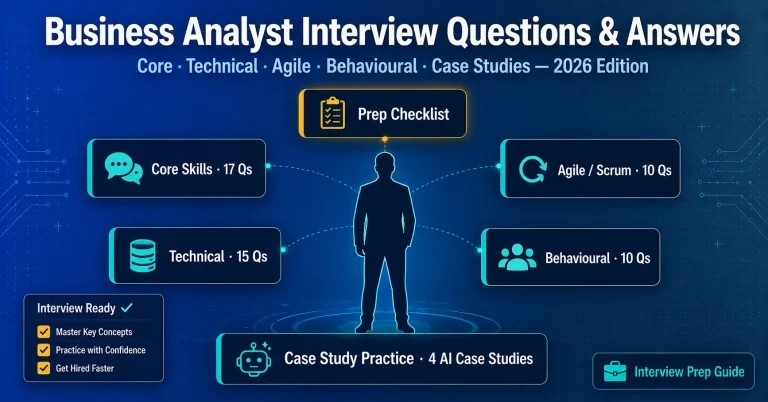
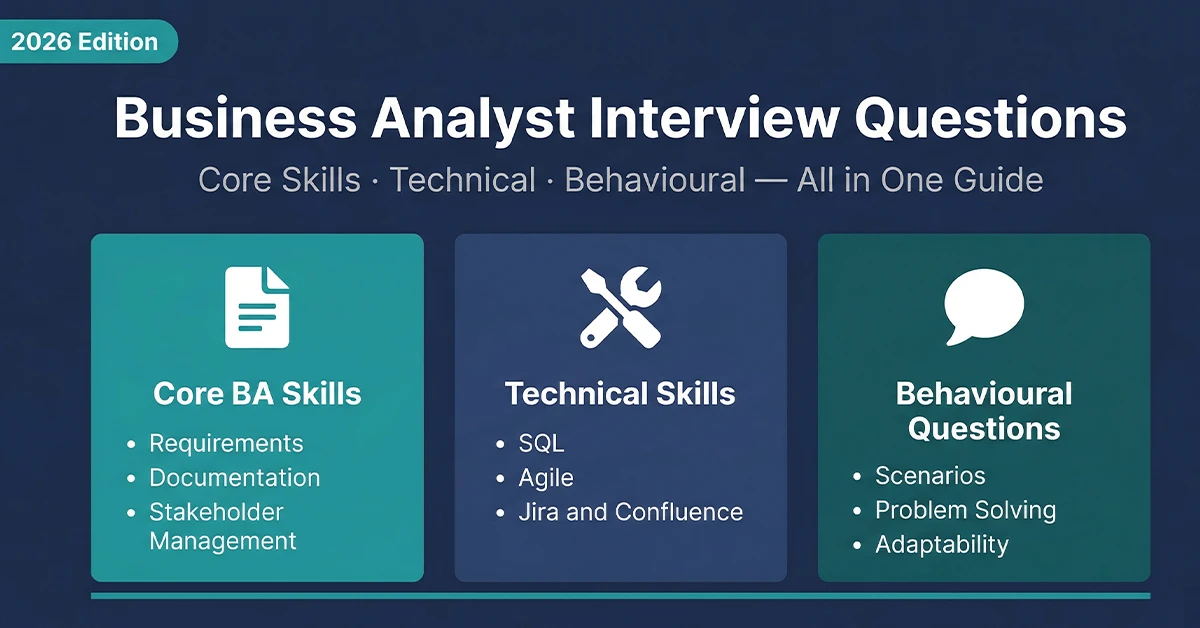
Ready to practice interview questions?
Use scenario-based BA interview questions after you understand the roadmap, deliverables, and portfolio story.




Frequently asked questions
Use these FAQs with FAQ schema to capture long-tail queries and clarify common doubts for aspiring BAs.
How do I become a Business Analyst?
Start by understanding the BA role, learning requirements and stakeholder concepts, practicing BA deliverables, learning Agile and tools, building a portfolio project, and preparing your resume and interviews.
Can I become a Business Analyst without IT experience?
Yes. Non-IT professionals can become Business Analysts if they learn software project basics, requirements analysis, process modelling, documentation, Agile, and BA tools while using their domain experience as an advantage.
Do Business Analysts need coding?
No. Coding is not mandatory for most BA roles. However, BAs should understand SDLC, Agile, databases, SQL basics, APIs conceptually, and how to communicate with technology teams.
Which certification is best for beginner Business Analysts?
ECBA is a common entry-level certification for aspiring Business Analysts. It should be combined with practical BA deliverables and portfolio projects for stronger job readiness.
How long does it take to become a Business Analyst?
With structured preparation, many aspirants can build foundational readiness in 8 to 12 weeks. The timeline depends on your background, domain knowledge, communication skills, and practice effort.
Can freshers become Business Analysts?
Yes. Freshers can target trainee BA, junior BA, associate BA, business analyst intern, or business systems analyst roles by building BA fundamentals, tools, sample deliverables, and interview readiness.
What tools should a Business Analyst learn?
Useful tools include Jira, Confluence, Excel, PowerPoint, draw.io, Lucidchart, Miro, Visio, and SQL basics. The exact tools depend on the company and role.
How do I get BA experience without a BA job?
Create portfolio projects using realistic business scenarios. Prepare process maps, requirements documents, user stories, acceptance criteria, stakeholder maps, wireframes, and UAT scenarios.
Should I follow a different roadmap for USA or Canada?
Follow the global roadmap first. Then use the USA or Canada country guide to understand local market expectations, salary context, certification positioning, resume expectations, and interview preparation.