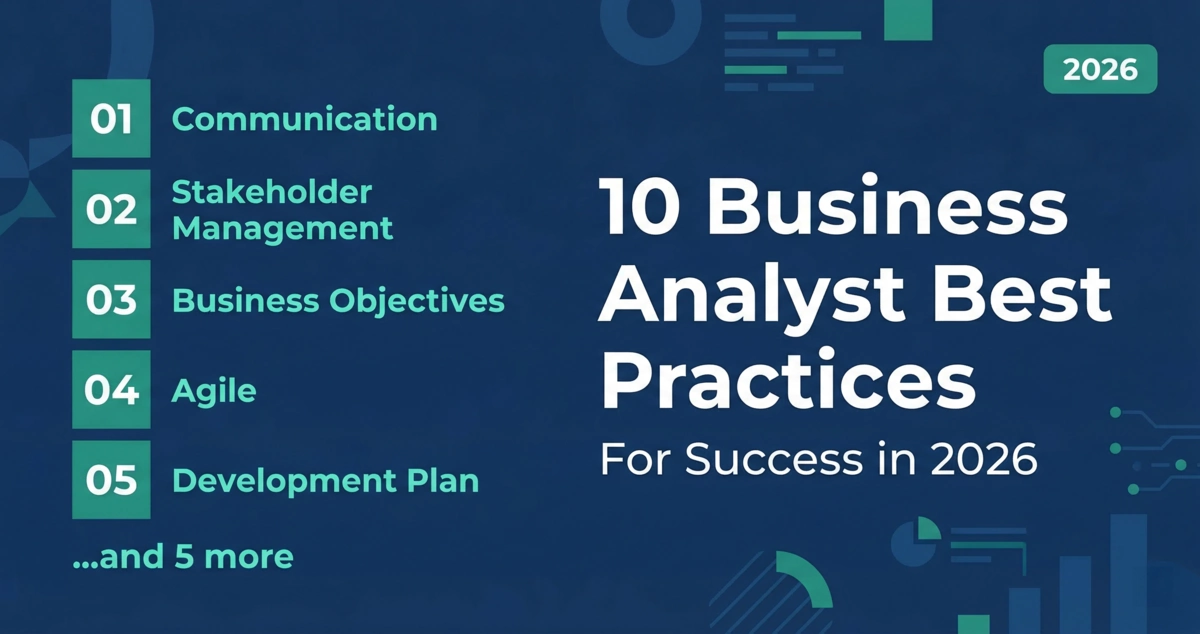
10 Business Analyst Best Practices for Success in 2026
| Key Facts | Details |
|---|---|
| Article type | 10 best practices with actionable guidance and real-world examples |
| Primary audience | Practising Business Analysts, entry to mid-level, and BAs preparing for CBAP/CCBA/ECBA |
| Methodology coverage | Traditional, agile, and hybrid project environments |
| Certification relevance | All 10 practices align with BABOK v3 competencies tested in IIBA certifications |
| Key skills addressed | Communication, stakeholder management, requirements analysis, agile, feedback, continuous learning |
| Last updated | March 2026 |
In This Article
Introduction: What Separates a Good Business Analyst from a Great One?
Business analysis is one of the fastest-growing professional disciplines in IT and digital transformation. But there is a significant gap between business analysts who deliver consistently strong outcomes and those who struggle with scope creep, stakeholder conflict, and requirements that miss the mark. The difference almost always comes down to the business analyst best practices they apply — or do not apply — in their daily work.
This guide covers the 10 essential best practices in business analysis used by high-performing BAs across industries, project methodologies, and experience levels. Whether you are an experienced BA looking to sharpen your approach or someone just starting out, our business analyst career guide can help you build the right foundation
These best practices draw on BABOK v3 competencies, real-world agile and waterfall project experience, and the accumulated wisdom of BA practitioners. They apply equally whether you are working in traditional project environments, fully agile teams, or the hybrid arrangements that are now the norm in most organisations.
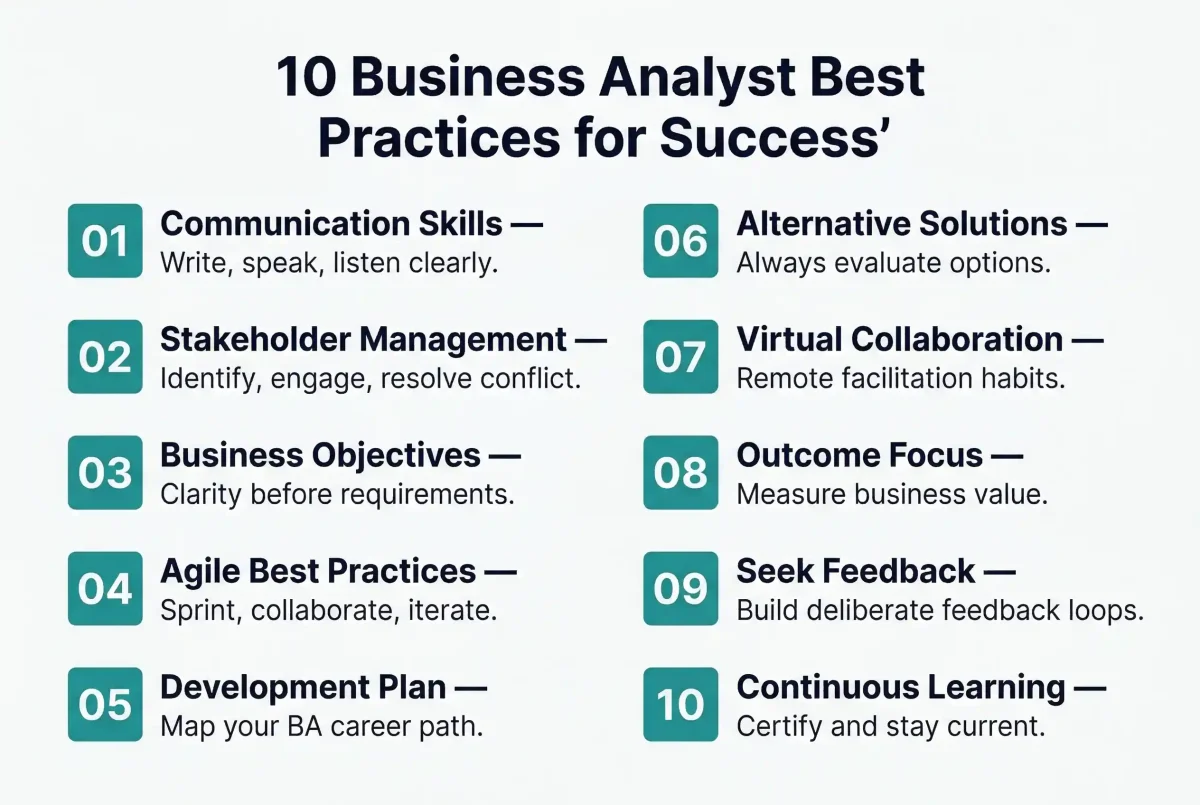
1. Develop Excellent Communication Skills — The Foundation of BA Best Practices
Of all the business analyst best practices, developing excellent communication skills has the widest impact. A business analyst who communicates well bridges the gap between technical teams who build solutions and business stakeholders who define the problems. Poor communication is the root cause of the majority of requirements failures — not poor analysis.
Business analyst communication operates across three registers. Written communication includes business requirements documents, user stories, process models, and stakeholder emails — all of which must be precise, unambiguous, and appropriate for the audience. Verbal communication includes elicitation workshops, stakeholder interviews, and sprint ceremonies — all of which require active listening as much as clear speaking. Visual communication includes process diagrams, data flow diagrams, wireframes, and dashboard prototypes — translating complex system behaviour into something stakeholders can respond to directly.
Practical tip: Adapt your communication style to your audience. A developer needs precision and technical completeness. An executive needs brevity and business impact. Using the same communication format for both is one of the most common mistakes junior BAs make. Before any communication, ask yourself: what does this person need to understand, and what is the clearest way to help them understand it?
Active listening is a frequently underestimated component of communication skill. In stakeholder interviews, the most valuable requirements are often not the ones stakeholders say directly — they are the ones implied by what stakeholders do not say, by the hesitations, the repeated themes, and the concerns that emerge between the formal answers. Business analysts who listen deeply capture the full picture.
For virtual team environments, communication skill requires additional investment. The loss of in-person cues — body language, side conversations, the energy in a room — means BAs must be more deliberate about check-ins, clarifications, and documentation to compensate for what the digital medium removes.
2. Master Stakeholder Management
Stakeholder management is not a project phase that happens at the beginning of an engagement — it is a continuous BA responsibility throughout the entire project lifecycle. Business analysts who treat stakeholder management as a one-time identification exercise invariably encounter resistance, conflicting priorities, and scope changes that derail delivery.
Effective stakeholder management starts with a thorough stakeholder analysis: who is affected by this change, what is their level of influence, what do they care about, and where are the potential conflicts? The RACI model (Responsible, Accountable, Consulted, Informed) is a useful starting point, but experienced BAs go further — mapping not just formal roles but informal influence, political dynamics, and historical relationships that shape how decisions are actually made.
The most dangerous stakeholders are not the ones who are actively hostile — they are the ones who are silent. A stakeholder who does not engage with requirements review sessions, does not respond to emails, and does not attend workshops is a risk that will materialise later in the project when they surface their concerns at the worst possible time. Part of stakeholder management is proactively drawing out disengaged stakeholders before their silence becomes a problem.
For virtual team environments, stakeholder management requires deliberate structure. Schedule regular one-on-one touchpoints with key stakeholders, not just group workshops. Use shared documentation and visual tools like MIRO or Confluence that allow stakeholders to engage asynchronously. Document all decisions and approvals in a way that is visible to all stakeholders — this prevents the ‘I never agreed to that’ conversation that plagues virtual projects.
- Related: For the BA skills needed to manage complex stakeholder environments in CBAP-level projects, see our CBAP certification guide.
3. Gain Clarity on Business Objectives Before Defining Requirements
One of the most persistent problems in business analysis is the tendency to jump to requirements and solutions before the business objective is precisely understood. Requirements defined without a clear objective are orphaned — they cannot be prioritised, they cannot be validated, and they cannot be traced to the value the project is supposed to deliver.
Before any elicitation session, the business analyst should be able to answer three questions: What business outcome is this project trying to achieve? How will we measure whether the outcome has been achieved? And what are the constraints within which the solution must operate? If these questions do not have clear, agreed answers, the requirements work has not yet started — the objective work has.
Practical technique: Use the SMART objectives framework (Specific, Measurable, Achievable, Relevant, Time-bound) to validate business objectives before translating them into requirements. A vague objective like ‘improve customer satisfaction’ cannot drive requirements. A SMART objective like ‘increase first-call resolution rate from 67% to 85% within 6 months’ can be directly traced to system requirements, process requirements, and training requirements.
Requirements traceability — the ability to show how each requirement maps to a business objective — is both a BA best practice and an IIBA certification competency. Maintaining a requirements traceability matrix from the start of the project protects against scope creep, simplifies change control, and makes UAT planning significantly more straightforward.
- Related: The BACCM model and core concepts framework from BABOK v3 provides a structured way to think about business needs before translating them into requirements.
4. Understand Agile Best Practices for Business Analysts
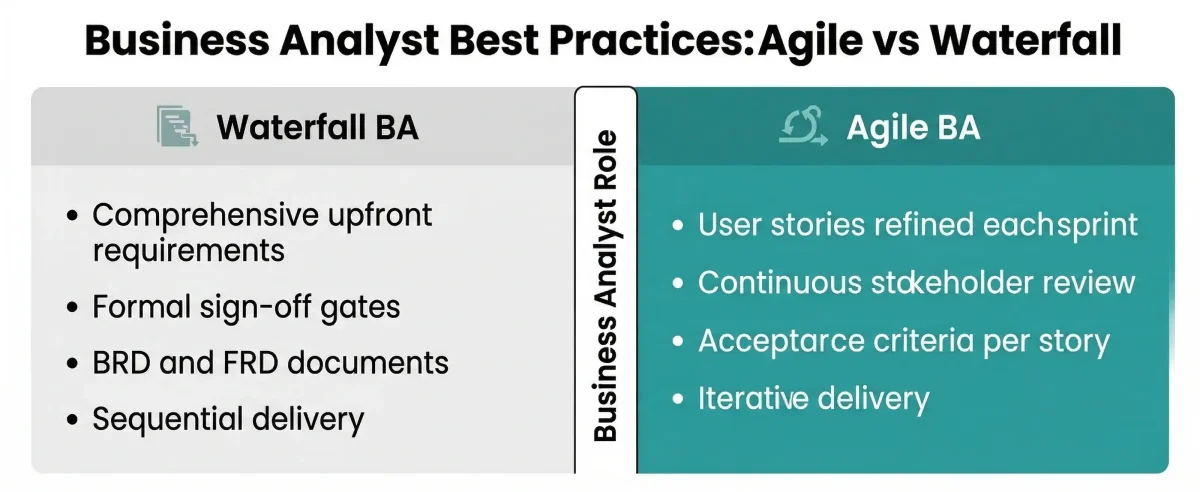
Agile best practices for business analysts differ significantly from traditional waterfall approaches — and mastering the agile BA role is now a core competency for the majority of BA positions. In agile environments, the business analyst is not a gate between the business and the development team. They are a collaborative partner who works within the sprint cadence, continuously refines the product backlog, and ensures that user stories reflect genuine user needs rather than technical assumptions.
The key agile best practices for business analysts include: maintaining a well-refined product backlog with user stories that meet the team’s Definition of Ready, actively participating in sprint ceremonies (particularly sprint planning and sprint retrospectives), collaborating directly with product owners to align business priorities with sprint goals, and facilitating regular stakeholder reviews of working software rather than waiting for formal sign-off sessions.
Writing effective user stories is one of the most important agile BA skills. The standard format ‘As a [user type], I want [goal], so that [benefit]’ must be accompanied by clear, testable acceptance criteria that the development team can use to know when the story is done. Vague acceptance criteria — or the absence of them — is the most common source of rework in agile projects.
Business analysts in agile environments must also manage requirements volatility differently from waterfall projects. Change is not an exception — it is expected. The BA’s role is to ensure that changes are evaluated for business value, prioritised appropriately, and communicated to all affected parties without disrupting sprint delivery.
Practical agile BA tip: Attend every sprint review and use it as a low-friction requirements validation session. Watching stakeholders interact with working software reveals more about their actual needs than any interview or workshop. The sprint review is the best elicitation tool available in agile — use it deliberately.
For BAs transitioning from waterfall to agile, the most important mindset shift is moving from ‘complete requirements documentation’ to ‘just enough requirements just in time.’ This is not about doing less work — it is about doing the right requirements work at the right stage of the sprint cycle.
5. Create Your Own Business Analyst Development Plan
One of the most consistently overlooked business analyst best practices is creating and maintaining a personal professional development plan. Most BAs let their skill development happen reactively — they pick up new tools because a project requires them, or they attend a training course because their manager recommended it. High-performing BAs treat professional development as a deliberate, structured practice with clear goals and milestones.
A business analyst development plan should cover four dimensions: technical skills (new tools, modelling techniques, domain knowledge), soft skills (facilitation, negotiation, presentation, conflict resolution), industry knowledge (staying current with the industries you serve), and professional credentials (IIBA certifications, agile certifications, domain-specific qualifications).
IIBA certification roadmap: For BAs at different career stages, the IIBA certification pathway provides a structured development framework. ECBA (Entry Certificate in Business Analysis) is the starting point for BA professionals with less than 2 years of experience. CCBA (Certification of Competency in Business Analysis) suits mid-level BAs with 2-3 years of practice. CBAP (Certified Business Analysis Professional) is the gold standard for senior BAs with 5+ years of experience. Each certification requires demonstrated competency in BABOK knowledge areas — making the study process itself a structured learning exercise.
Seeking a mentor — an experienced BA who can review your work, challenge your thinking, and help you navigate organisational challenges — is one of the highest-return investments a developing BA can make. Formal mentoring programmes, BA communities of practice, and organisations like the IIBA local chapters are all good starting points.
Ready to take your BA career to the next level?
Techcanvass is an IIBA-endorsed education provider offering structured preparation for ECBA, CCBA, and CBAP certification exams.
6. Always Offer the Alternative Solution
A business analyst who only documents what stakeholders ask for is a scribe. A business analyst who evaluates multiple solution options, assesses trade-offs, and presents alternatives with clear reasoning is a strategic partner. Offering alternative solutions is one of the practices that most clearly distinguishes senior BAs from junior ones.
When a stakeholder presents a requirement, the instinct of a junior BA is to document it and move to the next requirement. The instinct of an experienced BA is to ask: is this the only way to address the underlying need? What would happen if we solved the need differently? What is the simplest solution that would still deliver the required value?
The build-vs-buy-vs-configure decision is a classic alternative solution evaluation. When a stakeholder says ‘we need a new CRM system’, the BA should evaluate: build a custom solution (high cost, high flexibility), buy a commercial off-the-shelf product (lower cost, limited flexibility), configure an existing internal system (lowest cost, constrained scope), or accept the current state with process changes (no cost, partial solution). Presenting this evaluation with clear trade-offs is a high-value BA deliverable that most analysts skip.
Document your alternative solution evaluation using a structured format: for each option, state the solution approach, the estimated cost and effort, the benefits and risks, and a recommendation with rationale. This creates an audit trail that protects the BA if the chosen option later proves problematic — and it demonstrates strategic thinking that stakeholders and project sponsors value.
7. Build Effective Habits for Virtual Team Collaboration
The shift to distributed and hybrid working has permanently changed how business analysts operate. Managing requirements across time zones, facilitating virtual workshops with 20 participants on video calls, and maintaining stakeholder engagement when you cannot have corridor conversations — these are now standard BA challenges that require specific techniques.
Virtual elicitation requires more structure than in-person sessions. Pre-session preparation is essential: share the agenda, pre-read materials, and any decision-making context at least 24 hours before the session. During the session, use digital collaboration tools (MIRO, Mural, Confluence, or equivalent) to make participation visible — when everyone is writing on a shared board, silence does not mean agreement, it means thinking.
Practical technique — silent brainstorming: In virtual workshops, ask participants to write their responses on sticky notes or a shared document simultaneously, then review together. This eliminates the HiPPO effect (Highest Paid Person’s Opinion dominating), generates more ideas faster, and ensures that quieter participants contribute equally. It is one of the most effective virtual facilitation techniques for requirements gathering.
Documentation discipline is even more important in virtual teams than in co-located ones. Decisions made in a Teams or Zoom call evaporate unless they are immediately documented and shared. Develop a habit of circulating meeting notes with decisions, actions, and owners within 24 hours of every stakeholder session.
8. Prioritise Outcomes Over Attribution
One of the cultural best practices for business analysts — and one of the hardest to maintain in politically complex organisations — is consistently focusing on business outcomes rather than who gets credit for them. In organisations where BA teams compete with product owners, project managers, and consultants for recognition, the instinct to protect territorial boundaries is understandable. It is also counterproductive.
Business analysts who focus on outcomes ask: did the project deliver the value it was supposed to deliver? Did the solution address the business need? Are the stakeholders able to achieve their goals more effectively? These questions cut through organisational politics and keep the BA’s credibility grounded in objective results.
Measuring BA value: Define your contribution metrics before the project starts, not after. Metrics might include: reduction in defects attributable to unclear requirements, stakeholder satisfaction score at project close, requirements change rate during development (lower is better), and traceability coverage (percentage of requirements linked to business objectives). Having these metrics defined and visible makes the BA’s contribution legible without requiring political maneuvering.
Outcome focus also applies to the solutions you recommend. The goal is not to recommend the most sophisticated solution or the one that best showcases your analytical skills. The goal is to recommend the solution that best addresses the business need within the project’s constraints. Sometimes the best recommendation is the simplest one.
9. Actively Seek Feedback on Your Performance
How to improve business analyst skills is one of the most searched questions by practising BAs — and the most underutilised answer is: ask for feedback, systematically and regularly. Most BAs receive feedback accidentally, when something goes wrong or when a performance review happens. High-performing BAs build feedback loops into their practice deliberately.
After every significant BA deliverable — a requirements document, a stakeholder workshop, a design review — ask two or three stakeholders for brief feedback: What worked well? What could have been clearer or more useful? What would you want to see differently next time? These questions take five minutes to answer and generate insight that no amount of self-reflection produces.
The 360-degree feedback approach is particularly valuable for business analysts because BA work involves so many different audiences. Ask your technical stakeholders how well your user stories and specifications served the development team. Ask your business stakeholders how well you understood and represented their needs. Ask your project manager how your requirements work affected project planning. Each audience has a fundamentally different perspective on what good BA work looks like.
Receiving feedback well is a skill in itself. The natural response to criticism — defensiveness, explanation, or dismissal — reduces the likelihood that stakeholders will offer honest feedback in the future. Practise responding to feedback with curiosity rather than defence: ‘Tell me more about that’ and ‘What would have been more helpful?’ are far more useful responses than ‘The reason I did it that way was…’
10. Commit to Continuous Learning and Professional Development
The business analysis profession is not static. New methodologies emerge, tools evolve, domains shift, and the skills that make a BA effective in one organisational context may be insufficient in another. The business analysts who build the longest, most impactful careers are those who treat learning as a core professional habit, not an occasional event.
Continuous learning for business analysts takes several forms. Formal learning includes IIBA certification programmes, domain-specific training (banking, healthcare, insurance, technology), tool proficiency courses (Jira, Confluence, Power BI, Visio), and methodology training (SAFe, Scrum, Design Thinking). Informal learning includes reading BABOK v3 cover to cover at least once, following BA communities and thought leaders, attending BA conferences and webinars, and participating in case study discussions with peer groups.
Building a learning habit: Dedicate a minimum of 2 hours per week to deliberate professional development. Block this time in your calendar and protect it from project work. Track what you learn and how you apply it. The most effective learning happens when there is a short gap between learning and application — try to apply something from every training session within two weeks of attending it.
The IIBA certification pathway is the most structured route to professional development for business analysts. ECBA demonstrates foundational BA knowledge for early-career professionals. CCBA validates competency at the practitioner level. CBAP is the globally recognised standard for senior BA professionals. Each certification requires structured study of BABOK knowledge areas, which simultaneously builds practical competency and exam readiness.
Take the next step in your BA career with a recognised IIBA certification.
Techcanvass is an IIBA-endorsed education provider. Our structured certification programmes are designed for working professionals and cover all BABOK knowledge areas.
Conclusion: From Best Practices to Business Analysis Excellence
The 10 business analyst best practices covered in this guide are not isolated techniques — they form an integrated approach to the BA role. Communication enables stakeholder management. Objective clarity makes requirements traceable. Agile understanding makes the BA relevant in modern project environments. Feedback accelerates skill development. Continuous learning ensures the other nine practices remain current.
The most effective business analysts do not apply these practices occasionally or selectively. They build them into the rhythm of their daily work until the practices become invisible — the design invisibility that marks true professional mastery. When a BA no longer has to think about how to structure a stakeholder conversation or how to frame a requirements question, they are free to think about the strategic substance of the problem they are solving.
Start with one practice from this list. Apply it deliberately for four weeks. Then add another. Sustainable improvement in business analysis practice comes from incremental, consistent application — not from trying to transform every habit at once.
Frequently Asked Questions: Business Analyst Best Practices
The most important skills for a business analyst combine analytical ability, communication excellence, and domain knowledge. Communication is consistently cited as the single most critical skill — specifically the ability to translate technical concepts for business audiences and business concepts for technical teams.
Analytical skills include requirements analysis, process modelling, data analysis, and the ability to identify root causes. Stakeholder management is the third pillar — the ability to navigate complex relationships and maintain trust. Technical skills (Jira, Confluence, Visio, Power BI) and domain knowledge are also increasingly expected.
A business analyst and a project manager serve distinct but complementary roles. The business analyst is responsible for understanding and defining the ‘what’ — what problem needs to be solved, what requirements must be met, and what solution will deliver business value.
The project manager is responsible for the ‘when and how’ — managing timelines, resources, risks, and the delivery process. The BA focuses externally on the business problem and stakeholders, while the PM focuses internally on team coordination and delivery governance.
In agile environments, BA best practices prioritise continuous collaboration, iterative requirements development, and just-enough documentation at the right time. User stories are written at the sprint level, and the backlog is continuously reprioritised.
In waterfall environments, the BA typically produces comprehensive requirements documentation upfront before development begins. The core analytical skills remain the same, but the timing and format of deliverables differ significantly.
Improving stakeholder management starts with understanding that it is a relationship skill, not just a process skill. Techniques like stakeholder mapping or RACI matrices are supporting tools. The real substance is building genuine understanding of what each stakeholder cares about and what their constraints are.
Practical strategies include: conducting stakeholder interviews focused on listening, proactively engaging disengaged stakeholders, practising structured conflict facilitation, and deliberately seeking feedback at the end of each project phase.
The IIBA (International Institute of Business Analysis) is the global professional association for business analysts. It is important for three reasons: First, it publishes the BABOK Guide, the definitive reference standard for BA practice worldwide.
Second, it offers globally recognised certification credentials — ECBA, CCBA, and CBAP — that validate BA skills. Third, it operates a global network of chapters and resources for continuous professional development and networking.
Success requires developing competency across four areas: technical skills, communication skills, domain knowledge, and professional practice (stakeholder management, ethics). Start by learning the fundamentals through the BABOK Guide and formal training.
Build practical experience through real projects or case studies. Seek certification through the IIBA pathway (starting with ECBA). Success is achieved through the consistent application of these competencies across multiple projects and contexts over time.
BAs use various tools depending on their project type. Requirements management tools include JIRA, Azure DevOps, and IBM DOORS. Process modelling tools include Microsoft Visio, Lucidchart, and Draw.io. Collaboration tools include Confluence, SharePoint, and Notion.
Prototyping tools include Figma, Balsamiq, and Axure. Data analysis tools include Microsoft Excel, Power BI, and Tableau. Proficiency in at least one tool from each category is generally expected for mid-to-senior level roles.
The most common mistakes fall into three categories. First, jumping to solutions before fully understanding the problem (documenting what stakeholders request rather than what they actually need). Second, over-engineering documentation at the expense of stakeholder engagement and validation.
Third, treating requirements as static and failing to manage changes systematically as project context evolves. Avoiding these mistakes accounts for the majority of the quality gap between average and high-performing practitioners.
For someone with relevant adjacent skills, 6-12 months of structured learning and practical application typically produces junior-level competency. For those starting from scratch, 12-18 months is a more realistic timeframe. ECBA certification can usually be achieved within 6-12 months.
Reaching senior BA competency (the level required for CBAP certification) typically requires 5+ years of practical experience across multiple project types and stakeholder environments.
Yes, if it fills a competency gap or provides a recognised credential in your target market. The IIBA certification pathway (ECBA, CCBA, CBAP) is the most widely recognised and aligns with BABOK v3.
ECBA provides a structured framework for early-career BAs. CBAP provides credibility for mid-level BAs seeking senior roles. Certifications provide a measurable competitive advantage, especially in markets like Australia, Canada, the US, and India, when combined with practical experience.