CCBA Certification:
Eligibility, Exam, Cost & Preparation Guide
A complete guide to the Certification of Capability in Business Analysis (CCBA) — the second-level IIBA credential for mid-level business analysts. Eligibility, exam pattern, BABOK knowledge areas, cost, and how to prepare. Updated for 2026.
What is the CCBA Certification?
The Certification of Capability in Business Analysis (CCBA) is the second-level business analysis certification from the International Institute of Business Analysis (IIBA). It recognises skilled business analysis professionals who have 2–3 years of practical BA work experience, and it acknowledges a business analyst’s ability to take responsibility for larger and more complex projects.
CCBA is one of the most reputed and recognised business analysis certifications in the world. Based on the Business Analysis Body of Knowledge (BABOK) Guide, it evaluates your business analysis ability on the basis of how well you apply BA skills to real-life scenarios — not just whether you can recall theory. The learning gained while preparing for CCBA also enables business analysts to perform their roles more effectively.
IIBA credential
The mid-level certification, between ECBA and CBAP
Higher earnings
Certified BAs earn more than non-certified peers (IIBA Salary Survey)
Experience required
Minimum BA work experience in the last 7 years
Who Is the CCBA Certification For?
The CCBA certification is designed for a broad range of professionals who perform business analysis work — not just those with a “business analyst” job title:
Business Analysts & Product Managers
Mid-level BAs and product managers looking to validate their skills and advance their careers.
Trainers & Hybrid BA Professionals
Project managers, testers, QA professionals, change/transformation managers, and designers who perform BA work.
Non-BA Consultants
Consultants who apply business analysis skills in their engagements, even without a formal BA designation.
No Designation Barrier
There is no requirement to hold the title of business analyst. Your experience simply needs to be in the field of business analysis.
CCBA Certification Eligibility Criteria
The IIBA specifies the following eligibility criteria for the CCBA certification. You must meet all of them before you can apply:
-
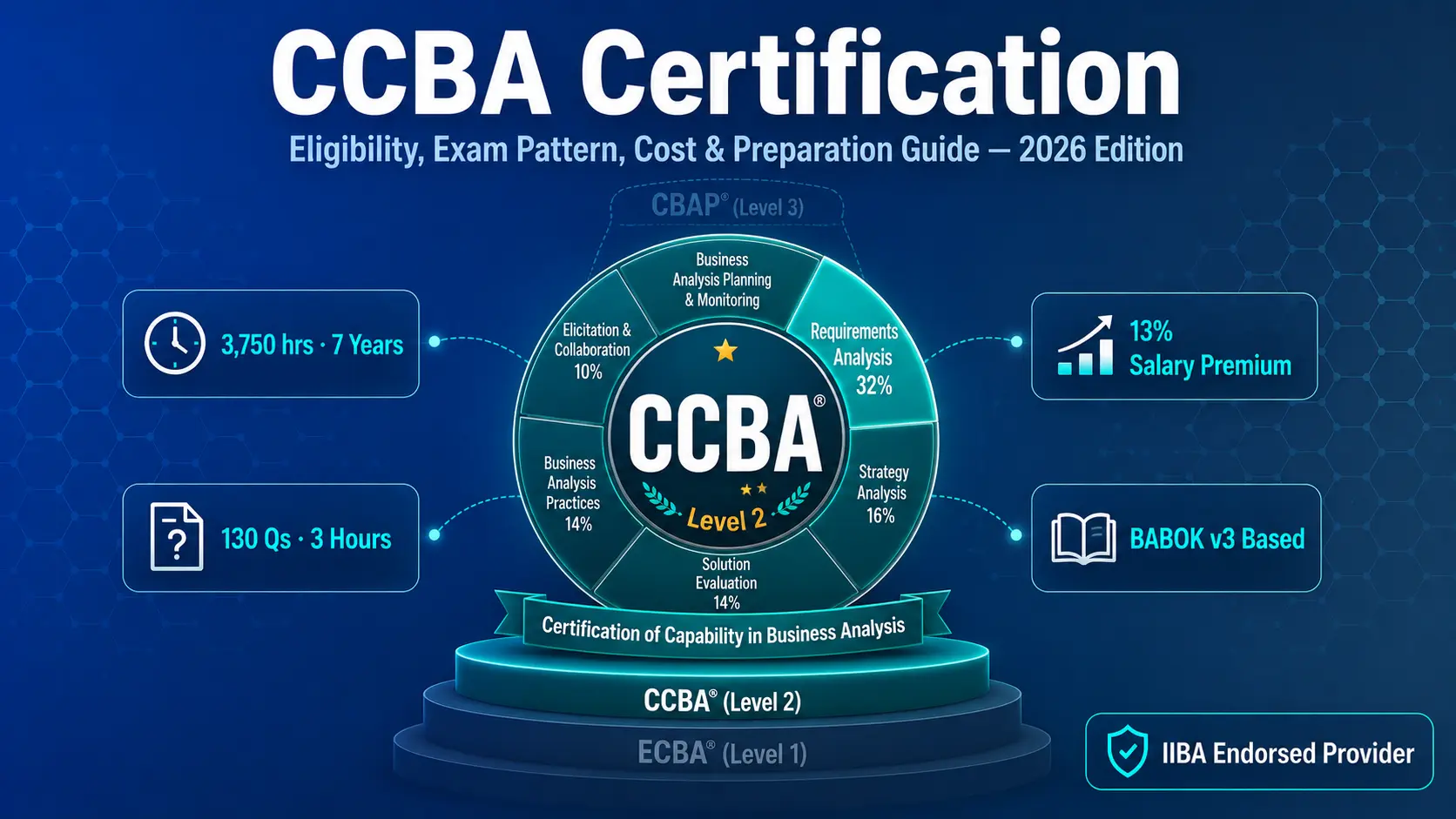
3,750 Hours of Business Analysis Work Experience
Completed within the last 7 years. Your experience should be in the field of business analysis — even if your job title is not “business analyst”.
-
Hours Across BABOK Knowledge Areas
Within those 3,750 hours, either 900 hours in each of 2 of the 6 BABOK Knowledge Areas, OR 500 hours in each of 4 of the 6 BABOK Knowledge Areas.
-
21 Hours of Professional Development
Completed within the last 4 years. A training course such as Techcanvass’s CCBA program fulfils this requirement.
-
References, Code of Conduct & Terms
Provide professional references, agree to IIBA’s Code of Conduct and Terms and Conditions, and pass the exam.
CCBA Certification Exam Pattern
The CCBA exam is a multiple-choice question-based exam, with all questions derived from the BABOK Guide. The number of questions per topic is in proportion to the weightage of each knowledge area. Questions are designed to test your ability to apply BABOK concepts — there is very little chance of direct, definition-style questions. The majority are scenario-based and need a logical approach while keeping the time factor in mind.
130 Questions
Multiple choice, scenario-based. Each question has four options with exactly one correct answer.
180 Minutes (3 Hours)
Time limit for the full exam. Pacing matters, since most questions require analysing a scenario.
Based on BABOK v3
All questions are derived from the Business Analysis Body of Knowledge (BABOK) Guide v3.
No Negative Marking
There is no negative marking, so you should attempt every question — never leave one blank.
You can try a free CCBA mock test to get a feel for the type of questions asked in the exam.
CCBA Syllabus & Knowledge Area Weightage
The CCBA exam is based on BABOK Guide v3, which comprises six knowledge areas. The table below shows the approximate weightage of each knowledge area in the CCBA exam:
Business Analysis Planning & Monitoring
How BAs plan and manage their work
Elicitation & Collaboration
Gathering requirements from stakeholders
Requirements Life Cycle Management
Managing requirements over time
Strategy Analysis
Current and future state analysis
Requirements Analysis & Design Definition
Organising and modelling requirements
Solution Evaluation
Assessing proposed and delivered solutions
Requirements Analysis & Design Definition carries the heaviest weight (32%), followed by Elicitation & Collaboration (20%). Plan your preparation time in proportion to these weightages.
Benefits of CCBA Certification
An IIBA certification makes a business analysis professional more marketable and employable, and improves earning potential. As per the IIBA Global Business Analysis Salary Survey, business analysts who hold at least one certification earn more than non-certified respondents — and CCBA is no different.
Certified business analysts earn more than non-certified respondents, according to the IIBA salary survey.
CCBA validates your ability to handle larger, more complex projects — a credible mid-career milestone and stepping stone to CBAP.
One of the most reputed and recognised BA certifications worldwide, improving employability across geographies.
Ready to start your CCBA journey?
Techcanvass is an IIBA Endorsed Education Provider. Our CCBA training covers all six BABOK knowledge areas with live weekend classes, a question bank, and mentoring — and it fulfils your 21 professional development hours.
CCBA Certification Cost
The CCBA certification cost comprises three components — the membership fee, the application fee, and the exam fee. The membership fee depends on the region your country of residence belongs to. The application fee is the same for everyone, while the exam fee is lower for IIBA members.
You do not need to be an IIBA member to apply. However, membership has many benefits — discounted exam and recertification fees, a free PDF copy of the BABOK Guide, and more — which is why most candidates join before applying.
| Fee Component | IIBA Members | Non-Members |
|---|---|---|
| IIBA Membership (Region 1 — US/UK/Canada) | US $155 | — |
| IIBA Membership (Region 3 — India) | US $60 | — |
| Application Fee | US $145 | US $145 |
| Exam Fee | US $250 | US $405 |
| Total (US — member) | US $550 | US $550 |
| Total (India — member) | US $455 (~₹42,315) | US $550 (~₹51,150) |
Note: IIBA divides countries into three regions. Region 1: US, Canada, UK, Australia, UAE, Japan, New Zealand. Region 2: Brazil, China, Malaysia, Oman, South Africa. Region 3: India, Bangladesh, Pakistan, Sri Lanka, Nepal, Indonesia.
CCBA vs CBAP — Which Should You Choose?
The CBAP (Certified Business Analysis Professional) is the senior-level IIBA credential. CCBA sits one level below it. This quick comparison helps you decide which fits your current profile:
| Criteria | CCBA | CBAP |
|---|---|---|
| Experience Required | 3,750 BA hours (7 yrs) | 7,500 BA hours (10 yrs) |
| Target Level | Mid-level BA | Senior / Lead BA |
| Exam Questions | 130 questions | 120 questions |
| Exam Duration | 3 hours | 3.5 hours |
| PD Hours Required | 21 hours | 35 hours |
| Exam Difficulty | Moderate — application focus | Higher — strategic focus |
If you have 2–3 years of BA experience (3,750 hours), CCBA is the right fit. Once you cross the 7,500-hour threshold, you can upgrade to CBAP. There’s no benefit in rushing to CBAP before you meet the requirements — CCBA itself carries significant employer recognition.
How to Prepare for the CCBA Exam
The CCBA exam is not an easy exam to crack, so your preparation strategy should follow a structured approach rather than being improvised. Going through the BABOK Guide multiple times, understanding the relationships among knowledge areas, and practising with CCBA mock questions must all be part of your study plan.
Read the BABOK Guide v3 Thoroughly
Go through the BABOK Guide multiple times and focus on understanding the relationships among the six knowledge areas.
Practise with CCBA Mock Questions
Scenario-based practice questions that mirror the real exam format are essential — generic MCQs won’t prepare you.
Structured / Instructor-Led Training
A structured course keeps your preparation on track, covers all six knowledge areas, and fulfils your 21 PD hours.
Understand Knowledge Area Relationships
Since questions are scenario-based, knowing how knowledge areas connect matters more than memorising definitions.
Tip: The CBAP preparation strategy is largely applicable to the CCBA exam as well, since both are based on the same BABOK Guide.
CCBA Training Program by Techcanvass
Techcanvass offers a CCBA Certification training program designed to help you meet all the eligibility criteria and prepare effectively for the exam. The key aspects of the program are:
-
21 Hours of Professional Development (PD)
The program provides the 21 PD hours required for CCBA eligibility.
-
Online Weekend Training
Live online weekend sessions, convenient for working professionals across time zones.
-
BABOK Revision Guide
Includes a structured BABOK revision guide to support your preparation.
-
Free Question Bank
Knowledge-area-wise questions plus full-length practice tests to build exam readiness.
CCBA Renewal and Recertification
Your CCBA certification is valid for 3 years. To renew, you must earn 60 Continuing Development Units (CDUs) within that 3-year cycle and pay a recertification fee — you do not retake the exam.
Recertification Fee
US $85 for IIBA members
US $120 for non-members
Paid every 3 years at renewal.
How to Earn 60 CDUs
Training courses, webinars, writing BA articles, volunteering with IIBA chapters, and active BA work experience all count.
Plan your CDU accumulation across the full 3-year window so renewal doesn’t become a last-minute scramble.
Frequently Asked Questions
What is CCBA certification?
What is the CCBA eligibility criteria?
Do I need to be a business analyst by designation to apply?
What is the CCBA exam pattern?
How much does CCBA certification cost?
What is the difference between CCBA and CBAP?
How should I prepare for the CCBA exam?
Where can I take the CCBA exam?
Start Preparing with an IIBA-Endorsed Provider
Techcanvass’s CCBA training is aligned with BABOK v3 and guided by industry experts, with live weekend classes, a BABOK revision guide, a free question bank, and support right up to your exam date.