The Trade Life Cycle:
8 Stages Every Capital Markets BA Must Know
What the trade life cycle is, its eight stages from pre-trade to settlement and reporting, and how Business Analysts and IT professionals work across the front, middle, and back office of investment banking and capital markets. Updated for 2026.
What is the trade life cycle?
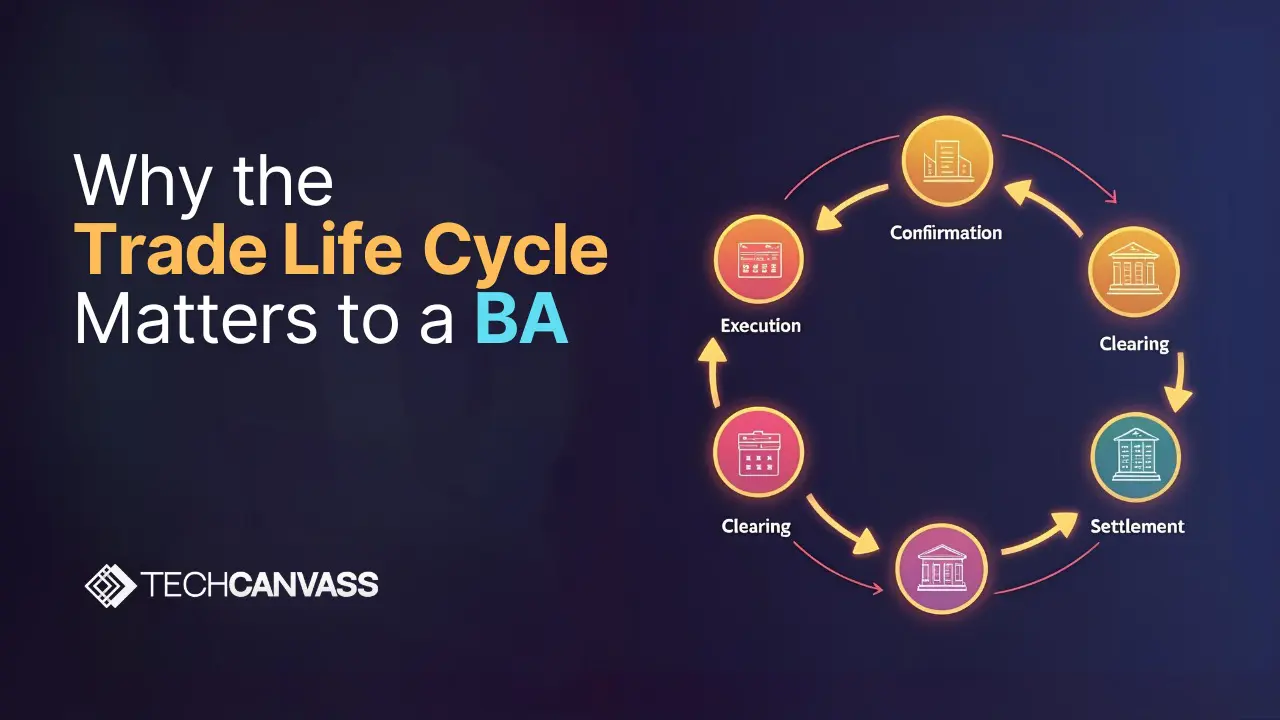
The trade life cycle is the end-to-end process a trade goes through in capital markets — from pre-trade order creation through execution, enrichment, confirmation, clearing, and settlement, to post-trade reconciliation and reporting.
In investment banking and capital markets, this lifecycle spans the front office (trading), middle office (risk and enrichment), and back office (settlement and reconciliation). For a Business Analyst, mapping the trade life cycle is the foundation of every capital markets IT project.
The 8 stages at a glance
- 1Pre-trade & order creation (front office)
- 2Execution & trade capture
- 3Trade Enrichment (Middle Office)
- 4Confirmation & Affirmation
- 5Clearing
- 6Settlement (Back Office)
- 7Reconciliation
- 8Post-Trade Reporting & Analytics
What is the Trade Life Cycle?
The trade life cycle is the complete journey of a trade in capital markets — from the moment an order is created, through execution and processing, to final settlement and post-trade reporting. Every stage has operational, technological, and regulatory implications, which is why understanding the trade life cycle is essential knowledge for any Business Analyst or IT professional working in the financial industry.
The lifecycle flows across three operational areas of a trading firm: the front office (where trades are created and executed), the middle office (where trades are enriched, confirmed, and risk-managed), and the back office (where trades are cleared, settled, and reconciled). A trade that takes milliseconds to execute can take a full day or more to settle and reconcile.
Pre-trade to reporting
From order creation through settlement to post-trade analytics.
Front, middle, back
Each stage is owned by a different operational area of the firm.
Standard settlement
Most major markets now settle one business day after the trade.
The Trade Life Cycle in Investment Banking & Capital Markets
The trade life cycle is the operational backbone of investment banking and capital markets. Whenever an investment bank, asset manager, hedge fund, or broker buys or sells a security — equities, bonds, derivatives, or foreign exchange — that transaction moves through the same lifecycle. This is why “trade life cycle in investment banking” and “trade life cycle in capital markets” describe the same core process, viewed from the operations side of a financial institution.
Investment banks organise this work across the front, middle, and back office. The front office generates revenue (sales and trading); the middle office manages risk, enrichment, and confirmation; and the back office handles clearing, settlement, and reconciliation. Most technology projects in an investment bank exist to make one or more stages of this lifecycle faster, cheaper, or more compliant — which is exactly why domain knowledge of the trade life cycle is so valuable for a capital markets Business Analyst.
| Asset Class | Trade Life Cycle Nuance | BA / IT Relevance |
|---|---|---|
| Equities | High volume, exchange-traded, standardised clearing via CCPs | Low-latency OMS/EMS, smart order routing, T+1 settlement projects |
| Fixed Income (Bonds) | Often OTC, negotiated, more manual confirmation | Confirmation/affirmation workflows, SSI management, pricing data |
| Exchange-Traded Derivatives (ETD) | Margined daily, cleared through a CCP, position lifecycle events | Margin calculation, position keeping, lifecycle event processing |
| OTC Derivatives | Bilateral, complex confirmation, collateral and CSA management | Trade repositories, collateral systems, regulatory reporting (EMIR, DFA) |
| Foreign Exchange (FX) | Very high volume, settlement risk managed via CLS | FX trade capture, CLS settlement integration, multi-currency netting |
Note on reference data: reference data (instrument identifiers such as ISIN/CUSIP, counterparty data, Standing Settlement Instructions) flows through every stage of the trade life cycle. Poor reference data is the single most common root cause of trade breaks and settlement fails, making it a recurring focus of capital markets IT projects.
Why the Trade Life Cycle Matters to a Business Analyst
Projects in capital markets rarely live in silos. A small change in the trading engine can ripple into risk systems, regulatory reporting, and even client billing. Mapping the trade life cycle is what lets a Business Analyst work effectively across that complexity.
See interdependencies
Spot where front-office changes ripple into back-office breaks before they become expensive problems.
Speak everyone’s language
Traders care about milliseconds, ops about breaks, compliance about flags. A lifecycle view is your universal translator.
Miss nothing
Forget one event — say corporate actions — and the system can misprice positions. The lifecycle is your checklist.
The 8 Stages of the Trade Life Cycle
The trade life cycle breaks into eight core stages. For each, here is what happens and the key things a Business Analyst should watch for.
Pre-Trade & Order Creation
Front OfficeA portfolio manager or client decides to buy or sell a security and enters the order into an Order Management System (OMS) or trading app. Compliance checks fire instantly.
- Rule engines: will limit checks live inside the OMS or a separate service?
- Data fields: capture intended trade date/time, instrument identifiers, order type (market/limit), client classification.
- Latency: equity desks may demand microseconds; fixed-income teams tolerate seconds.
Execution & Trade Capture
Front OfficeThe order hits a venue — stock exchange, alternative trading system, or dark pool — and a match occurs. The venue returns fills (partial or complete) to the firm.
- Trade ID schema: venue execution IDs, internal IDs, or both?
- Partial fills and child orders: the workflow must handle one order spawning multiple trades.
- FIX protocol mapping: define which FIX tags feed downstream applications.
Trade Enrichment
Middle OfficeRaw executions lack context. Middle-office systems enrich trades with settlement instructions, account codes, taxes, fees, and counterparty details.
- Static data sources: where do Standing Settlement Instructions (SSIs) come from — a golden source or a fragile spreadsheet?
- Time zones and calendars: a T+1 in one market may be T+2 in another.
- Enrichment-rule traceability: document every if/then for auditors.
Confirmation & Affirmation
Middle OfficeFirms send trade confirmations to counterparties or clients — electronically via SWIFT or as documents. Both parties affirm price, quantity, currency, and settlement date.
- Break management: define states (pending, matched, mismatched) and resolution SLAs.
- Approval method: digital signatures versus email approvals — pick one for legal clarity.
- Versioning: a corrected confirmation must not overwrite the original; keep an audit trail.
Clearing
Back OfficeClearinghouses (CCPs) step in as the buyer to every seller and the seller to every buyer. They require margin and guarantee settlement.
- Margin calculations: do they run in front-office risk or the clearing gateway?
- Netting logic: will the system net buys and sells across the same instrument and settlement date?
- Regulatory hooks: SEBI and other rules may dictate file formats and reporting times.
Settlement
Back OfficeOn settlement date (typically T+1), custodians exchange securities and cash via delivery-versus-payment (DvP).
- Status updates: real-time SWIFT MT54x messages or hourly batch files? Decide early.
- Fails and buy-ins: model scenarios where settlement fails and a mandatory buy-in is triggered.
- Multi-currency payments: FX conversions may create extra trades — do not ignore them.
Reconciliation
Back OfficeOperations teams compare internal books against custodian or prime-broker statements. Breaks trigger investigations.
- Matching keys: trade date vs settle date, gross vs net — define precedence to cut false breaks.
- Tolerance levels: is a 0.01 difference ignored or escalated?
- Dashboard metrics: decide which KPIs (aging breaks, break count by counterparty) surface to management.
Post-Trade Reporting & Analytics
Back OfficeFirms report trades to regulators (for example SEBI transaction reporting). Performance teams analyse P&L attribution and risk teams calculate Value at Risk (VaR).
- Regulatory report templates: hard-coded XML schemas or configurable mappings?
- Historical data retention: five years or seven? Storage cost versus compliance risk.
- Data lineage: auditors will ask which upstream field fed each value in the report.
Master the Trade Life Cycle with Capital Market Domain Training
Techcanvass’s Capital Market Domain Training covers the full trade life cycle — front, middle, and back office — in the context of real BA project work, with hands-on capital markets scenarios for IT and Business Analysis professionals.
Front, Middle & Back Office in the Trade Life Cycle
Every stage of the trade life cycle is owned by one of three operational areas. Knowing which office owns which stage is essential for a Business Analyst scoping a capital markets project — it tells you who the stakeholders are and which systems are in play.
| Office | Owns These Stages | Primary Concern | Key Systems |
|---|---|---|---|
| Front Office | Pre-trade, order creation, execution, trade capture | Revenue, speed, market access | OMS, EMS, smart order router, compliance engine |
| Middle Office | Enrichment, confirmation, affirmation, risk | Accuracy, risk control, breaks | Trade Management System, CTM, SWIFT gateway |
| Back Office | Clearing, settlement, reconciliation, reporting | Finality, compliance, accounting | CCP gateway, custody platform, recs tool, regulatory hub |
Typical Systems in the Trade Life Cycle Ecosystem
This table aligns the key systems with their role in each stage. For a Business Analyst, knowing these system touchpoints — and the right question to ask at each — is vital for successful project delivery.
| Life-Cycle Stage | Common System Names | What to Ask as a BA |
|---|---|---|
| Pre-Trade | OMS, Compliance Engine | Which rules execute synchronously vs asynchronously? |
| Execution | EMS, Smart Order Router | Do we support algorithmic routes, or only direct market access? |
| Enrichment | Trade Management System (TMS) | Who owns reference data quality — ops or IT? |
| Confirmation | CTM, SWIFT Gateway | How do we handle counterparties not on CTM? |
| Clearing | CCP Gateway | Is margin posted automatically via SWIFT or manually? |
| Settlement | Custody Platform | Do we need multi-custodian netting? |
| Reconciliation | Recs Tool | What is our target break-resolution time? |
| Reporting | Regulatory Hub, Data Lake | How do schema changes propagate — CI/CD or weekend release? |
Clearing vs Settlement: What is the Difference?
Clearing is the process of validating and finalising the terms of a trade before it is settled; settlement is the final stage where the actual transfer of securities and funds between buyer and seller takes place. Clearing is handled by a clearinghouse (CCP) that calculates obligations and manages margin; settlement is the movement of assets, typically on a delivery-versus-payment basis on settlement date (T+1).
Clearing
Validates and nets obligations; CCP guarantees the trade and manages margin. Happens before settlement.
Settlement
The actual exchange of securities and cash via DvP, completing the trade on settlement date.
Trade Life Cycle Interview Questions
These questions come up frequently in Business Analyst and operations interviews for capital markets and investment banking roles. They test domain understanding of the trade life cycle rather than technical skills.
Can you walk me through the trade life cycle?
What is the difference between the front, middle, and back office?
What is the difference between clearing and settlement?
Why is reference data important in the trade life cycle?
What is a trade break and how is it resolved?
How to Build Trade Life Cycle & Capital Markets Skills
You do not need to have worked on a trading floor to build capital markets domain knowledge. A Business Analyst needs enough understanding of the trade life cycle to map processes, identify system dependencies, and speak the language of front-, middle-, and back-office stakeholders. A practical path:
- 1
Learn the eight stages cold
Be able to draw the full trade life cycle from pre-trade to reporting from memory.
- 2
Map stages to offices and systems
Know which office owns each stage and which system (OMS, TMS, CCP gateway, recs tool) is involved.
- 3
Understand asset-class nuances
Equities, fixed income, ETD, OTC derivatives, and FX each process differently.
- 4
Take structured capital market domain training
A focused course adds real project context and hands-on scenarios faster than self-study.
Ready to specialise in capital markets?
Explore Techcanvass’s capital markets resources and training, built for Business Analysts who want to win trading, investment banking, and capital markets projects with confidence.