Healthcare Business Analyst:
What the Job Looks Like in Real Projects
A healthcare business analyst sits between clinicians, billing teams, compliance and IT, and turns how a hospital or health plan really works into requirements a system can be built from. This guide covers the roles and responsibilities, a typical day, and one full project from problem to go-live, then closes with career prospects.
What a Healthcare Business Analyst Does
A business analyst in healthcare works out what a hospital, clinic, health plan or health technology company needs from a system, and writes it down precisely enough for developers, vendors and testers to deliver it. The business analyst role in healthcare is less about the technology and more about the questions: who does this step today, what goes wrong, what must the new system enforce, and how will we know it works?
What makes healthcare BA work different
Regulated data. Patient information is protected, so access, audit and display rules become requirements.
Busy users. Clinicians give you minutes, so every session must be short and prepared.
High stakes. A small rule can affect patient safety or revenue, so every requirement needs a way to be tested.
The work in four verbs
- 1Observe how care and billing really run
- 2Define what the system must do
- 3Align clinicians, finance, compliance and IT
- 4Verify it works before and after go-live
Where a Healthcare BA Works
The same title means different day-to-day work depending on who pays for it. Job titles such as clinical business analyst, healthcare IT analyst or revenue cycle analyst usually point to one of these three settings.
Providers
Hospitals and clinic networks. Projects cover EHR changes, scheduling, registration, orders, discharge and billing. You sit close to users and own a department’s systems for years.
Payers
Insurers and health plans. Work centres on enrolment, claims adjudication, prior authorization, provider data and member portals.
Health tech and IT services
EHR vendors, consultancies and outsourcing firms. You move between client projects, work to a statement of work and lean on client experts for local workflow.
Why it matters: pick the setting first. A provider BA learns one workflow deeply, while a services BA learns to get up to speed fast. For a wider view of how domains compare, read which BA domain to choose.
Healthcare Business Analyst Roles and Responsibilities Across a Project
A job description lists duties; a project shows when each one actually happens. This is how the responsibilities of a healthcare BA spread across a typical delivery cycle.
| Project phase | What the BA does | Typical output |
|---|---|---|
| Discover | Interviews users, shadows the front desk or ward, pulls current reports, and maps how the process really runs, including the workarounds nobody wrote down. Example: how a nurse records a discharge today. | As-Is process map, problem statement, stakeholder list |
| Define | Turns findings into business and functional requirements, ranks them with the sponsor, and records the compliance rules the build must respect. Example: who may view a restricted patient record. | BRD or epics, user stories, acceptance criteria |
| Design and build | Answers developer and vendor questions daily, confirms field mappings and message flows with integration engineers, and keeps scope changes visible. Example: agreeing which fields an admission message must carry. | Wireframe reviews, interface mapping notes, change log |
| Test and UAT | Writes scenarios from real cases, coaches clinicians and billing staff through testing, and decides with the team which defects block go-live. Example: a lab result that shows under the wrong patient blocks release. | UAT scenarios, traceability matrix, defect triage notes |
| Go-live and after | Supports the first weeks on the floor, separates defects from training gaps, and checks whether the original problem actually improved. | Hypercare log, benefits review, backlog of fixes |
The documents are the visible part. The invisible part is keeping everyone working from the same understanding. For a fuller list of what each document contains, see the documents prepared by a business analyst.
Who You Work With and What They Want
Requirements in healthcare are rarely hard to write. They are hard to agree on, because each group wants something different from the same screen.
-
Clinicians (doctors, nurses, technologists)
Want fewer clicks and information in the order they think. Time with you is borrowed from patient care, so sessions must be short and prepared.
-
Front desk and registration
Own data entry at the start of every patient journey. They know the workarounds and where mistakes enter the system.
-
Billing, coding and revenue cycle
Want clean data at the source so claims are not rejected. They push for mandatory fields and hard stops.
-
Compliance and privacy officers
Decide what is allowed under HIPAA and local rules. You convert their decisions into access, audit and display requirements.
-
Integration engineers and vendor teams
Own the interfaces between EHR, billing, labs and portals. You agree message content, field mappings and error handling with them.
Systems and Standards You Touch
You do not need to configure these, but you must know what each one holds and who depends on it.
Electronic health record
The clinical record: orders, notes, results, medications. Epic, Oracle Health (Cerner) and Meditech are common names.
Registration, billing and claims
Registration data, charge capture, coding, claim submission and denial work queues.
Patient and provider portals
Booking, results, messaging and payments, usually fed by the EHR.
Lab, imaging and pharmacy systems
Departmental systems that exchange orders and results with the EHR.
Interfaces and integration engines
HL7 messages and FHIR APIs that move data between all of the above.
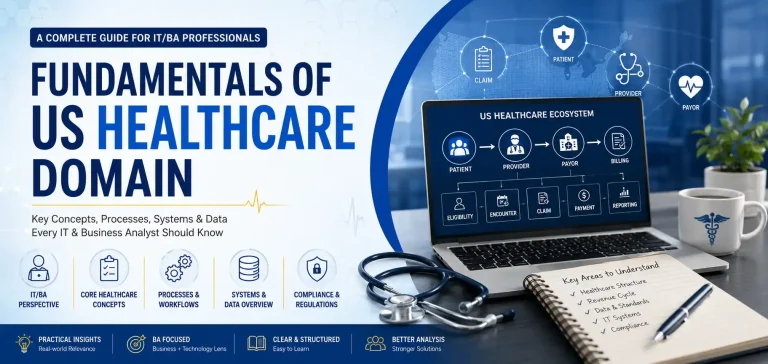
Standards you will hear weekly: HL7 and FHIR for data exchange, ICD-10 for diagnoses, CPT for procedures, X12 transactions such as the 270/271 eligibility check, and HIPAA for privacy and security. Learn each as it appears in a requirement. The US healthcare domain guide explains the surrounding system.
Learn the US Healthcare Domain Before Your First Project
Understand how providers, payers, claims and EHR systems fit together, so the vocabulary in project meetings stops being a barrier.
A Day in the Job
No two days match, but a mid-project day often looks like this, with the BA moving between people rather than sitting with documents.
- 9:00
Stand-up with developers and the vendor
Answer open questions from yesterday, such as what happens when a patient has two active policies.
- 10:00
Workshop with registration staff
Walk through the proposed screen on a mock-up and note every point where staff say, “we never do it that way.”
- 12:30
Denial report review with billing
Sort denials by reason code and agree which causes the project will and will not address.
- 2:00
Write and refine stories
Turn the morning’s decisions into user stories with acceptance criteria, then update the traceability matrix.
- 3:30
Field mapping with the integration engineer
Confirm which registration fields travel in the admission message and what the receiving system does when one is missing.
- 4:30
Check with the privacy officer
Confirm who may override a hard stop and what the audit log must record.
- 5:15
Status update to the project manager
Report decisions made, risks raised and scope questions that need a sponsor.
Real Project Example: Reducing Claim Denials at a Multi-Specialty Hospital
Illustrative exampleThis walkthrough is a composite built from the kind of project healthcare BAs commonly handle. Names, volumes and results are illustrative, but the sequence of work is realistic.
The problem
A 300-bed hospital sees about 14 in every 100 claims denied on first submission. Billing staff spend most of their week reworking claims, and cash arrives late. The sponsor, the revenue cycle director, asks IT for a fix and the BA is assigned.
Discovery: find the cause before writing anything
The BA sits with the registration desk for two mornings, interviews two billing leads, and groups a month of denials by reason.
- Coverage was inactive or wrong on the date of service.
- Procedures that needed prior authorization went ahead without one.
- Subscriber details were missing or mistyped at registration.
The swimlane map shows the gap: eligibility is checked manually, and only for some patients, after the visit is already booked.
Requirements: four rules the system must enforce
Each finding becomes a numbered requirement with a way to test it.
| ID | Requirement | How it is tested |
|---|---|---|
| BR-1 | The system shall run a real-time eligibility check when an appointment is booked and show active or inactive coverage. | Book with an active and a lapsed policy; both show the right status |
| BR-2 | The system shall flag procedures that need prior authorization using the CPT code and payer, and block scheduling until an authorization number is entered. | Schedule a flagged CPT with and without a number |
| BR-3 | Registration shall not complete without subscriber ID, relationship to subscriber and date of birth. | Try to save with each field blank |
| BR-4 | Overrides of a hard stop shall require a reason code and be written to the audit log. | Override and confirm the log entry |
The conflict: clicks versus hard stops
The front desk objected that hard stops would slow walk-in registration. Billing wanted no exceptions. The BA brought both groups and the privacy officer into one session and proposed a split: hard stop for scheduled elective visits, soft warning for walk-ins and emergencies, with every override logged under a reason code. Both sides signed off, and the decision went into the requirements log.
Build: interfaces and configuration
The BA reviewed the registration screen with the vendor, confirmed the eligibility request and response flow through the clearinghouse with the integration engineer, and handled two change requests, one adding a payer-specific authorization list, which the sponsor agreed to phase in later.
UAT: real cases, real users
Twelve scenarios were written from actual denied claims, and registration and billing staff ran them in the test environment. One scenario failed: a child covered under a parent’s plan was checked against the child’s own ID. The defect was fixed before go-live, which is exactly why users test.
Go-live and follow-up
The change launched department by department, with the BA on the floor for the first two weeks. Questions that came up were sorted into defects, training gaps and new requests, and fed back to the backlog.
Starting denial rate
Illustrative baseline.
After two quarters
Illustrative result.
Causes addressed
Coverage, authorization, registration data.
A Clinical-Side Example in Brief
Not every project is about billing. In a discharge medication reconciliation project, the BA shadows nurses and pharmacists, finds that the home medication list is copied by hand, and maps the steps from admission to discharge. The requirements then cover pulling the admission list into the discharge screen, forcing a continue, stop or change decision on each drug, and alerting the pharmacist when the decision is missing. The hard part is the same as in billing: nurses want speed, pharmacists want completeness, and the BA finds the rule both can work with.
What this shows: the BA never wrote code or ran a claim. The value came from finding the real cause, getting three groups to agree on one rule, and making every requirement testable.
Skills That Show Up in Real Projects
Rather than a generic checklist, here is where each skill was used in the project above.
| Skill | Where it showed up in the project above |
|---|---|
| Elicitation and observation | Shadowing registration and reading denial reports surfaced causes that interviews alone had missed. |
| Process modelling | A swimlane map of scheduling, registration and billing exposed the exact step where coverage was never checked. |
| Requirements writing | Each rule became a numbered, testable requirement with one acceptance criterion a tester could pass or fail. |
| Domain vocabulary | Knowing eligibility, prior authorization and denial codes meant billing leads answered in one meeting, not five. |
| SQL and data checking | Grouping a month of denials by reason confirmed which two causes deserved the build effort. |
| Facilitation and negotiation | The front desk wanted fewer clicks, billing wanted hard stops, and the BA brokered a rule both could accept. |
General business analysis methods carry over from every other domain. If you are building that base first, the ECBA certification training covers the core techniques.
Build BA Skills and Healthcare Domain Knowledge Together
Learn requirements, process mapping and UAT alongside healthcare workflows, so you can work on a project like the one above.
Career Prospects for a Healthcare Business Analyst
Healthcare spends heavily on software, from record systems to claims platforms and patient apps, and each change needs someone to define it. That gives BAs in this domain steady work, and depth in one sub-area tends to matter more than the title.
Healthcare BA
Documents requirements and process maps under guidance, supports UAT, learns one sub-area well.
Senior BA or workstream lead
Runs elicitation independently, owns a module such as registration or claims, mentors juniors.
Lead BA or domain SME
Owns requirements for a whole programme and is the client’s first call on workflow questions.
Product owner, consultant or programme role
Moves toward product ownership, advisory work or delivery management as scope widens.
On pay: compensation varies with country, employer type and depth in a sub-domain such as claims or EHR. Glassdoor 2025 figures for the role put the India average near 8 lakh rupees a year and the US average near 100,000 dollars, so check current listings in your market. Specialists in a high-demand area such as EHR build or claims usually command more than generalists.
What Your First Projects Usually Look Like
Document a workflow
Shadow a department and draw how the current process runs, which your senior BA reviews.
Write stories and test cases
Turn agreed decisions into user stories, then write the scenarios users will run in UAT.
Support a release
Sit with users at go-live, log issues and sort defects from training gaps.
People reach the role from several directions: IT or testing, general business analysis, insurance and billing, or clinical and health information roles. Whichever you come from, the fastest way to be useful is to get one workflow end to end, as in the example above.
Not Sure Healthcare Is the Right Domain for You?
Compare healthcare with banking, insurance and other domains, and see which fits your background before you commit to training.