Healthcare Business Analyst: Roles, Salary and Career Path Guide

Quick Answer
A Healthcare Business Analyst acts as the bridge between healthcare organisations and IT teams — translating clinical and administrative business requirements into system specifications. They work on Electronic Health Record (EHR) implementations, patient management systems, revenue cycle systems, and healthcare data platforms. In India, healthcare BAs earn ₹5–11 lakhs per year. In the US, the average is $100,000+. Domain knowledge of the US or Indian healthcare system is a prerequisite for senior roles.
In This Article
What Does a Healthcare Business Analyst Do?
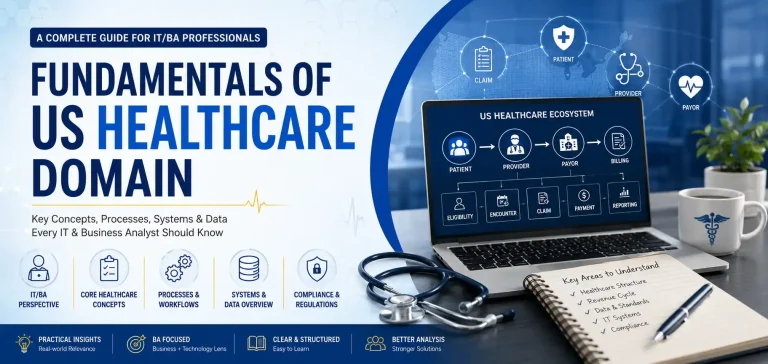
A Healthcare Business Analyst works at the intersection of healthcare operations and information technology — understanding how hospitals, insurance companies, pharmaceutical firms, and healthcare IT vendors run their business, and translating that understanding into precise system requirements for development teams.
Unlike a general Business Analyst, a Healthcare BA must navigate two domains simultaneously: the clinical and administrative domain (patient care workflows, billing cycles, regulatory compliance, EHR systems) and the BA methodology domain (requirements elicitation, process mapping, system design documentation). It is this dual expertise that makes healthcare BAs among the most sought-after IT professionals in the US and Indian IT services markets.
| Healthcare BA At a Glance | |
|---|---|
| Primary employers in India | TCS, Infosys, Wipro, HCL, Cognizant (serving US healthcare clients); Indian hospital chains (Apollo, Fortis, Narayana Health) |
| Primary employers in the US | Epic Systems, Cerner, Philips Healthcare, GE Healthcare, McKesson, Accenture, Deloitte Health |
| Key systems worked on | Electronic Health Records (EHR), Revenue Cycle Management (RCM), Patient Management Systems, Healthcare Data Warehouses, Insurance Claims Systems |
| Key regulations that drive projects | HIPAA (US data privacy), HL7/FHIR (interoperability standards), ICD-10/CPT coding, Meaningful Use, DPDP Act (India) |
| Average salary in India | ₹5–11 lakhs/year (₹8.2 lakhs average — Glassdoor 2025) |
| Average salary in the US | $90,000–$120,000/year ($100,749 average — Glassdoor 2025) |
| Most in-demand specialisation | EHR implementation BA — Epic and Cerner certified BAs command 20-30% salary premium |
Healthcare Business Analyst Roles and Responsibilities
| Responsibility Area | What the Healthcare BA Does | BA Methodology Used |
|---|---|---|
| Requirements Elicitation | Conducts interviews, workshops, and observation sessions with clinicians, administrators, IT staff, and executives to understand business needs — for example, how a hospital manages patient admissions or how a payer processes insurance claims. | Interviews, JAD sessions, ethnographic observation, surveys |
| Process Analysis and Mapping | Documents current-state (As-Is) healthcare workflows — patient registration, claim submission, prescription management — and designs future-state (To-Be) processes that the new IT system will support. | Process flow diagrams, BPMN, swimlane diagrams, value stream mapping |
| Requirements Documentation | Produces the formal requirements artefacts that development teams use to build healthcare systems — covering functional, non-functional, and regulatory requirements. | BRD, FRD, Use Case documents, User Stories with acceptance criteria, System Requirements Specifications |
| Regulatory Compliance Requirements | Identifies and documents compliance requirements that the system must meet — HIPAA data privacy, HL7/FHIR interoperability, ICD-10/CPT coding, Meaningful Use criteria, DPDP Act requirements for India-based projects. | Compliance requirements matrix, audit trail requirements, data privacy impact assessment |
| Stakeholder Management | Manages competing priorities between clinical staff (who want ease of use), IT teams (who want technical clarity), compliance officers (who need regulatory coverage), and finance teams (who want ROI). | Stakeholder analysis matrix, communication plan, conflict resolution, change management support |
| EHR/System Implementation Support | During EHR or healthcare IT system implementations, the BA bridges between the vendor’s configuration team and the client’s clinical and administrative users — ensuring the system is configured to match actual workflows. | Gap analysis, configuration decision documentation, UAT planning and execution |
| Data Analysis and Reporting Requirements | Defines requirements for healthcare data reports, dashboards, and analytics — what data to capture, how to aggregate it, what KPIs to track (patient wait time, readmission rate, claims denial rate). | Data requirements specification, report mockups, KPI definition documents |
| Solution Evaluation | After system go-live, assesses whether the implemented solution delivers the intended business value — if value is not realised, designs process or configuration improvements. | Benefits realisation tracking, post-implementation review, continuous improvement documentation |
Types of Healthcare Business Analyst Roles
The ‘healthcare business analyst’ title covers several distinct role types that differ significantly in their focus area, required domain knowledge, and the systems they work on. Understanding the distinctions helps you target the right job postings and build the right skills.
| Role Type | Focus Area | Key Domain Knowledge | Key Systems | Typical Employer |
|---|---|---|---|---|
| Clinical Business Analyst | Clinical workflows — patient care processes, clinical documentation, physician and nurse workflows | Clinical terminology, clinical pathways, patient safety protocols, CPOE (Computerised Physician Order Entry), clinical decision support | Epic, Cerner, Meditech clinical modules | Hospital health systems, large clinical networks, healthcare IT vendors |
| Healthcare IT Business Analyst | IT system implementation across clinical and administrative functions — EHR, patient portals, interoperability | HL7/FHIR standards, healthcare interoperability, API integration between healthcare systems, HIPAA technical requirements | Epic, Cerner, Allscripts, InterSystems HealthShare | Healthcare IT consulting firms, EHR vendors, large hospital IT departments |
| Medical Business Analyst | Medical device, pharmaceutical, or medical research IT systems — regulatory and clinical trial data systems | Medical device regulations (FDA, MDR), clinical trial data management, GxP compliance, medical coding (ICD-10, CPT) | Clinical trial management systems (CTMS), EDC platforms, regulatory submission tools | Pharma companies, medical device manufacturers, CROs (Contract Research Organisations) |
| Revenue Cycle Business Analyst | Healthcare billing, claims, coding, and payment systems — ensuring accurate revenue capture from patient encounter to payment | Medical billing and coding (ICD-10, CPT, DRG), insurance claims workflow, denial management, payer contracts | Revenue cycle management (RCM) systems, claims clearinghouses, patient billing portals | Hospital revenue cycle departments, RCM outsourcing firms, healthcare payers |
| EHR Business Analyst | Electronic Health Record system implementation, optimisation, and migration | Epic, Cerner, or Meditech-specific workflows and configuration, clinical documentation standards, EHR data migration | Primarily Epic and Cerner — the dominant EHR platforms in the US | Epic-certified consulting firms, large hospital systems, Cerner implementation partners |
| Hospital Business Analyst | Hospital operations — bed management, scheduling, supply chain, facility management alongside clinical IT | Hospital operations management, patient flow, capacity planning, hospital supply chain, infection control systems | Hospital information systems (HIS), patient flow tools, supply chain management systems | Hospital management groups, healthcare operations consulting, large multi-site hospital chains |
For IT professionals in India: The most in-demand healthcare BA type in the Indian IT services market is the Healthcare IT Business Analyst with HL7/FHIR and EHR implementation knowledge — this is the profile that US healthcare domain knowledge clients most commonly seek from Indian IT vendors. Clinical BA roles are more common in direct hospital employment.
Healthcare Business Analyst Salary (2026)
| Country | Entry Level (0-3 years) | Mid Level (3-7 years) | Senior Level (7+ years) | Average | Source |
|---|---|---|---|---|---|
| India (₹) | ₹4–6 lakhs/year | ₹7–12 lakhs/year | ₹14–22 lakhs/year | ₹8.2 lakhs/year | Glassdoor India, 2025 |
| United States ($) | $65,000–$75,000 | $85,000–$110,000 | $115,000–$145,000 | $100,749/year | Glassdoor US, 2025 |
| United Kingdom (£) | £28,000–£34,000 | £36,000–£48,000 | £52,000–£70,000 | £36,331/year | Glassdoor UK, 2025 |
| Canada (CA$) | CA$50,000–CA$60,000 | CA$65,000–CA$80,000 | CA$85,000–CA$110,000 | CA$57,139/year | Glassdoor Canada, 2025 |
| Australia (A$) | A$75,000–A$90,000 | A$95,000–A$120,000 | A$125,000–A$150,000 | A$113,729/year | Glassdoor Australia, 2025 |
India City-Wise Salary Breakdown
| City | Average Healthcare BA Salary | Premium vs National Average | Reason |
|---|---|---|---|
| Bengaluru | ₹9.5–11 lakhs/year | +15-20% | Largest US healthcare IT outsourcing hub — Cognizant, TCS, Infosys have major healthcare practices here |
| Hyderabad | ₹8.5–10 lakhs/year | +5-15% | Growing healthcare IT cluster — Deloitte, Accenture Health, GE Healthcare offices |
| Chennai | ₹8–9.5 lakhs/year | At average | Significant IT outsourcing concentration; healthcare clients of large Indian IT firms |
| Mumbai | ₹8.5–10.5 lakhs/year | +5-15% | Healthcare payer and pharma sector concentration; financial services overlap |
| Pune | ₹7.5–9 lakhs/year | Slightly below average | Growing IT hub; smaller healthcare IT cluster than Bengaluru/Hyderabad |
| NCR (Delhi/Gurgaon/Noida) | ₹7.5–9.5 lakhs/year | At average | Government healthcare IT projects + IT services firms serving US clients |
Certification Impact: Epic or Cerner certification adds 15-25% premium in the US and for India-based roles serving US clients. CPHIMS certification adds 10-15%. Specialisation in revenue cycle or EHR implementation commands higher rates than general healthcare BA roles.
Healthcare Business Analyst Career Path
| Level | Experience | Typical Role Titles | Key Responsibilities | Career Milestone |
|---|---|---|---|---|
| Entry Level | 0–2 years | Healthcare Business Analyst, Junior BA — Healthcare, BA Trainee (Healthcare) | Requirements documentation under supervision; process mapping; test case creation; UAT support | Complete BA training with healthcare domain; work on 1-2 EHR or healthcare IT implementation projects; build portfolio documentation |
| Mid Level | 3–5 years | Healthcare Business Analyst, Senior BA — Healthcare, Healthcare IT Analyst | Independent requirements elicitation; stakeholder management; lead workstreams within projects; mentor junior BAs | Obtain CCBA or CBAP certification; develop specialisation (EHR, revenue cycle, clinical); lead a full project requirements phase |
| Senior Level | 5–10 years | Senior Healthcare Business Analyst, Healthcare BA Lead, Principal BA | Own end-to-end requirements for large healthcare IT programmes; client relationship management; proposal writing; team leadership | CBAP certification; deep specialisation in one healthcare sub-domain; recognised as domain SME by clients |
| Principal / SME Level | 10+ years | Healthcare Domain SME, Business Analyst Manager, Healthcare IT Consultant, Business Consultant | Strategic advisory; business development support; practice leadership; speaking at healthcare IT events | CPHIMS or CHDA certification; thought leadership content; recognised industry expertise |
| Executive / CXO | 15+ years (selective) | Director of Business Analysis, VP Healthcare IT, Chief Analytics Officer | P&L responsibility; strategic direction; team building and hiring; executive stakeholder relationships | Combination of domain expertise + business leadership skills + strong professional network |
Skills Required for a Healthcare Business Analyst
| Skill Category | Specific Skills | How to Develop It |
|---|---|---|
| Healthcare Domain Knowledge | US healthcare system structure (Medicare, Medicaid, private insurance); Indian healthcare system (public/private, ABDM); hospital operations; clinical workflows; healthcare revenue cycle; pharmaceutical and medical device sector basics | US Healthcare Domain Knowledge; hospital observation; healthcare IT project experience; industry publications (HIMSS, Health Affairs) |
| BA Core Methodology | Requirements elicitation techniques (interviews, workshops, observation); process mapping (BPMN, swimlane); documentation (BRD, FRD, user stories, use cases); stakeholder management; gap analysis | IIBA certifications (ECBA/CCBA/CBAP); BA methodology training; practice projects with mentor guidance |
| Healthcare IT Systems Knowledge | EHR platforms (Epic, Cerner, Meditech); revenue cycle management systems; HL7/FHIR interoperability standards; healthcare data standards (ICD-10, CPT, SNOMED); API integration basics | Epic or Cerner online training (publicly available); HL7 FHIR documentation; healthcare IT project exposure |
| Regulatory and Compliance Knowledge | HIPAA privacy and security rules; HL7/FHIR interoperability requirements; Meaningful Use / Promoting Interoperability criteria; ICD-10/CPT coding basics; DPDP Act (India); FDA regulations for medical device BAs | Regulatory body publications; compliance training modules; project experience with compliance requirements |
| Data Analysis Skills | Healthcare KPI definitions; data quality assessment; basic SQL for data validation; Power BI or Tableau for dashboard requirements; claims data analysis | Data analytics training; practice with publicly available healthcare datasets (CMS, NHANES); Power BI/Tableau learning |
| Communication and Facilitation | Facilitating clinical staff and IT team meetings; translating clinical terminology for IT teams (and vice versa); executive communication; written requirements clarity | On-the-job practice; facilitation training; stakeholder management courses |
Healthcare Business Analyst Certifications
Healthcare Business Analysts can pursue two parallel certification tracks — Business Analysis certifications from IIBA and healthcare-specific IT certifications from HIMSS and AHIMA. Senior healthcare BAs often hold at least one from each track.
BA Methodology Certifications (IIBA)
| Certification | Full Name | Who It Is For | Experience Required | Value for Healthcare BA |
|---|---|---|---|---|
| ECBA | Entry Certificate in Business Analysis | Freshers and career-switchers entering BA | No experience required — foundational | Establishes BA methodology credibility before healthcare domain is deep |
| CCBA | Certification of Capability in Business Analysis | Mid-level BAs with 2-3 years experience | 3,750 hours BA work experience | Validates end-to-end requirements competency — most commonly held by mid-level healthcare BAs in India |
| CBAP | Certified Business Analysis Professional | Senior BAs with 5+ years experience | 7,500 hours BA work experience | Highest IIBA credential — healthcare BAs with CBAP command significant salary premium; recognised globally by healthcare IT firms |
The Business Analyst Course with Healthcare Domain prepares you for the ECBA certification while simultaneously building your healthcare domain knowledge — covering both the BA methodology content the ECBA tests and the US healthcare domain context that healthcare IT employers require.
Healthcare-Specific Certifications (HIMSS and AHIMA)
| Certification | Full Name | Issuing Body | Who It Is For | Value for Healthcare BA |
|---|---|---|---|---|
| CPHIMS | Certified Professional in Health Informatics and Information Management | HIMSS | Healthcare IT professionals with 5+ years experience — includes BAs, project managers, analysts | Most recognised US healthcare IT credential — held by senior healthcare BAs targeting US clients; commands 10-15% salary premium in India for US-facing roles |
| CHDA | Certified Health Data Analyst | AHIMA | Healthcare data analysts and BAs working with clinical and administrative health data | Validates healthcare data analysis competency — relevant for BAs working on analytics, reporting, or data warehouse healthcare projects |
| RHIA | Registered Health Information Administrator | AHIMA | Health information management professionals — background in medical records, coding, HIM | Relevant for healthcare BAs transitioning from health information management roles |
| Epic/Cerner Certification | Platform-specific certification | Epic Systems / Cerner (Oracle Health) | BAs and analysts implementing Epic or Cerner EHR systems | Most commercially valuable for Indian IT professionals serving US healthcare clients — Epic-certified BAs earn 20-30% premium; certification is employer-sponsored |
For Indian IT professionals targeting US healthcare projects: The most practical certification path is (1) CCBA for BA methodology credibility, then (2) either CPHIMS or an Epic/Cerner implementation certification depending on whether you are targeting consulting or vendor implementation roles. Epic certification requires employer sponsorship and is obtained through project placement.
Techcanvass’s Healthcare Domain Training is designed for Business Analysts targeting healthcare IT roles — covering the US healthcare system, EHR fundamentals, revenue cycle, and BA deliverables for healthcare projects.
How to Become a Healthcare Business Analyst — Step by Step
Step 1 — Build Your BA Methodology Foundation (0-6 months)
Healthcare domain knowledge alone does not make a healthcare BA — you need the methodology first. Learn requirements elicitation, process mapping, BRD and use case documentation, user story writing, and stakeholder management. If you are new to BA, a structured BA training course with a focus on core methodology is your starting point. Consider the ECBA certification to validate this foundation formally.
Step 2 — Learn the Healthcare Domain (2-4 months, concurrent with Step 1)
Healthcare domain knowledge covers the US or Indian healthcare system structure, how hospitals operate, how insurance claims and revenue cycle work, what EHR systems do, and the key regulations — HIPAA (US), DPDP Act (India), HL7/FHIR interoperability standards. This is the knowledge that separates a general BA from a healthcare BA. Domain training that covers both the business side and the IT systems side is far more efficient than self-study.
Step 3 — Build a Healthcare BA Portfolio (3-6 months)
Employers cannot hire a healthcare BA without evidence of healthcare domain knowledge applied to BA work. Build 2-3 portfolio projects in healthcare scenarios — a patient management system, a hospital billing requirements document, or an EHR workflow analysis. Each project should include a full BRD, process flow diagrams, and use cases. Mentor-guided live projects are the most effective way to build portfolio quality — self-study projects without review feedback are harder to defend in interviews.
Step 4 — Target Entry-Level Healthcare IT Roles (Month 4-8)
Look for roles that combine BA work with healthcare IT exposure — healthcare IT BA, BA trainee at a hospital or healthcare IT vendor, clinical systems analyst, healthcare project coordinator. In India, the largest entry point is IT services companies (TCS, Cognizant, Infosys, Wipro) with US healthcare practice groups. In the US, Epic and Cerner implementation consulting firms regularly hire BAs with healthcare domain training.
Step 5 — Get Certified and Specialise (Year 1-3)
Once you have 1-2 years of experience, invest in formal certification. CCBA or CBAP validates your BA methodology depth. CPHIMS validates your healthcare IT expertise. If you are placed on an Epic or Cerner implementation project, pursue the vendor-specific certification — Epic-certified BAs are the highest-demand and best-compensated healthcare BA specialisation in the Indian IT market serving US clients.
Techcanvass’s Business Analyst Course with Healthcare Domain covers Steps 1 and 2 in one structured programme — BA methodology, US healthcare domain knowledge, EHR fundamentals, and a capstone healthcare BA project. Designed for freshers and career-switchers targeting healthcare IT roles.
Conclusion
Healthcare Business Analysis is one of the highest-demand IT specialisations in both the Indian IT services market and the US healthcare IT sector. The combination of growing healthcare IT investment — particularly in EHR modernisation, revenue cycle optimisation, and healthcare data analytics — and the persistent shortage of BAs with genuine healthcare domain knowledge creates strong career prospects for the foreseeable future.
The path is clear: build your BA methodology foundation, develop deep healthcare domain knowledge covering the US healthcare system and key IT systems, build a portfolio of healthcare BA work, and pursue the certifications that validate both tracks — CCBA or CBAP for BA methodology, and CPHIMS or Epic/Cerner certification for healthcare IT credibility. The combination is rare and commands premium compensation.