Business Analyst Career Path: 3 Roadmaps for the AI Age
A complete career guide for Business Analysts showing the three practical growth paths: Strategic Product Leadership, Project & Delivery Ladder, and Domain / Product SME.
Each path includes stage-wise roles, skills to build, AI skills to develop, and relevant certifications to support career growth.
Business Analyst career paths are changing in the AI age
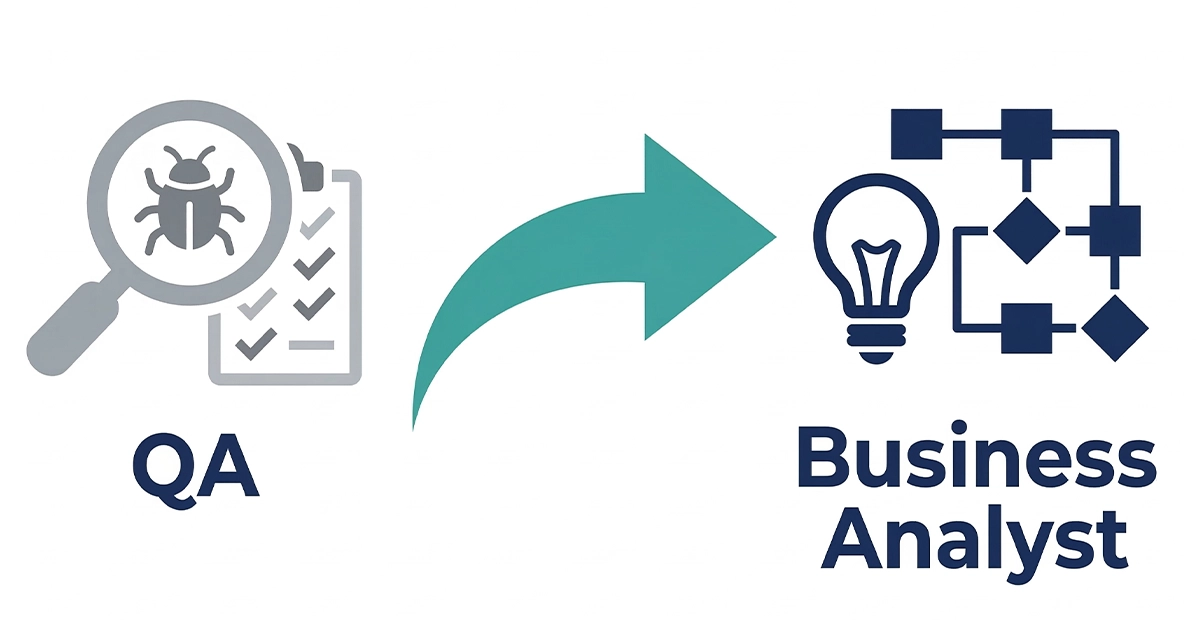
Earlier, many BAs saw career growth as one linear path: Junior BA → BA → Senior BA → Lead BA. In the AI age, the career path is more flexible. BAs can grow toward product leadership, delivery leadership, or domain/product advisory roles.
The AI First Rule
Before choosing a specialization, every BA must become an AI-powered BA to improve productivity, support AI projects, interpret data, and identify AI opportunities.
Strategic Product Leadership
Move from requirements to product ownership, product strategy, and portfolio-level decisions.
Project & Delivery Ladder
Move from requirements to delivery excellence, agile facilitation, and project leadership.
Domain / Product SME
Move from BA execution to trusted domain expertise and product advisory.
3 Business Analyst career paths in the AI age
These three career paths show the three practical growth paths: Strategic Product Leadership, Project & Delivery Ladder, and Domain / Product SME.
Path 1: Strategic Product Leadership
Transition: from requirements to visionary ownership. This path is for BAs who want to move toward product ownership, product strategy and portfolio-level product decisions.
Junior BA
Learns BA basics and supports requirements.
BA / Sr. BA
Owns functional specs and process foundation.
Product Owner
Manages backlog and optimizes value.
Product Manager
Defines the “why” and market roadmap.
Product Director
Drives product strategy and portfolio.
Path 2: Project & Delivery Ladder
Transition: from requirements to delivery excellence and leadership. This path is for BAs who enjoy execution, governance, delivery coordination and project leadership.
Junior BA
Learns BA basics and supports delivery teams.
BA / Sr. BA
Owns functional specs and process foundation.
Scrum Master / PM
Facilitates agility and tactical ownership.
Sr Project Manager
Governs multi-team execution and risks.
Head of Engineering
Leads large-scale delivery and PMO outcomes.
Path 3: Domain / Product SME
Growth path: from BA execution to trusted domain/product advisory. This path is for BAs who want to become deep experts in a domain or product area.
Junior BA
Builds BA basics and domain awareness.
Mid-level BA
Owns requirements and process improvement.
Senior BA
Advises stakeholders with domain insight.
Domain / Product SME
Guides domain and product decisions.
Domain / Product Advisor
Shapes roadmap and innovation priorities.
Business Analyst career path by experience level
This view helps learners understand what changes at each stage and how the three paths begin to separate after the BA foundation stage.
| Experience Stage | Common BA Foundation | Strategic Product Leadership | Project & Delivery Ladder | Domain / Product SME |
|---|---|---|---|---|
| 0–2 years Junior BA stage |
Learn BA basics, SDLC, Agile, stakeholder communication, requirements, documentation and AI productivity. | Understand customer problems, user stories, product value and backlog basics. | Understand Agile ceremonies, delivery coordination, UAT support and project communication. | Build domain awareness, process understanding and business rule clarity. |
| 2–5 years BA / Mid-level stage |
Own requirements, functional specs, process analysis, stakeholder discussions, change requests and validation. | Move toward Product Owner by learning prioritization, MVP, product metrics and value optimization. | Move toward Scrum Master or Project Manager by learning facilitation, risks, dependencies and team coordination. | Move toward stronger domain ownership by learning regulations, workflows, domain KPIs and process improvement. |
| 5–8 years Senior stage |
Lead complex initiatives, manage ambiguity, mentor BAs, influence decisions and connect analysis with outcomes. | Move toward Product Manager by owning product roadmap inputs, market research and business outcomes. | Move toward Senior Project Manager by governing multi-team execution, dependencies, risks and stakeholder reporting. | Move toward Senior BA or Domain/Product SME by advising stakeholders with deep domain insight. |
| 8+ years Leadership / advisory stage |
Use AI, business judgement, product thinking and leadership to influence strategic decisions. | Product Director: product strategy, portfolio decisions and long-term product growth. | Head of Engineering / PMO leadership: large-scale delivery, governance and portfolio execution. | Domain/Product Advisor: roadmap guidance, innovation priorities and business value analysis. |
Skills and certifications required at each stage
Use this section as a practical learning roadmap. Certifications support credibility, but skills and project application are more important.
Stage 1: Junior BA
- BA role and responsibilities
- SDLC, Agile and Scrum basics
- Requirements basics and documentation
- Process modelling and stakeholder basics
- AI tools for research, notes and first drafts
Stage 2: BA / Sr. BA
- Elicitation and facilitation
- User stories and acceptance criteria
- BRD, SRS and functional specs
- Impact analysis and change management
- AI for requirement review and stakeholder preparation
Stage 3: Product Owner / Scrum Master / Senior BA
- Backlog refinement and prioritization
- Product discovery or delivery governance
- Risk, dependency and stakeholder management
- Metrics, KPIs and business value analysis
- AI for insights, reporting and decision support
Stage 4: Product Manager / Sr PM / SME
- Roadmap planning and product strategy
- Multi-team delivery governance
- Domain advisory and business consulting
- Financial impact and prioritization
- AI use cases, guardrails and value realization
Stage 5: Director / Head / Advisor
- Portfolio strategy and leadership
- Operating model and governance
- Enterprise-level stakeholder influence
- Innovation roadmap and transformation thinking
- AI strategy, responsible AI and business value governance
Cross-cutting AI skills
- Prompting for BA deliverables
- AI-assisted analysis and summarization
- AI opportunity identification
- AI project lifecycle understanding
- Ethics, guardrails, bias and hallucination awareness
Why AI skills are critical across all three career paths
AI does not remove the need for Business Analysts. It raises expectations. BAs are expected to analyze faster, compare options better, ask sharper questions and identify AI-enabled business opportunities.
| Career Path | How AI Helps | Examples of AI Use |
|---|---|---|
| Strategic Product Leadership | Improves product discovery, customer insight and product decision-making. | Market research, customer feedback summarization, user story refinement, backlog prioritization, experiment ideas. |
| Project & Delivery Ladder | Improves planning, risk visibility, reporting and dependency tracking. | Sprint insights, risk logs, status reports, meeting summaries, blocker analysis, dependency mapping. |
| Domain / Product SME | Combines deep domain insight with AI use cases and value analysis. | Domain trend analysis, policy interpretation, data interpretation, AI use case identification, guardrail definition. |
Which BA career path should you choose?
Choose the path based on what energizes you, not just the title. The right path should match your strengths, interests and long-term role expectations.
| Your Strength / Interest | Recommended Path | Roles to Target | Skills to Prioritize |
|---|---|---|---|
| Slide into customer problems, value, product decisions and roadmap thinking. | Strategic Product Leadership | Product Owner, Product Manager, Product Director. | Product discovery, prioritization, metrics, roadmap, market research and AI-powered customer insight. |
| You enjoy execution, Agile ceremonies, planning, risk management and delivery governance. | Project & Delivery Ladder | Scrum Master, Project Manager, Sr Project Manager, Head of Engineering / PMO. | Agile facilitation, planning, risk, dependencies, reporting and AI-enabled delivery control. |
| You enjoy domain depth, business rules, process improvement and advisory conversations. | Domain / Product SME | Senior BA, Domain/Product SME, Domain/Product Advisor. | Domain knowledge, data interpretation, AI use cases, business value analysis and guardrails. |
Not sure which path is right for you?
We can help. Sometimes it is difficult to decide which is the best career path. You can talk to senior Industry professionals to decide what is best for you?
Frequently asked questions
These FAQs answer the common doubts professionals have while choosing a BA career path in the AI age.