What’s the Future of Requirement Gathering in a World With AI?
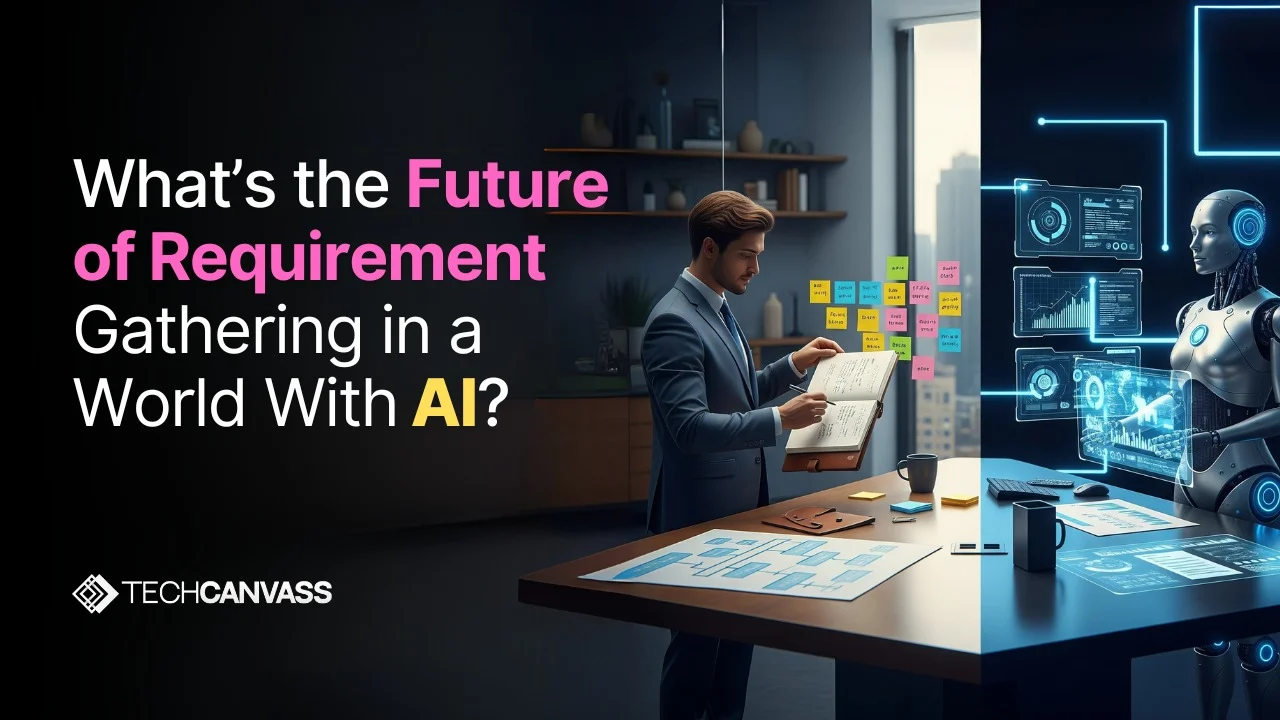
Table of Contents
Overview
There’s something oddly comforting about a well-run requirement gathering session.
People in a room (or on Zoom), whiteboards filled with notes, sticky notes everywhere, maybe someone drawing a flowchart, someone else going on a passionate monologue about a feature that might never get built… And somewhere in the middle of all that, a Business Analyst is listening, absorbing, organizing — turning chaos into clarity.
But let’s be honest — requirement gathering has never been easy.
Half the time, stakeholders themselves aren’t entirely sure what they want. Users give you vague complaints. Developers want specifics. Everyone has their own version of “done.” And you, the BA, are the bridge.
Now, add AI into the picture.
Not as a buzzword. Not as a magic wand. But as a very real, very practical change in how we work.
So the question is: what does the future of requirement gathering look like when AI starts becoming part of the team?
Let’s walk through this — no jargon, no hype. Just the reality.
Want to future-proof your career? Explore our AI Certification for Business Analysts and gain hands-on skills with real-world tools.
Curious about the evolving role of an AI Business Analyst? Dive into our blog to understand what this new-age career path looks like.
1. First, Let’s Get One Thing Straight: AI Isn’t Coming for Your Job
If you’re a Business Analyst and you’ve been worried that AI might replace you, take a breath.
AI can write summaries. It can suggest user stories. It can even spot patterns across tons of user feedback.
But it doesn’t know how to read the room. It doesn’t know when a stakeholder says “this is fine,” but their body language screams “absolutely not.” It doesn’t understand politics. Or human egos. Or why Feature X is a non-negotiable for a team lead who once built a career on it.
AI can process data. But you process people.
That’s not changing anytime soon.
2. But It Will Change the Way You Work
Here’s where it gets real.
AI is already baked into tools you’re using, whether you realize it or not. Maybe it’s Microsoft Copilot writing a first draft of your meeting summary. Maybe it’s a plugin that pulls out action items from your Zoom call.
And these tools are only getting better.
Here’s what that means for requirement gathering:
I. Faster note-taking
Imagine leaving a stakeholder interview and already having a transcript, summary, and keyword list waiting for you.
II. Suggested user stories
You feed in a meeting transcript, and the tool gives you a rough set of stories or tasks — maybe 60% there, but enough to get you started.
III. Consistency across projects
AI can help standardize formats, check for missing sections in your BRDs, or flag incomplete requirements.
IV. Smarter data use
Analyzing hundreds of pieces of user feedback to identify trends? What used to take days can now take hours — or less.
Thisdoesn’tmeanyour role becomes less valuable. It just means you spend less time on busywork and more time on the real work — thinking, questioning, connecting dots.
Requirement gathering lets you focus more on strategy and less on documentation.
3. You’ll Spend Less Time Writing… and More Time Thinking
Here’s an honest truth: a lot of requirement gathering today is documentation-heavy. Writing meeting minutes. Translating vague feedback into structured requirements. Sending follow-up emails. Updating spreadsheets.
With AI in your corner, that part gets lighter.
What becomes more important? Asking better questions. Noticing when something doesn’t add up. Guiding the conversation in a way that AI never could.
In the future, great BAs won’t be the ones who write the cleanest documentation. They’ll be the ones who know how to uncover the truth beneath what’s being said.
Want to future-proof your career? Explore our AI Certification for Business Analysts and gain hands-on skills with real-world tools.
Curious about the evolving role of an AI Business Analyst? Dive into our blog to understand what this new-age career path looks like.
4. But Here’s the Catch — You Still Need to Know Your Stuff
Let’s not pretend AI is perfect.
Sometimes it misinterprets tone. Sometimes it grabs the wrong context. And sometimes it produces beautifully formatted nonsense.
That’s why you, the human, still matter more than ever.
AI can write a user story that looks right. But it can’t tell you if it’s useful. It can’t sense that what the stakeholder asked for isn’t actually going to solve their problem. That’s your job.
So in the future, BAs won’t just need to use AI — they’ll need to review, refine, and correct what AI produces. Think of AI like a junior analyst: fast, helpful, but still learning.
5. Skills That Will Matter More Than Ever
Let’s be real. If AI is changing the way we work, it makes sense that how we work has to evolve too.
Here are some skills that will set future BAs apart:
I. Better communication
Can you ask questions that get to the heart of the issue? Can you explain complex ideas simply — to a dev, a stakeholder, or a customer?
II. Critical thinking
Are you able to challenge AI output? Spot when something “feels off”? Put things in the right business context?
III. Empathy and emotional intelligence
Requirement gathering is emotional. People have fears, hopes, and biases. If you can tune into that, you’ll always stay relevant.
IV. Curiosity about tools
You don’t need to be a tech wizard. But knowing what AI tools can do (and can’t do) will keep you ahead of the curve.
6. The Human Touch Is Still the Heart of It
Here’s the thing I keep coming back to:
Great requirement gathering isn’t about documents. It’s about understanding.
AI can help us collect, organize, and summarize. But only a human can connect the dots, challenge assumptions, and build trust across messy teams with competing priorities.
So while the tools are changing, the heart of the work — curiosity, listening, clarity — stays the same.
Conclusion
We’re not moving into a world where requirement gathering disappears.
We’re moving into a world where it becomes smarter — more about conversations and insights, less about copy-pasting meeting notes.
So if you’re a Business Analyst, don’t fear AI. Work with it. Let it handle the noise so you can focus on the signal. Use it to dig deeper, move faster, and — hopefully — make your job a little less stressful.
Because in the end, AI might help you gather requirements.
But only you can truly understand them.
Want to future-proof your career? Explore our AI Certification for Business Analysts and gain hands-on skills with real-world tools.
Curious about the evolving role of an AI Business Analyst? Dive into our blog to understand what this new-age career path looks like.

FAQs on AI and Requirement Gathering
Q. How will AI change requirement gathering?
AI will transform requirement gathering by automating tasks like transcribing meetings and generating summaries. This will free up BAs to focus on higher-value activities like strategic analysis, challenging assumptions, and building relationships.
Q. Will AI replace the role of a business analyst?
No, AI will not replace a business analyst. While AI can handle data collection and initial analysis, the core of the BA role—such as critical thinking, empathy, and asking insightful questions—is uniquely human.
Q. How can a business analyst upskill with AI?
To get started with an upskill journey, business analysts can take courses that teach them how to leverage AI tools for efficiency. Techcanvass offers the AI Certification for Business Analysts course, which helps professionals work smarter, manage AI projects, and future-proof their career in an evolving professional landscape.
Q. What does requirement gathering with AI look like in practice?
In practice, requirement gathering with AI can involve using AI-powered tools to analyze user feedback from various sources, automatically identify trends, and suggest potential user stories. This makes the process faster and more data-driven.
Q. What is the role of a BA in an AI project lifecycle?
In an AI project lifecycle, the BA acts as the crucial link between business needs and the AI development team. Their role is to define the problem, ensure that the project’s goals align with business value, and manage stakeholders.