CBAP Certification:
Requirements, Exam & Career Guide
Everything you need to know before applying for CBAP certification — eligibility criteria, exam structure, BABOK knowledge areas, application process, certification cost, benefits, and renewal requirements. Updated for 2026.
Looking for a preparation roadmap? Read our CBAP Preparation Guide.
What is the CBAP Certification?
The Certified Business Analysis Professional (CBAP) is the most widely recognised senior-level business analysis credential in the world. Awarded by the International Institute of Business Analysis (IIBA), it is designed specifically for professionals who have already spent years in the field — not those entering it.
Unlike entry-level certifications, the CBAP isn’t about proving you know the theory. It validates that you can lead complex, strategic-level analysis work in real organisations. Employers use it as a filter for senior BA, lead analyst, and business architecture roles.
Global CBAP holders
One of the rarest senior BA credentials worldwide
Salary premium
Over non-certified peers (IIBA Salary Survey)
Experience required
Minimum BA work experience in the last 10 years
CBAP Certification Requirements
IIBA requires you to demonstrate substantial work experience before you can even apply. Here are the four criteria you must meet:
-
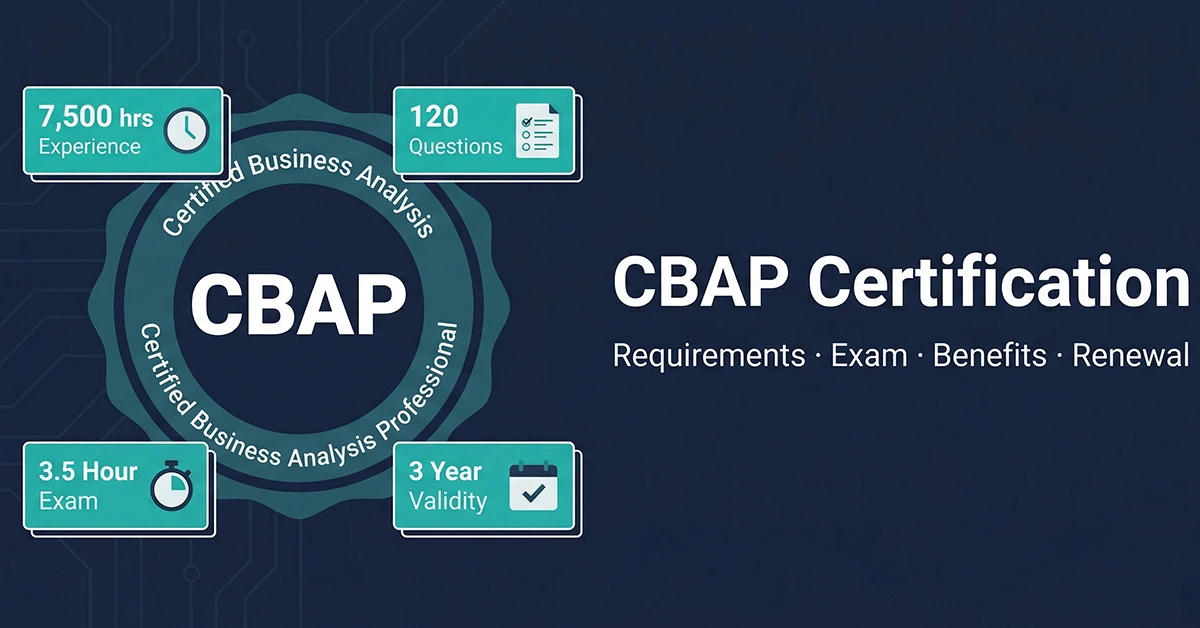
7,500 Hours of Business Analysis Work Experience
Must be completed within the last 10 years. These are hours spent performing BA tasks — not general project management or development work.
-
3,600 Hours Across BABOK Knowledge Areas
Of your total hours, at least 900 hours in 4 of the 6 BABOK Knowledge Areas (totalling 3,600 hours). This ensures breadth across the full BA framework.
-
35 Hours of Professional Development
Completed within the last 4 years. Must be formal, structured education directly aligned with the BABOK Guide — not general presentations or workshops.
-
Two Professional References
References can be a career manager, client, or a CBAP-certified professional who can vouch for your BA experience and skills.
CBAP Exam Structure
The CBAP exam is intentionally difficult. It does not test your ability to recall BABOK definitions — it tests whether you can apply BA thinking to real-world scenarios. Most questions present a complex business situation and ask what the best analytical approach would be.
120 Questions
Multiple choice, scenario-based and case study-based. Case studies can be 1–1.5 pages long with multiple questions per case.
3.5 Hours
Time limit for the full exam. A calculator is provided for questions requiring numerical analysis.
Based on BABOK v3
All questions are derived from the Business Analysis Body of Knowledge (BABOK) Guide v3 — the industry standard reference.
Must Pass All Knowledge Areas
You need a passing score in every individual knowledge area — not just a high overall average. This ensures well-rounded competency.
Pacing & Exam Rules
-
Pacing Target
You get roughly 1.75 minutes per question on average (120 questions in 210 minutes). Case studies are long, though — a single case can take 5–10 minutes to read before you answer.
-
Multi-Question Cases
A single case study can carry more than one question.
-
Flagging Option
You can flag a question for review and return to it later.
-
No Negative Marking
There is no negative marking, so never leave a question unanswered.
BABOK Knowledge Area Weightage
The exam draws questions from all six BABOK knowledge areas. Here’s the approximate distribution:
Business Analysis Planning & Monitoring
How BAs plan their work
Elicitation & Collaboration
Gathering requirements from stakeholders
Requirements Life Cycle Mgmt
Managing requirements over time
Strategy Analysis
Current and future state analysis
Requirements Analysis & Design
Organising and modelling requirements
Solution Evaluation
Assessing proposed and delivered solutions
What Is the CBAP Passing Score?
IIBA does not publish an official passing score for the CBAP exam. There is no fixed percentage or number of correct answers confirmed by the International Institute of Business Analysis. The patterns below come from conversations with CBAP-certified professionals, including our own trainers — they reflect observed experience, not an official IIBA statement.
Two patterns consistently emerge:
-
Clear Knowledge Areas Individually
You must clear each of the six knowledge areas individually. A strong overall score will not make up for one weak knowledge area.
-
Estimated Passing Threshold
The passing level appears to sit around 70% and above, based on candidate feedback.
Note: This is not based on any official IIBA communication. Treat the ~70% figure as a preparation benchmark, not a guaranteed cut-off.
How the Passing Requirement Works in Practice
Because every knowledge area is scored separately, your preparation should be even across all six. Many candidates fail not because their overall performance is weak, but because they neglected one or two areas. Aim for consistency rather than peaking only in your strongest topics.
Is the CBAP Exam Hard?
Yes — the CBAP is regarded as a challenging exam, and it is meant to be. It spans all six BABOK knowledge areas and tests whether you can apply business analysis thinking to real situations, rather than recall definitions. That said, “hard” is relative: your experience level and the quality of your preparation matter far more than the exam itself. With a structured study plan, most well-prepared candidates pass.
How to Manage the Difficulty
The CBAP exam is challenging because it tests application of BABOK concepts through scenario-based and case-study questions. Candidates should understand the exam pattern, practise application-based questions, and avoid relying only on workplace experience. For a detailed preparation roadmap, read our CBAP Preparation Guide, or work through our CBAP Sample Questions for worked examples.
What Types of Questions Does the CBAP Exam Have?
The exam is multiple choice, but the questions fall into three distinct styles:
-
Situational / Scenario-based
You’re given a business situation and asked for the best analytical decision or recommendation — testing how you apply BA skills in practice.
-
Numerical
You solve quantitative problems, such as ROI calculations or weighted decision-matrix scoring. A calculator is provided.
-
Case-study Based
A longer, detailed business case with several questions attached, testing how you apply BABOK principles to complex, real-world situations.
For worked examples of each type, see our CBAP sample questions.
Top Reasons Candidates Fail the CBAP Exam
Most failures come down to a handful of avoidable mistakes:
Underestimating the preparation effort
Underestimating the study commitment is the most common cause of failure.
Over-relying on work experience
Day-to-day BA work doesn’t cover every BABOK knowledge area or technique the exam tests.
Memorising BABOK instead of understanding application
Situational questions reward application, not recall.
Ignoring scenario and case-study questions
Skipping this practice leaves you unprepared for the question format that makes up most of the exam.
Poor time management
Spending too long on hard questions leaves later sections rushed or incomplete.
Answering from personal workplace habits instead of BABOK logic
The exam expects BABOK-aligned answers, not your own workplace habits.
For a detailed list of preparation mistakes and how to avoid them, read our CBAP Preparation Guide.
CBAP Application Process — Step by Step
The application itself takes time. Budget 2–4 weeks to document your hours properly before submitting.
Create your IIBA account and log your hours
Log your work experience (BA Development Log) and professional development hours through your IIBA profile. Be thorough — IIBA audits a percentage of applications and will ask for supporting documentation.
Pay the application fee (US $145)
Non-refundable and non-transferable. Paid when you submit the application form. The same fee applies to both members and non-members.
Submit references and agree to the Code of Conduct
Two professional references must confirm your experience. Both must agree to IIBA’s Code of Ethical Conduct and Professional Standards.
Await approval (and possible audit)
IIBA reviews and approves applications, some of which are selected for audit. If audited, you’ll need to provide documentation for your claimed hours.
Pay the exam fee and schedule your date
Once approved, pay the exam fee (US $350 for members / US $505 for non-members) and book through Pearson VUE. You have 12 months from approval to sit the exam.
Benefits of CBAP Certification
The credential has three measurable career impacts that show up consistently in industry data:
CBAP-certified professionals earn significantly more than non-certified peers across all geographies.
Roughly 1 in 5 senior BA job descriptions now explicitly prefer or require the CBAP credential.
With fewer than 21,000 CBAPs worldwide, the credential remains rare — giving holders a genuine competitive edge.
Ready to start your CBAP journey?
Techcanvass is an IIBA Endorsed Education Provider. Our CBAP training covers all six BABOK knowledge areas with live classes, 1,200+ mock questions, and mentoring — designed to help you pass on the first attempt.
CBAP Certification Cost
The total cost has three official IIBA components — membership, application fee, and exam fee — plus training if you use a structured course.
| Fee Component | IIBA Members | Non-Members |
|---|---|---|
| IIBA Membership (Region 1 — US/UK/Canada) | US $139 | — |
| IIBA Membership (Region 3 — India) | US $55 | — |
| Application Fee | US $145 | US $145 |
| Exam Fee | US $350 | US $505 |
| Total (US — member) | US $634 | US $650 |
| Total (India — member) | US $550 (~₹45,650) | US $650 (~₹53,950) |
CBAP vs CCBA — Which Should You Choose?
The CCBA (Certification of Competency in Business Analysis) is the mid-level IIBA credential. If you’re not sure which fits your profile, this quick comparison helps:
| Criteria | CBAP | CCBA |
|---|---|---|
| Experience Required | 7,500 BA hours (10 yrs) | 3,750 BA hours (7 yrs) |
| Target Level | Senior / Lead BA | Mid-level BA |
| Exam Questions | 120 questions | 130 questions |
| Exam Duration | 3.5 hours | 3.5 hours |
| Exam Difficulty | Higher — strategic focus | Moderate — application focus |
| Renewal Cycle | 3 years (60 CDUs) | 3 years (60 CDUs) |
If you have 5–7 years of BA experience, start with CCBA and upgrade to CBAP once you hit the 7,500-hour threshold. There’s no benefit in rushing to CBAP if you don’t yet meet the requirements — CCBA itself carries significant employer recognition.
CBAP Preparation Overview
CBAP preparation should start with understanding the exam structure and confirming your eligibility. Once you know you qualify, your preparation should focus on BABOK concepts, application-based understanding, scenario and case-study practice, mock tests, and regular review of mistakes.
Since the CBAP exam tests application rather than memorization, candidates should avoid relying only on work experience or passive BABOK reading. A structured preparation plan helps you cover all BABOK knowledge areas, practise the right question types, and build exam confidence.
For a detailed preparation roadmap, study sequence, 12-week plan, BABOK study method, and exam-day tips, read our CBAP Preparation Guide.
For the resources required for preparation, such as BABOK, revision guide, mock tests, case-study questions, flashcards, and study checklist, see our CBAP Study Material page, or practise directly with our CBAP Question Bank.
CBAP Renewal and Recertification
Your CBAP is valid for 3 years from the date you pass the exam. To renew, you must earn 60 Continuing Development Units (CDUs) within that 3-year cycle — you do not retake the exam.
Recertification Fee
US $85 for IIBA members
US $120 for non-members
Paid every 3 years at renewal.
How to Earn 60 CDUs
Training courses, webinars, writing BA articles, volunteering with IIBA chapters, presenting at conferences, and active BA work experience all count.
If you don’t renew, your certification is suspended. Suspended professionals cannot use the CBAP designation and are removed from the IIBA registry. Plan your CDU accumulation across the full 3-year window — don’t leave it to the final months.
Frequently Asked Questions
How much BA experience do I need to apply for CBAP?
How much does CBAP certification cost in India?
Is IIBA membership mandatory for CBAP?
How long does it take to prepare for the CBAP exam?
What is the CBAP exam passing score?
Is the CBAP exam hard?
Why do people fail the CBAP exam?
What study material is required for CBAP preparation?
Can I retake the CBAP exam if I fail?
How long is the CBAP certification valid?
Is CBAP worth it in 2026?
Start Preparing with an IIBA-Endorsed Provider
Ready to prepare with structured guidance? Techcanvass CBAP training helps candidates cover BABOK knowledge areas, practise application-based questions, and earn the required professional development hours.