How to Become an AI Business Analyst: A Real-World Roadmap
The BA role is not disappearing. It is splitting into two groups: those who still do things the old way, and those who let AI carry the busywork so they can focus on judgment, strategy, and people. Here is exactly how to land in the second group.
Same core skills. A very different day at work.
Introduction
Here is something most articles will not tell you straight: the traditional Business Analyst role, the one built purely around gathering requirements and writing documents, is quietly shrinking. Not because BAs are becoming less valuable. Because the parts of the job that used to eat entire afternoons, formatting a BRD, transcribing a stakeholder call, chasing down a status update, can now be done by an AI assistant in minutes.
That can feel unsettling if you read it the wrong way. Read it the right way, and it is actually good news. It means the parts of your job that were never the interesting parts anyway are getting automated, and the parts that made you good at this in the first place, judgment, empathy, the ability to ask the one question nobody else thought to ask, are becoming more valuable, not less.
An AI Business Analyst is not someone who has memorized which button to click in ChatGPT. It is a BA who has learned to use AI as a genuine working partner, who still owns the thinking, the ethics, and the outcome, but no longer wastes hours on work a machine can do faster. This guide walks through why that shift matters, exactly which skills close the gap, and a step-by-step roadmap to get you there without burning out trying to learn everything at once.
Why is AI Important for Business Analysts?
You do not need to take anyone’s word for it that AI is changing this profession. You can see it in what organizations expect now compared to five years ago. Here is what is actually driving that shift, in plain terms.
AI is the new baseline, not a bonus skill. A working understanding of machine learning, natural language processing, and AI ethics has quietly moved from “nice to have” to “expected on day one” for most BA job descriptions.
AI makes you a sharper researcher. Instead of manually digging through historical project data for patterns, AI can summarize it in minutes and flag trends you might have taken days to spot on your own.
It gives you your time back. Picture this: instead of typing up Minutes of Meeting after a two-hour stakeholder call, a tool like Microsoft Copilot joins the call, listens, and hands you the action items before you have even closed your laptop.
You become the person who spots the opportunity. Every software company wants to ship AI-powered features right now. The BAs who can point at a real business problem and say “this is genuinely solvable with AI, and here is why” are the ones getting pulled into the interesting projects.
You will soon be briefing AI agents, not just people. User stories are starting to be read directly by autonomous coding agents. Writing requirements clearly enough for a machine to act on them correctly is quickly becoming a core BA skill, not a niche one.
Someone has to be the conscience in the room. As AI adoption speeds up, so does the risk of biased models and privacy violations. BAs are increasingly the ones catching algorithmic bias early and making sure a solution actually complies with regulations like GDPR.
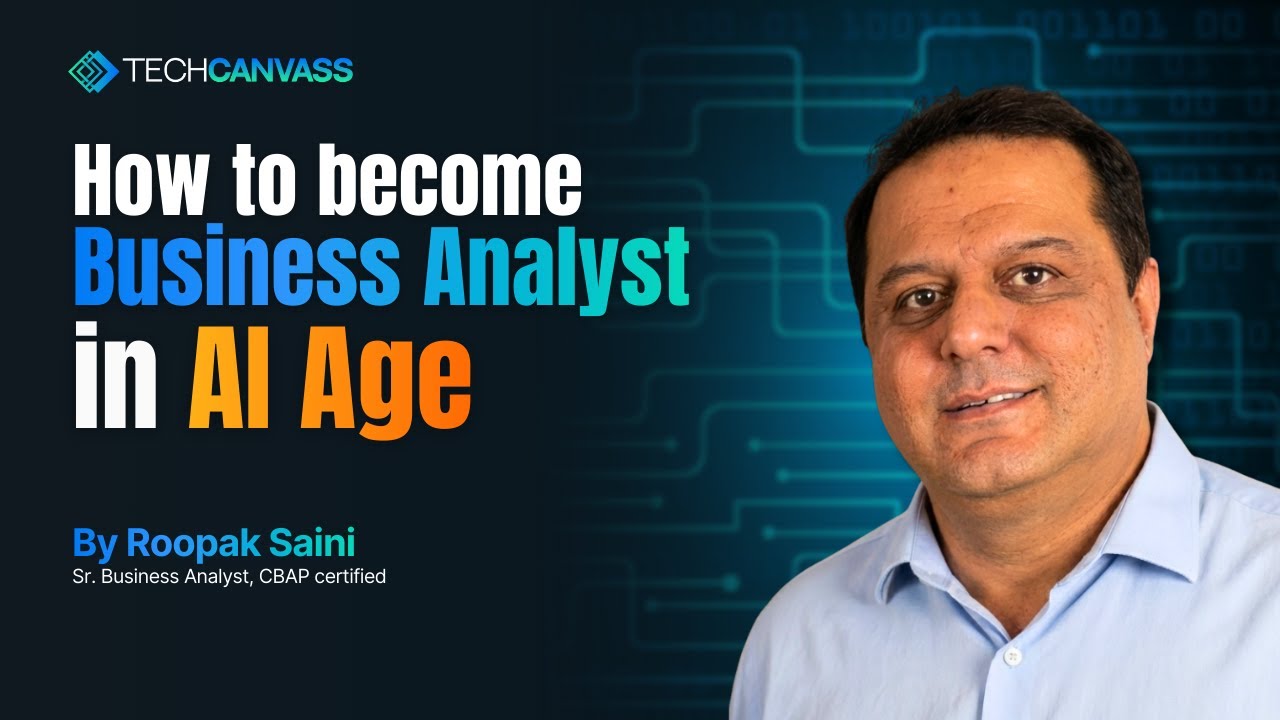
Watch: How AI Is Reshaping the Business Analyst Role
AI is not replacing Business Analysts, it is changing what the role actually does. In this webinar clip, CBAP-certified Senior Business Analyst Roopak Saini breaks down how BAs are shifting from pure documentation into strategic, high-impact decision support, and exactly which skills close that gap.
- Why AI will not replace Business Analysts, and what it changes instead
- How AI automates documentation, analysis, and requirement drafting
- The skills that matter now: prompt engineering, data literacy, and responsible AI
- Real-world guidance from a CBAP-certified Senior Business Analyst
Essential Skills and Tools for an AI Business Analyst
Being an effective AI Business Analyst is not about chasing every new tool that launches. It is about three layers working together: the BA fundamentals you already have or are building, real fluency with AI tools, and the human judgment that no model can replicate. Here is what belongs in each layer.
1. Core BA Foundations
This does not go away, it becomes the ground everything else stands on. Before you touch a single AI tool professionally, you need to be genuinely comfortable with elicitation, analysis, process modeling, and cost-benefit analysis. AI amplifies good BA instincts. It does not replace the need for them.
2. AI Literacy and Tools
This is where most people focus first, and it is worth doing properly rather than superficially.
GenAI platforms: Get genuinely comfortable with ChatGPT, Microsoft Copilot, Gemini, and NotebookLM for analyzing data, summarizing documents, and drafting first versions of your artifacts.
Atlassian Rovo: Learn how AI agents inside your project management tools can automate searching, summarizing, and updating tickets across Jira and Confluence.
Vibe coding: This is the increasingly common practice of describing what you want in plain language and letting an LLM generate a working mockup or prototype from that description.
AI agent platforms: Get a working understanding of how agentic AI apps are built and used, on platforms such as Base44, CrewAI, and n8n.
3. The Human Skills Layer
This is the layer that actually protects your career, and it is the one people underestimate. AI cannot sit across the table from a nervous stakeholder and read the room. It cannot negotiate scope with a difficult sponsor, or make the ethical call on a gray-area feature. Critical thinking, facilitation, empathy, negotiation, ethical judgment, and storytelling are your real competitive edge, and they only get more valuable as automation spreads.
AI will change what you spend your time on. It will not change why organizations need a good BA in the room in the first place.
A Structured Roadmap: How to Become an AI Business Analyst
You do not need to learn all of this in a single weekend, and you should not try. Here is a structured path that builds in the right order, so each step actually makes the next one easier.
Step 1: Build Core Business Analysis Foundations
There is no shortcut past this step. You cannot be a strong AI BA without first being a strong BA.
- Learn SDLC, Agile methodologies, and Business Process Modeling (BPMN).
- Get genuinely skilled at writing user stories, managing stakeholders, elicitation, and User Acceptance Testing.
- Build credibility with a recognized certification, such as the IIBA Certified Business Analysis Professional (CBAP).
Step 2: Start with GenAI and Master Prompt Engineering
This is where you start reclaiming your time. Begin folding AI into your daily tasks, not as an experiment, as a habit.
- Use AI as a sounding board, a virtual stakeholder, to draft and refine requirements before you take them to a real meeting.
- Learn to auto-generate BRDs, SRS documents, flowcharts, and meeting summaries as a first draft you then refine.
- Master the structure of a good prompt: a clear Role, Context, Objective, Task, Input, and Constraints.
- Never accept AI output blindly. It can hallucinate, carry bias, or work from stale data. A human-in-the-loop check on facts, logic, and assumptions is not optional, it is the job.
If you want structure around this, something like Coursera’s Generative AI for Business Analysts Specialization is worth exploring.
Step 3: Develop Data Literacy and Technical Skills
AI projects live and die on data, so you need to be able to speak that language, even if you never become a data scientist.
- Learn enough SQL to query databases, map data, and run basic data quality checks yourself.
- Get comfortable in Power BI or Tableau for turning raw numbers into something a stakeholder can actually act on.
- Pick up the basics of Python and understand, at least conceptually, how a machine learning model takes inputs and produces outputs.
Step 4: Master the AI Project Lifecycle (ASDLC)
An AI project does not run like a traditional software rollout, and knowing exactly where a BA fits across that lifecycle sets you apart fast.
- Own problem framing first. Make sure the team is solving the right problem before validating whether AI is even the right tool for it.
- Understand the flow of data collection, model selection, training, evaluation, deployment, and ongoing monitoring.
- Push hard on ethical AI considerations, data privacy compliance, and setting up real guardrails, not just documentation about guardrails.
Step 5: Package Your Portfolio
Knowing this material is one thing. Being able to show it convincingly in an interview is what actually gets you hired. Nobody hires an AI Business Analyst on a checklist of skills alone, they hire someone who can show real judgment applied to real work. Before your next interview, make sure your portfolio includes these three things.
- A GenAI prompt pack: the actual prompts you rely on for daily BA tasks, showing you use AI habitually rather than only when asked to in an interview.
- 2 to 3 case studies: before-and-after artifacts, such as a BRD or prototype, that prove you can guide a tool rather than just prompt it and accept whatever comes out.
- An AI solution blueprint: detailing the data needs, value metrics, and ethical controls for a proposed AI solution, showing you can think at the solution level, not just the task level.
A small but honest tip: hiring managers can tell the difference between a portfolio built to check a box and one built because you were genuinely curious. Pick a problem you actually care about for your case studies. It shows, and it makes the interview conversation a lot easier to have.
Stop Piecing This Together on Your Own
Every step above takes real time to figure out alone. Techcanvass’s AI Certification for Business Analysts is built to take you through this exact roadmap, prompt engineering, the ASDLC, and portfolio-ready case studies, with structured guidance instead of scattered tutorials.
Conclusion
Learning how to become an AI Business Analyst is not really about learning a tool. It is a mindset shift. You stop treating AI as a threat to route around and start treating it as the most capable junior analyst you have ever worked with, one that never gets tired, never complains about formatting a document twice, but still needs your judgment to know what actually matters.
You do not need to have this all figured out by next week. Start small. Sharpen your Agile and SDLC fundamentals if they need it. Practice prompt engineering daily, even on tasks that feel too small to bother with. Pick up enough SQL to hold your own in a data conversation. Get familiar with how an AI project actually moves from idea to deployment.
Do that consistently, and you are not just future-proofing a job title. You are positioning yourself as the person organizations actually trust to make the call when the stakes are real. That is a strategic seat at the table, and it is one that is waiting for BAs willing to put in the work to get there.
You already have the hardest part.
The judgment, the stakeholder instincts, the ability to untangle a messy problem, that took years to build and no AI model can shortcut it. Layering AI fluency on top of that is the easier half of this journey. Start today, and give yourself permission to learn it one step at a time.