40 Technical Business Analyst Interview Questions (With Answers)
Most “Technical BA” question lists online are just generic Business Analyst questions with a new label. These 40 actually test the technical layer: systems, databases, APIs, and documentation, the way real interviewers do.
Twice the depth of the typical “Top 20” lists.
Search “technical business analyst interview questions” and you will find several lists floating around online. Look closely, and most of them are recycled general Business Analyst questions, stakeholder management, BRDs, SWOT analysis, with the word “technical” bolted onto the title. That is not what actually gets tested when a hiring manager is evaluating a Technical Business Analyst for a role that touches APIs, databases, and system architecture.
This guide covers 40 questions, organized into seven categories that mirror how technical BA interviews are actually structured: mindset, systems and architecture, databases and SQL, APIs and integrations, system design and documentation, AI tools, and behavioral scenarios. Each question includes what it is really testing and a sample answer you can adapt to your own experience, not a script to memorize word for word.
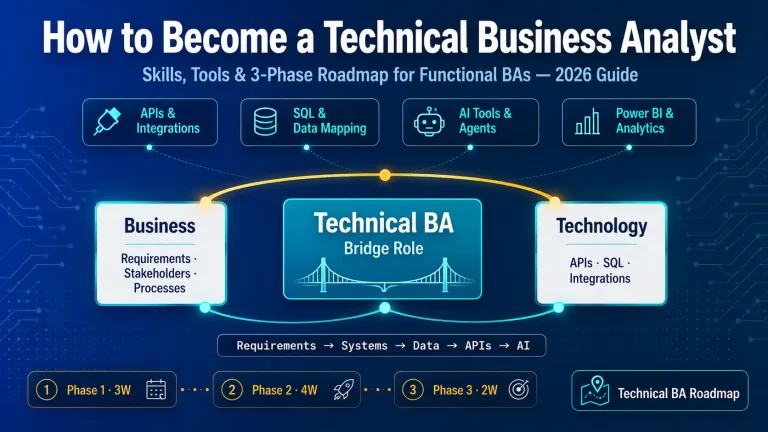
This guide assumes some familiarity with what a Technical BA actually does day to day. If any question below feels unfamiliar, these two guides fill in the background.
Foundational and Mindset Questions
These open most interviews. They are not hard technically, but they reveal whether you actually understand what the role is, versus reciting a job title.
Q1.What is the difference between a Business Analyst and a Technical Business Analyst?
Sample answer:
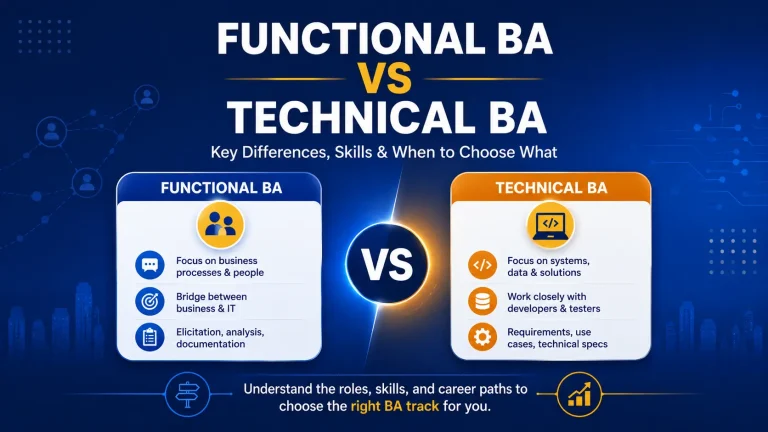
“A Business Analyst focuses on business needs, processes, and stakeholders. A Technical BA does all of that, but also understands systems, data, and APIs well enough to work directly with engineering teams without a translator in between. The core BA skills don’t change, the technical layer sits on top of them.”
Q2.Why are companies increasingly hiring Technical Business Analysts instead of purely functional BAs?
Sample answer:
“Projects today involve more integrations, cloud systems, and AI-enabled features than a few years ago. A BA who can only write business requirements creates a bottleneck the moment a conversation touches APIs or data structure. Companies want someone who can bridge that gap directly, which speeds up delivery and reduces miscommunication.”
Q3.Do you need to know how to code to be a Technical Business Analyst?
Sample answer:
“No, and I’d be cautious of anyone who claims otherwise. What matters is understanding system logic, data structures, and integration concepts well enough to ask the right questions and write requirements a developer can act on. I don’t need to write production code, I need to understand what the code is doing and why.”
Q4.How do you decide how much technical detail to include in a requirement document?
Sample answer:
“It depends on who is reading it. A business requirements document stays in business language, focused on outcomes. A technical specification for the development team goes deeper, data fields, API behavior, error handling. I try never to mix the two in one document, because it ends up serving neither audience well.”
Q5.Describe a time you had to learn a new technical concept quickly to do your job well.
Sample answer:
“On one project I needed to understand how our system handled asynchronous API calls before I could write realistic requirements for a new integration. I spent time with the lead developer, read the existing API documentation, and tested a few calls myself in Postman before writing anything. It took a day, but it meant my requirements didn’t need three rounds of correction later.”
Systems and Architecture Questions
This is where generic BA candidates usually start to struggle. These questions check whether you have a working mental model of how modern applications are actually built.
Q6.What is the difference between a monolithic and a microservices architecture, and why does it matter to a BA?
Sample answer:
“A monolithic application is built and deployed as one large unit, while a microservices architecture splits functionality into smaller, independently deployable services. It matters to a BA because a small requirement change in a microservices environment might only affect one service, while the same change in a monolith could require a full redeployment, which changes how I estimate impact and risk.”
Q7.Walk me through what happens, at a high level, when a user submits a form on a website.
Sample answer:
“The front end captures the input and sends it as a request to the back end, usually over an API. The back end validates the data, may check it against business rules, writes it to a database, and sends a response back confirming success or explaining an error. As a BA, I care about every one of those steps, because each one is a place a requirement can go wrong.”
Q8.What is the difference between the front end and the back end of an application?
Sample answer:
“The front end is what the user sees and interacts with, the screens, buttons, and forms. The back end handles the logic, data storage, and business rules behind the scenes. When a bug report comes in, one of my first questions is always whether the issue looks like a front-end display problem or a back-end data or logic problem, because that changes who I loop in first.”
Q9.What role does a load balancer play, and why would a BA ever need to know about it?
Sample answer:
“A load balancer distributes incoming traffic across multiple servers so no single one gets overwhelmed. I don’t configure load balancers, but understanding they exist helps me ask better questions during a performance discussion, like whether a slowdown is a code issue or a capacity issue, instead of assuming it’s always the application’s fault.”
Q10.What is caching, and why can it cause a business user to report incorrect data on a dashboard?
Sample answer:
“Caching stores a copy of data temporarily so systems don’t have to fetch it fresh every time, which improves speed. But it means a user can be looking at slightly stale data without realizing it. When a stakeholder says a number ‘looks wrong,’ checking cache refresh timing is one of the first things I rule out before assuming there’s a real data bug.”
Q11.How do you document a request lifecycle for a new feature so both business and technical teams understand it?
Sample answer:
“I usually build a simple flow diagram showing each step, from the user action through the system components involved, to the final outcome, and pair it with plain-language notes at each step. Developers get the technical flow, business stakeholders get the plain-language version, and everyone is looking at the same picture instead of two disconnected documents.”
Databases and SQL Questions
SQL comes up in almost every Technical BA interview. Interviewers are not expecting a database administrator, they are checking whether you can hold your own in a data conversation.
Q12.What is the difference between a relational database and a NoSQL database?
Sample answer:
“A relational database organizes data into structured tables with defined relationships between them, and it’s a good fit when data is consistent and well-structured, like customer or transaction records. A NoSQL database is more flexible with structure, which suits data that varies a lot in shape, like logs or content that doesn’t fit neatly into rows and columns.”
Q13.Can you explain what a primary key and a foreign key are, and why they matter?
Sample answer:
“A primary key uniquely identifies each row in a table, and a foreign key is a field in one table that references the primary key in another, which is how tables relate to each other. Understanding this matters because a lot of reporting bugs trace back to a broken or mismatched key relationship between tables.”
Q14.What is a JOIN in SQL, and when would you use an INNER JOIN versus a LEFT JOIN?
Sample answer:
“A JOIN combines rows from two or more tables based on a related column. An INNER JOIN only returns rows where there is a match in both tables, while a LEFT JOIN returns all rows from the first table, and matching data from the second where it exists, or blank where it doesn’t. I reach for LEFT JOIN whenever I need to see every record even if some related data is missing.”
Q15.How would you use SQL to validate that a data migration was successful?
Sample answer:
“I’d start by comparing row counts between the source and target systems, then spot-check specific records for accuracy, and finally run aggregate checks, like sums or counts, on key fields to confirm totals match. Row counts alone don’t catch everything, so I always pair them with a few targeted data quality checks.”
Q16.What is an Entity-Relationship Diagram, and when would you create one as a BA?
Sample answer:
“An ER diagram visually maps entities, like customers or orders, and how they relate to each other. I create one early in a project when the data model isn’t fully defined yet, it’s a fast way to catch a missing relationship or a misunderstanding about how two pieces of data connect, before anyone starts building.”
Q17.How do you approach a situation where two systems have different definitions of the same data field?
Sample answer:
“I document both definitions clearly, side by side, and bring the right stakeholders together to agree on a single source of truth, or a clear transformation rule if both definitions genuinely need to coexist. Letting this stay ambiguous is how integration projects end up with silently wrong numbers months later.”
APIs and Integrations Questions
Modern systems rarely stand alone. This category checks whether you understand how they talk to each other, and whether you can write requirements for that conversation.
Q18.In plain language, what is an API, and why should a BA care about it?
Sample answer:
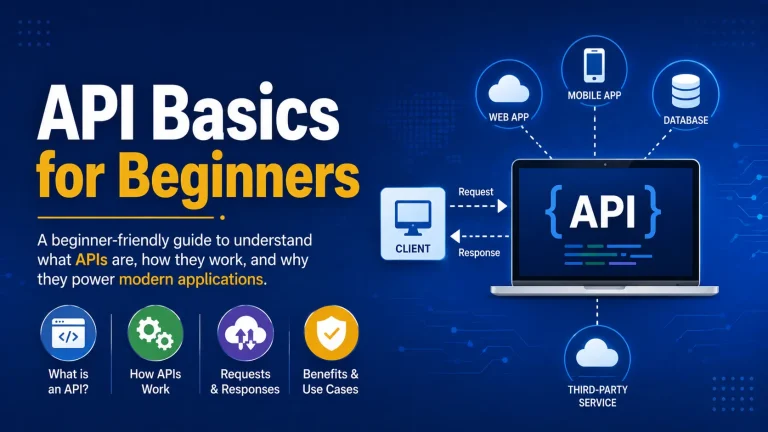
“An API is a defined way for two systems to exchange data or trigger actions in each other, like a waiter taking an order between a customer and a kitchen. I care about it because most modern requirements involve one system asking another for data, and I need to define what’s being asked for and what should happen if that request fails.”
Q19.What is the difference between a REST API and a SOAP API?
Sample answer:
“REST is a lighter, more flexible style that typically uses JSON and standard web methods, and it’s the most common approach for modern applications. SOAP is a stricter, XML-based protocol often still used in older enterprise or highly regulated systems, like some banking integrations. I don’t need to build either, but knowing the difference helps me understand what an integration will realistically look like.”
Q20.Can you explain what a JSON payload is and how you would document one?
Sample answer:
“A JSON payload is the structured data sent in an API request or response, made up of key-value pairs. When documenting one, I list each field, its data type, whether it’s required or optional, and any validation rules, so a developer isn’t guessing what a field like ‘status’ is actually allowed to contain.”
Q21.What is the difference between a GET request and a POST request?
Sample answer:
“A GET request retrieves data without changing anything on the server, like loading a page of results. A POST request sends data to create or update something, like submitting a form. When I’m mapping out a workflow, distinguishing the two helps me flag which steps are read-only and which ones actually change data, since those need more careful error handling.”
Q22.How would you write a requirement for what should happen when an API call fails?
Sample answer:
“I’d specify the expected error scenarios, like a timeout or an invalid response, and define exactly what the user should see and what the system should do in each case, retry automatically, show an error message, or fall back to cached data. Leaving failure handling undefined is one of the most common gaps I see in requirement documents.”
Q23.What is API authentication, and why does it matter for a requirement document?
Sample answer:
“API authentication confirms that a request is coming from an authorized source before any data is exchanged, often through methods like API keys or tokens. I flag this in requirements because it affects error scenarios too, an unauthorized request needs its own defined behavior, separate from a general failure.”
System Design and Documentation Questions
This is where a Technical BA earns their keep: turning a fuzzy idea into something precise enough for a developer to build and a tester to verify.
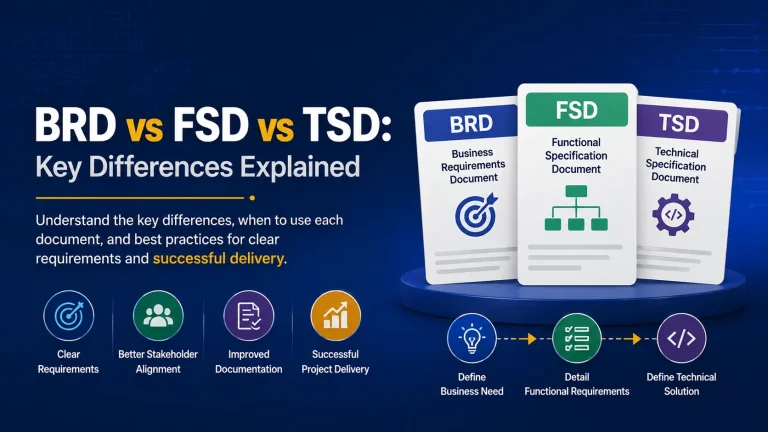
Q24.What is the difference between a Business Requirements Document and a Technical Specification Document?
Sample answer:
“A BRD captures the business problem, goals, and scope in business language. A Technical Specification Document translates that into implementation detail, data fields, API behavior, system logic, that a development team can build directly from. I treat the BRD as the ‘why’ and ‘what,’ and the TSD as the ‘how.'”
Q25.How do you handle a situation where developers say a requirement is technically not feasible?
Sample answer:
“First I ask them to walk me through exactly why, so I understand the real constraint rather than assuming it’s a flat no. Then I go back to the business problem behind the requirement and explore alternative solutions with the team. Usually the underlying business need can still be met a different way, even if the original approach can’t.”
Q26.What are non-functional requirements, and can you give examples relevant to a Technical BA?
Sample answer:
“Non-functional requirements describe how a system should perform rather than what it should do, things like response time, security, scalability, and availability. For example, I might specify that a report must load within three seconds for up to 500 concurrent users, since that’s a real constraint developers need to design around, not an afterthought.”
Q27.How would you document an edge case that the development team hasn’t considered?
Sample answer:
“I write it as an explicit scenario with a clear expected outcome, for example, what should happen if a user submits a form twice within the same second, rather than leaving it as an assumption. I’d rather raise ten edge cases that turn out to be non-issues than miss the one that causes a production incident.”
Q28.What is a data mapping document, and when is it needed?
Sample answer:
“A data mapping document shows how each field in a source system corresponds to a field in a target system, including any transformation rules along the way. It’s essential any time data moves between systems, migrations, integrations, or reporting pipelines, because that’s exactly where silent, hard-to-trace data errors tend to happen.”
Q29.How do you use flowcharts or diagrams to communicate system logic to both technical and non-technical stakeholders?
Sample answer:
“I keep one version high-level, showing the overall flow and decision points in plain language, for business stakeholders. For the technical team, I add detail underneath, specific conditions, data checks, system calls, at each step. Same underlying logic, two levels of detail depending on who’s reading it.”
AI Tools and Modern Tech BA Questions
Newer to the role, but increasingly common. Interviewers want to know you can use AI as a genuine productivity tool, not just as a buzzword on a resume.
Q30.How are you currently using AI tools in your day-to-day BA work?
Sample answer:
“I use AI tools to draft first versions of user stories, summarize long stakeholder discussions into action items, and generate initial data mapping drafts I then review and correct. It’s genuinely saved me hours on documentation, but I always treat the output as a first draft, never a final answer.”
Q31.What are the risks of relying on AI-generated requirements or documentation without review?
Sample answer:
“AI can sound confident while being factually wrong, miss edge cases entirely, or generate generic requirements that don’t reflect the actual system constraints. I always review AI output against real system behavior and stakeholder input before it goes anywhere near a development team. The judgment stays mine.”
Q32.What is an AI agent, and how is it different from a chatbot?
Sample answer:
“A chatbot mostly responds to what you type. An AI agent can take multi-step actions on its own toward a goal, calling tools, checking conditions, and deciding what to do next, with a human usually reviewing the outcome. As a BA, I think of agents in terms of what workflow they’re automating and what guardrails need to exist around them.”
Q33.How would you use AI to speed up a gap analysis between an AS-IS and TO-BE process?
Sample answer:
“I’d feed in the documented AS-IS process and the TO-BE goals and ask the tool to draft an initial list of gaps and impacted steps. That gives me a starting structure fast, but I still validate every gap against actual stakeholder input, since the AI has no visibility into the political or operational realities behind the process.”
Q34.What cloud concepts should a Technical BA be comfortable with, even without a DevOps background?
Sample answer:
“Enough to hold a conversation: the difference between environments like development, staging, and production, what an outage or scaling issue generally implies, and roughly how cloud services get billed and provisioned. I don’t need to configure any of it, but I need to understand it well enough that a technical conversation about deployment doesn’t leave me guessing.”
Ready to Prepare for These Interviews Properly?
Reading answers is a start. Techcanvass’s Technical Business Analyst Course covers APIs, SQL, system design, technical documentation, and AI tools through hands-on project work, including a capstone project you can talk about in interviews.
Behavioral and Scenario-Based Questions
Technical knowledge gets you in the room. These questions decide whether you get the offer, because they test judgment, not recall.
Q35.Describe a time you had to explain a technical constraint to a non-technical stakeholder.
Sample answer:
“A stakeholder once wanted a real-time update that our system architecture genuinely couldn’t support without a significant redesign. I explained the constraint using an analogy tied to their own business process, then offered a near-real-time alternative that met the actual underlying need. They cared about the outcome, not the architecture, so I framed it around that.”
Q36.Tell me about a project where you had to work closely with developers to refine a requirement.
Sample answer:
“I wrote an initial requirement for a data validation rule, and in review, the lead developer pointed out an edge case I’d missed involving how the field behaved with null values. We worked through it together and updated the requirement before any code was written. I see moments like that as the requirement getting better, not as me getting something wrong.”
Q37.How do you handle a situation where a stakeholder wants a feature that would require a major system redesign?
Sample answer:
“I make the tradeoff visible early, what the redesign would cost in time and risk versus a smaller, faster alternative that gets most of the value. I’ve found stakeholders rarely insist on the expensive path once they can actually see the tradeoff laid out clearly, rather than being told ‘no’ without context.”
Q38.Describe how you would investigate a bug that stakeholders are reporting as “the numbers are wrong.”
Sample answer:
“I’d start by getting a specific example, not a general complaint, then trace the number back through the system: is the source data correct, is the calculation logic correct, and is the report reflecting the latest refresh. Most ‘wrong number’ reports turn out to be a stale cache, a filter misunderstanding, or a data timing issue rather than an actual calculation bug.”
Q39.How do you keep your technical knowledge up to date as systems and tools keep changing?
Sample answer:
“I try to learn one new tool or concept hands-on every quarter rather than passively reading about all of them. Right now that’s meant getting comfortable with AI agent workflows. I’d rather go deep on a few relevant things than stay shallow across everything trending that month.”
Q40.Where do you see the Technical Business Analyst role heading over the next few years?
Sample answer:
“I expect the technical bar to keep rising, particularly around AI-enabled systems and integrations, as more of the ‘plumbing’ work that BAs used to hand off entirely gets close enough that BAs need to understand it directly. The core skill that won’t change is translating a real business problem into something a technical team can build correctly the first time.”