Functional BA vs. Technical BA: Key Differences, Skill Gaps & Salary Growth
Two titles that sound almost identical, doing genuinely different work. Here is where they actually diverge, what it takes to close the gap, and what that gap tends to mean for your paycheck.
Both bridge business and IT. They just bridge different layers of it.
Introduction
If you have spent any time browsing BA job postings, you have probably noticed two titles doing very different work under names that sound almost identical: Functional Business Analyst and Technical Business Analyst. The confusion is understandable. Both roles sit at the intersection of business and technology, both write requirements, and both work inside the same delivery teams. But the day you actually start the job, the difference becomes obvious fast.
A Functional BA lives in the “what”: what the business needs, what the user is struggling with, what the process should look like once it is fixed. A Technical BA lives in the “how”: how the system architecture supports that fix, how data moves between components, how an API should behave when something goes wrong. Neither role is more valuable than the other. They solve different halves of the same puzzle.
This guide breaks down exactly where these two roles diverge, the skill gap between them, and what that gap tends to mean for pay and career growth.
Key Differences
Primary Focus
A Functional BA’s job starts and ends with the business side of a project. They spend their time understanding what stakeholders actually need, why current processes create friction, and what a better version of that process should look like. Their output is usually a set of clear business rules, user stories, and acceptance criteria describing the outcome a system needs to deliver, without necessarily specifying how the system delivers it.
A Technical BA picks up roughly where that description ends. Once the business need is defined, the Technical BA works out what that means at the system level: which database tables need to change, what a new API endpoint needs to accept and return, how two systems that were never designed to talk to each other are going to exchange data reliably. The focus shifts from business rules to system rules.
Daily Tasks
On any given day, a Functional BA might be running a stakeholder workshop, refining a backlog of user stories, or walking a business sponsor through a proposed workflow change. Their calendar tends to be full of conversations.
A Technical BA’s day looks different. It might include reviewing an API’s response schema, writing a query to check whether a data migration actually preserved referential integrity, or sitting with a developer to work out why two systems are returning conflicting numbers for the same metric. There is still plenty of conversation, but it happens alongside a lot more time spent inside the systems themselves.
Functional BA Snapshot
Business goals, user pain points, operational rules, As-Is and To-Be process mapping, user stories and acceptance criteria.
Technical BA Snapshot
System capabilities and limitations, data flow analysis, integration logic, technical specifications and data mapping rules.
The Core Shift: From Defining the What to Engineering the How
This is the part most job descriptions never explain properly, and it is the actual line you cross when you move from functional to technical work. A functional requirement usually ends the moment the desired outcome is described. “The system should notify a customer when their order ships” is a complete, valid functional requirement. Nobody expects the Functional BA to specify which service sends that notification or what happens if the notification service is down.
A Technical BA’s job starts exactly where that requirement stops being enough. The same notification requirement now has to answer a much longer list of questions. Which system triggers the event. What data that event carries. Which API receives it and what it returns if the call times out. Whether the notification gets logged, retried, or silently dropped on failure. None of that changes what the business asked for. It defines how the system is actually going to make that happen, reliably, at scale, without quietly failing in a way nobody notices until a customer complains.
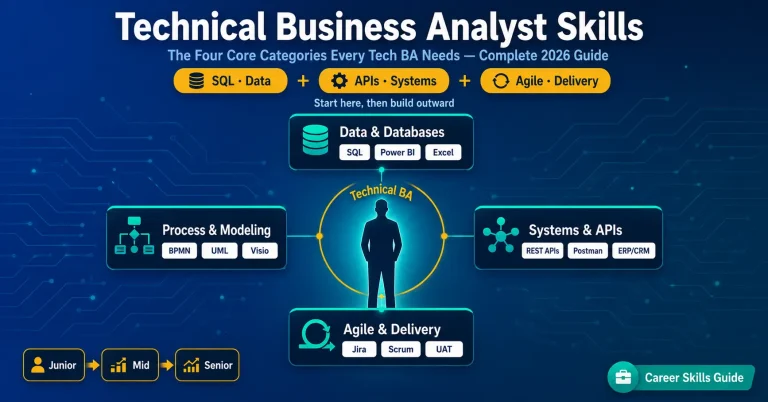
Making that shift consistently rests on four technical pillars. You do not need mastery in all four before you can call yourself a Technical BA, but a working comfort with each one is what separates someone who can write “how” requirements from someone still writing “what” requirements with technical vocabulary sprinkled on top.
APIs
Understanding how systems exchange data, request and response structures, and what should happen when a call fails.
Databases
Comfort with SQL and relational structure, so you can trace where data actually lives and verify it yourself.
System Design
Mapping how a feature will actually be built, components, data flow, and edge cases, before a line of code exists.
Architecture
A working picture of how the pieces fit together at scale, so requirements reflect what the system can realistically support.
Notice that none of these four are about writing production code. They are about understanding the system well enough to write a requirement a developer can implement without coming back to you three times with clarifying questions. That is the entire point of the technical layer, it removes ambiguity at exactly the point where ambiguity is most expensive to leave in.
Skill Gaps
The word “gap” makes this sound like one skill set is missing something the other has. It is more accurate to say both roles build outward from the same core BA foundation, just in different directions.
Core Functional Skills
Requirements gathering and elicitation across a range of stakeholder types
Process mapping, including As-Is and To-Be workflow design
Stakeholder management and negotiation across conflicting priorities
Working comfortably within Agile ceremonies and backlog management
Core Technical Skills
SQL and database querying to validate data directly rather than relying on secondhand reports
Understanding how REST and SOAP APIs exchange data between systems
System integration logic, including how failures and edge cases should be handled
Basic data modeling and enough programming literacy to follow a technical conversation without a translator
The tools each role reaches for tend to follow the same split.
| Category | Functional BA Tools | Technical BA Tools |
|---|---|---|
| Documentation & Collaboration | Jira, Confluence, Miro | Jira, Confluence, Postman |
| Diagramming & Modeling | MS Visio, Figma | ER diagram tools, system architecture diagrams |
| Data & Systems | Spreadsheets, basic reporting dashboards | SQL clients, Swagger, system logs |
Neither skill set replaces the other. A Technical BA who cannot run a stakeholder workshop is just as limited as a Functional BA who cannot read an API response.
Daily Collaboration
Who a BA spends the most time talking to says a lot about the role itself.
A Functional BA works closely with product owners, business stakeholders, and end users. Their success depends on trust built with the people who will actually use, or pay for, whatever gets built.
A Technical BA works closely with software developers, system architects, and quality assurance teams. Their success depends on being precise enough that a developer never has to guess what a requirement actually means at the code level.
Salary Growth
Earning Potential
Compensation for both roles tends to grow steadily with experience, but the shape of that growth differs. Functional BAs typically see earnings climb alongside domain expertise and project leadership responsibility. The longer you have worked in a specific industry and the bigger the initiatives you have led, the more you tend to be worth to an employer.
Technical BAs often start from a higher baseline, particularly in technology-heavy industries, because the skill set overlaps with roles that already command a premium, like systems analysis or data engineering. That technical layer tends to compress the time it takes to reach senior compensation levels, though it also demands continuous learning as systems, APIs, and tooling keep changing underneath the role.
Market Demand
Technical BAs sit at a genuinely scarce intersection: professionals who understand both business context and system mechanics well enough to translate between developers and product owners without losing anything along the way. That scarcity keeps demand for the role strong, particularly at companies running complex integrations or migrating legacy systems.
Functional BAs remain just as essential. Every digital transformation initiative, every large-scale process change, every merger that forces two companies’ workflows together still needs someone whose full-time job is understanding the business side well enough to guide that change. Demand for both roles keeps growing. They are simply growing in different places.
A note on numbers: exact salary figures shift by region, industry, and company size, so we have deliberately kept this section directional rather than quoting specific figures that would be out of date within a year. Treat the technical premium as a general pattern, not a guarantee.
Which Path Should You Choose?
If you enjoy being in the room when a business decision gets made, if stakeholder trust and process clarity feel like the satisfying part of the job, the Functional BA path plays to that strength directly.
If you would rather be the person who can open a database, trace a bug through three systems, and come back with the actual answer instead of a guess, the Technical BA path is where that curiosity gets rewarded.
Plenty of experienced BAs end up doing both, sometimes called a techno-functional BA, moving fluidly between stakeholder conversations and technical specifications depending on what a project needs that week. That flexibility does not happen by accident. It comes from deliberately building the technical layer on top of a solid functional foundation.
Ready to Close the Gap and Become a Technical BA?
Techcanvass’s Technical Business Analyst Course covers SQL, APIs, system design, and technical documentation through hands-on, project-based learning, built for functional BAs making exactly this transition.
Related Tech BA Reads
If you are seriously considering the technical path, these three guides are the natural next step.
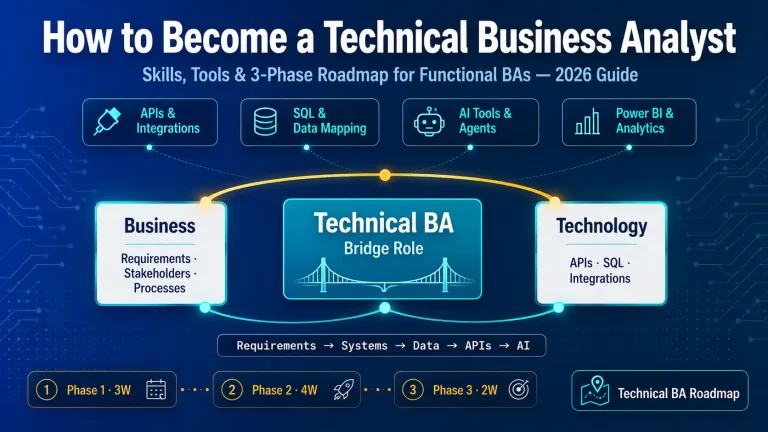
This is the full roadmap behind the Technical BA course, from first principles to your first 90 days.