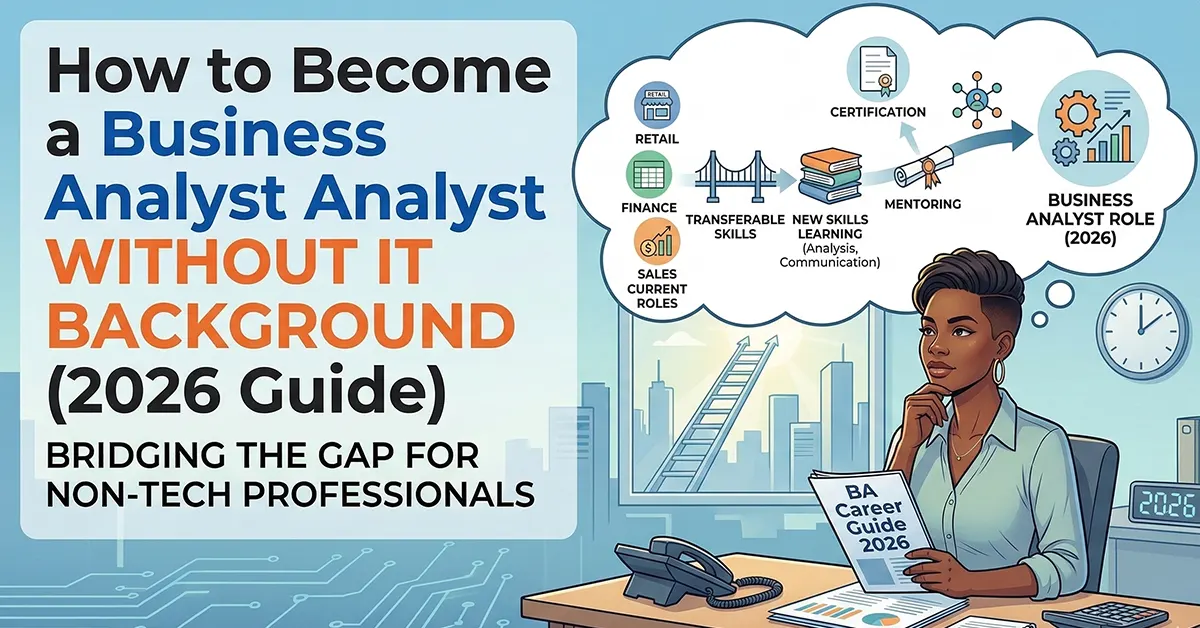
How to Become a Business Analyst Without IT Background (2026 Guide)
Here is a scenario you might recognise. You have spent five years in banking, HR, marketing, or supply chain. You understand how your organisation works — the processes, the inefficiencies, the gaps no one seems to fix. You have heard about Business Analysis as a career, and it sounds like exactly what you already do — just with a title.
Wondering how to become a business analyst without IT background? You are not alone — and the answer is a confident yes — and not just as a consolation. Professionals from non-IT backgrounds are actively preferred in many Business Analyst roles, because the most critical BA skill is not technical knowledge. It is the ability to understand a business problem deeply and communicate it clearly.
In this guide, we will walk you through exactly how to become a business analyst without IT background — the challenges, the skills you need, and the fastest path to making the switch.
First: Let’s Clear the Biggest Misconceptions
Most non-IT professionals avoid Business Analysis because of beliefs that simply are not true. Here is what the reality looks like:
| What People Believe | What Is Actually True |
| You must know programming | Programming is NOT required for most BA roles |
| Only CS/IT graduates can apply | Any graduate with domain knowledge can apply |
| You need to understand system architecture | You need to understand business problems — tech teams handle architecture |
| Non-IT people start from zero | Your finance, HR, or ops experience is a head start |
| It takes years of IT experience to qualify | With the right certification (ECBA), you can transition within months |
1. What Does a Business Analyst Actually Do?
Business Analysis is fundamentally about understanding how a business works and identifying how it can work better. A Business Analyst does not build software — they define what the software (or any solution) needs to do and why.
In practice, a BA spends their time:
- Talking to stakeholders across business and technical teams
- Understanding the current state of a process or system
- Identifying inefficiencies, gaps, and opportunities for improvement
- Writing clear requirements so that technical teams know what to build
- Validating that the final solution actually solves the original problem
Notice: none of that requires writing code. What it requires is deep listening, logical thinking, clear communication, and strong documentation — skills that people in finance, HR, operations, and marketing use every single day.
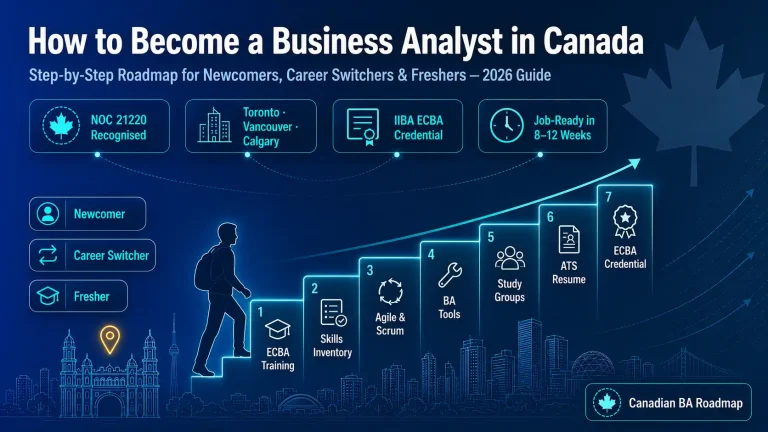
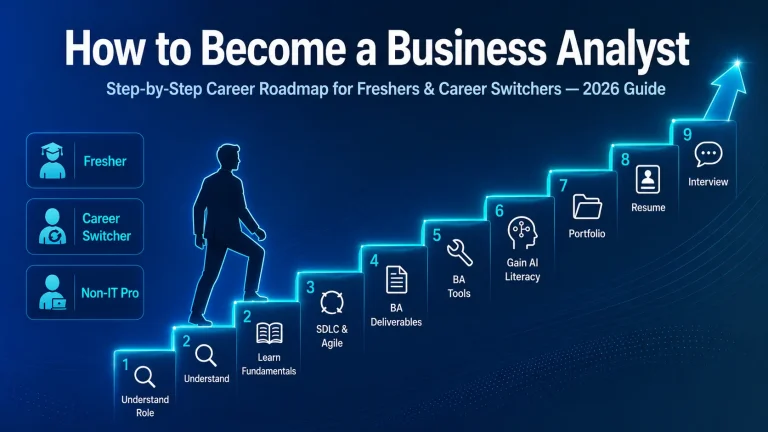
How to Become a Business Analyst in 2026
Explore our ultimate, step-by-step roadmap designed specifically for freshers and non-IT career switchers. Master the essential skills, tools, and certifications required to land your first BA role.
2. Why Non-IT Professionals Are Actually Well-Positioned
One of the biggest structural needs in modern organisations is a bridge between business teams and technology teams. Business users know the problem but cannot explain it technically. Developers know how to build but do not always understand the business context.
A Business Analyst fills that gap — and to fill it well, you need to genuinely understand the business side. That is precisely where non-IT professionals have a natural edge.
Your Domain Knowledge is Worth More Than You Think
Consider what you already bring to the table based on your background:
- A marketing professional understands customer journeys, CRM usage, campaign workflows, and data segmentation
- A finance professional understands accounting workflows, reconciliation processes, audit trails, and regulatory requirements — context that takes years to learn
- An HR professional understands hiring pipelines, onboarding flows, performance cycles, and people management — all areas where organisations increasingly deploy technology
- A supply chain professional understands end-to-end logistics, ERP systems in practice, vendor management, and operational bottlenecks
Technology can be taught in months. This depth of business understanding takes years to build. Companies often prefer a BA who already knows their industry over one who knows only tools.
3. The Real Challenges You Will Face (And How to Overcome Them)
Honesty matters here. Transitioning into BA from a non-IT background comes with real challenges. Knowing them upfront means you can prepare for them directly.
Challenge 1: Limited Technical Vocabulary
You will interact with developers, architects, and QA engineers who speak in technical terms. You are not expected to code — but you do need enough technical literacy to hold a productive conversation. This means understanding concepts like APIs, databases, system integrations, data flows, and software development lifecycles.
How to address it: Start with a structured BA training programme that covers basic IT concepts specifically for Business Analysts — not a coding course, but a business-context-focused technical orientation.
Challenge 2: Writing Structured Requirements Documents
Business Analysts produce formal documents: Business Requirements Documents (BRDs), Functional Specifications, Use Cases, User Stories, and Process Flow Diagrams using UML or BPMN standards. These formats are new for most non-IT professionals and take practice to master.
How to address it: Practise by documenting processes you already know from your current job. A banking professional can document a loan approval workflow. An HR professional can document the onboarding process. Same skill, familiar domain.
Challenge 3: Understanding Software Development Methodologies
In most technology projects, BAs work within Agile or Waterfall frameworks. You need to understand sprint cycles, backlog management, iteration planning, and how requirements evolve across project phases. Non-IT professionals are often unfamiliar with these structured methodologies.
How to address it: An ECBA certification or a structured BA course will cover these methodologies in the context of business analysis work — not just theory.
Ready to start? → Explore the ECBA Training at Techcanvass
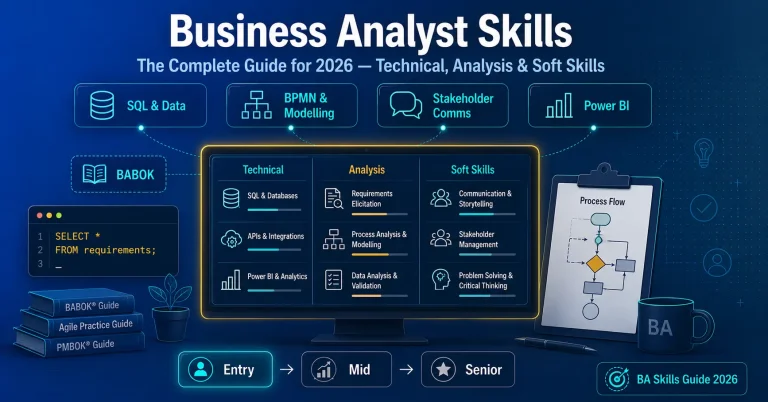
4. Core Skills You Need to Build
The following skills are the foundation of any Business Analyst role. The good news: most non-IT professionals already have several of these from their current careers.
Communication and Stakeholder Management
A BA is constantly communicating — conducting workshops, running interviews, presenting requirements to technical teams, and managing expectations across different stakeholder groups. This is where professionals from client-facing or team-based roles have an immediate advantage.
Requirements Elicitation and Documentation
This is the technical core of BA work. It involves drawing out requirements through structured techniques such as stakeholder interviews, focus groups, surveys, observation, and workshops — and then documenting them in formats like user stories, use cases, and process diagrams.
Process Modelling
BAs use standardised visual notations to map business processes. The two primary standards are UML (Unified Modelling Language) and BPMN (Business Process Model and Notation). These can be created in tools like MS Visio, Lucidchart, or draw.io.
Data Literacy
In 2026, almost every BA role involves some level of data. You do not need to be a data scientist, but you need to be comfortable reading dashboards, querying basic data, understanding data flows between systems, and working with tools like Excel or Power BI. If data analysis interests you, the CBDA certification from IIBA is worth exploring as a progression.
Functional Testing and UAT
Business Analysts often participate in or lead User Acceptance Testing (UAT) — verifying that the solution delivered matches the requirements that were documented. This involves writing test scenarios, coordinating with business users, and logging defects.
5. Which BA Roles Match Your Background?
One of the smartest moves for a non-IT professional is to target BA roles within your existing industry first. Your domain knowledge becomes your differentiator, and you are not competing with IT professionals on their home turf.
| Your Background | Natural BA Roles to Target | Your Advantage |
| Finance / Banking | Banking BA, Financial Systems BA | Domain knowledge of regulations & risk |
| HR / Ops | Process Analyst, Change Management BA | Deep understanding of workflows & people |
| Marketing | CRM BA, Digital Transformation BA | Customer journey & behaviour insight |
| Supply Chain / Logistics | Operations BA, ERP Business Analyst | End-to-end process knowledge |
| Healthcare | Healthcare IT BA, Clinical Systems BA | Patient workflow & compliance knowledge |
| Education | EdTech BA, Learning Systems Analyst | Communication, documentation, structure |
6. How to Become a Business Analyst Without IT Background: Step-by-Step
This is the practical path most successful non-IT to BA career switchers follow. Timelines are indicative — they will vary based on your starting point and time commitment.
| Phase | Action | Timeline | What to Do |
| Step 1 | Understand what Business Analysts actually do | Months 1–2 | Read BABOK overview, follow BA communities on LinkedIn |
| Step 2 | Identify your domain strength | Month 1 | Map your current experience to BA roles (use table above) |
| Step 3 | Learn core BA skills | Months 2–4 | Requirements elicitation, use cases, user stories, process modelling (UML/BPMN) |
| Step 4 | Get familiar with key tools | Months 3–5 | MS Visio, JIRA, Excel/Power BI, SQL basics, data visualisation |
| Step 5 | Earn an entry-level certification | Months 4–6 | ECBA certification — designed specifically for non-IT professionals |
| Step 6 | Build a portfolio project | Months 5–7 | Document a real or simulated business process improvement case study |
| Step 7 | Start applying + networking | Month 6 onwards | Target BA roles in your own industry first — your domain knowledge is the differentiator |
7. Should You Get a Business Analysis Certification?
For non-IT professionals, a structured certification is not just helpful — it is often the deciding factor that gets your CV shortlisted. Here is why:
- It is internationally recognised, which matters if you are targeting roles in Canada, the UK, the US, or Australia
- It signals to employers that you are serious and have acquired structured BA knowledge
- It gives you a recognised credential to compensate for the absence of IT experience on your CV
- It covers the core body of knowledge (BABOK) that defines what Business Analysts do across industries
ECBA — The Ideal Starting Point for Non-IT Professionals
The Entry Certificate in Business Analysis (ECBA) from IIBA (International Institute of Business Analysis) is specifically designed for people entering the BA profession — regardless of background. It requires no prior BA work experience, which makes it the right starting point for career switchers.
Key details about ECBA:
- Recognised by employers across industries worldwide
- No work experience requirement
- 21 hours of professional development (PD) required before applying
- Based on the BABOK Guide — the global standard for Business Analysis
An ECBA certification is specifically designed to help you learn how to become a business analyst without IT background, giving you a structured foundation that employers recognise.
Prepare for ECBA → Explore the ECBA Training at Techcanvass
What Comes After ECBA?
Once you have BA work experience, the natural certification progression is:
- CBDA (Certification in Business Data Analytics) — if your role moves towards data-driven BA work
- CCBA (Certification of Capability in Business Analysis) — for professionals with 2–3 years of BA experience
- CBAP (Certified Business Analysis Professional) — the senior-level global certification, typically pursued with 5+ years of experience
- AAC (Agile Analysis Certification) — if you work in Agile environments
8. Career Growth Paths from Business Analysis
One reason Business Analysis appeals to non-IT professionals is the breadth of career options it opens up. You are not locked into a single technical specialisation. Based on your strengths, you can grow in multiple directions:
- Senior Business Analyst → Lead BA → BA Manager
- Product Owner / Product Manager (especially if you enjoy Agile environments)
- Process Consultant or Business Process Manager
- Data or BI Analyst (if you develop strong data skills)
- Project Manager or Programme Manager
- Strategy or Operations roles at senior levels
This flexibility is rare. It means you can shape your career trajectory based on what you genuinely enjoy — whether that is working with people, data, processes, or strategy.
9. On Self-Doubt: Confidence Comes from Doing, Not from Background
The most common barrier is not skill — it is a question: “Will technical teams respect me if I don’t come from IT?”
The reality is that respect in Business Analysis is earned through clarity of thinking, quality of requirements, and the ability to ask the right questions at the right time. These are not things you are born with or acquire in a CS degree. They are built through practice.
Most successful BAs today did not start in IT. They started in banking, operations, customer service, or supply chain. Their credibility came from doing the work well — not from the background they came from.
Frequently Asked Questions
Conclusion
In Conclusion: Business Analysis Is a Thinking Career, Not a Technical One
Business Analysis in 2026 belongs to people who ask good questions, understand how organisations work, and can translate complexity into clarity. None of that requires a programming background.
If you come from finance, HR, marketing, operations, or any other non-IT field, you are not starting from zero. You are bringing years of domain expertise that many IT-trained BAs spend years trying to acquire. The structured skills — requirements writing, process modelling, certification knowledge — can be learned. Your business experience cannot be fast-tracked.
The practical path is straightforward: understand what the role requires, build the foundational skills, earn your ECBA certification, and start in the industry you already know. From there, the career grows.
Business Analysis is no longer a career for IT people. It is a career for people who understand business.
Start your BA career today → Explore ECBA Certification Training and Business Analysis Courses at Techcanvass