
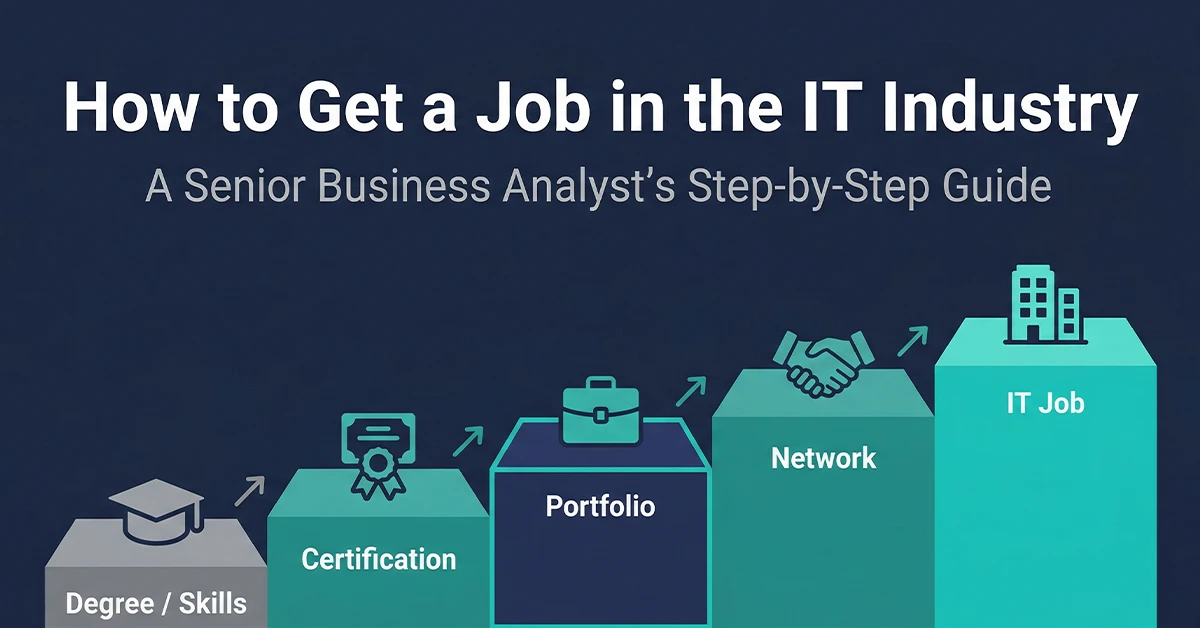
Learning how to get a job in the IT industry is one of the most valuable career decisions you can make today — whether you are a fresh graduate or a professional looking for a career pivot, the IT landscape offers a place for everyone. Many people assume that “IT” only means writing code in a dark room. As a Senior Business Analyst with over a decade of experience, I can tell you that this is a myth.
The tech world is a massive ecosystem. It needs developers, yes, but it also needs thinkers, planners, and communicators. This guide will walk you through securing a job in the IT field using a tried-and-true approach. I’ll also explain why becoming a Business Analyst is a particularly dynamic and fulfilling career choice.
1. Grasp the Varied Tech Career Avenues
First things first: figure out your place in the tech landscape.
The IT industry is divided into several specialized fields. You do not need to be an expert in all of them, but you should know what they are.
- Software Engineering: This involves building the actual applications and websites we use. You use programming languages like Python, Java, or JavaScript.
- Cloud computing shifts the responsibility for servers and storage from your office’s physical machines to the internet.
- Cybersecurity: With more data online, companies need experts to protect them from hackers and digital threats.
- Data scientists and analysts sift through vast datasets, hunting for trends and insights. Their efforts enable companies to make better decisions, backed by reliable data.
- Business analysis is where I shine. We act as the crucial bridge, linking business leaders with the technical experts. Our primary responsibility is to ensure the software being built effectively solves the company’s unique problems.
2. Why Business Analysis is a Vibrant Career Choice
If you enjoy solving puzzles and talking to people, Business Analysis is a fantastic option. Many people find the idea of staring at code all day boring. As a Business Analyst, your day is never the same.
One morning you might be meeting with a CEO to discuss a new product idea. In the afternoon, you could be working with a team of developers to map out how that idea will work technically. You are a translator. You take a messy business problem and turn it into a clear set of instructions for the tech team.
The demand for this role is skyrocketing because projects often fail when there is poor communication. Companies are willing to pay high salaries to someone who can prevent those mistakes. It is a career that offers a perfect mix of strategy, technology, and human interaction.
3. Build Your Foundational Tech Skills
Even if you choose a non-coding role, you must be “tech-literate.” You need to understand how computers and software work at a basic level.
Learn the Basics of Data
Almost every IT job requires some knowledge of data. You should learn the basics of SQL (Structured Query Language). This is a tool used to talk to databases. It is much easier to learn than a full programming language but just as valuable.
Master Collaboration Tools
In the modern workplace, we use specific tools to stay organized. Learn how to use Jira for task tracking and Confluence for documentation. If you want to be a Business Analyst, learn how to create flowcharts using tools like Microsoft Visio or Lucidchart.
Understand Software Development Lifecycles
You should know how software is made from start to finish. Most companies use a method called “Agile.” Research what a “Sprint” is and learn about the roles of a Product Owner and a Scrum Master. This knowledge will make you sound like an insider during your interviews.
4. Get the Right Certifications
Certifications help you get past the initial resume filters. They prove you have a baseline level of knowledge.
- For General IT: The CompTIA A+ is a classic starting point for hardware and support.
- For Cloud: The AWS Certified Cloud Practitioner is very popular right now.
- For those in business analysis, consider the ECBA (Entry Certificate in Business Analysis) offered by the IIBA. This credential carries weight internationally, signaling a commitment to the field.
- For project managers, earning a Certified Scrum Master (CSM) certification can be a real advantage.
5. Build a Portfolio of Actual Work
Employers are interested in your abilities, not just your academic background. This is the essence of the “Show, Don’t Tell” approach when seeking employment.
Developers, put your code on GitHub.
If you are aiming for a Business Analysis role, create a “Case Study.” Choose a well-known app, like Uber, and write a brief document explaining how you would add a new feature to it. Include a flowchart and a list of requirements. This demonstrates your ability to think critically, which is essential for this position.
6. Optimize Your Resume and LinkedIn Profile
Your resume is your first impression. Make it count. Most large companies use software called an Applicant Tracking System (ATS) to read your resume. If your resume is too fancy or uses strange fonts, the software might reject it.
- Use Keywords: Read the job description carefully. If they mention “Agile methodologies” three times, make sure that exact phrase is on your resume.
- Quantify Your Achievements: Instead of saying “I helped the team,” say “I reduced project documentation time by 20% through better templates.”
- LinkedIn is Mandatory: Your LinkedIn profile should be a more detailed version of your resume. Connect with people in the industry and share articles related to your field. This shows you are active in the tech community.
7. The Power of Networking
The best jobs are often found through the “hidden job market.” This means the job was filled before it was even posted on a website. How do you find these? Through people.
Don’t just ask for a job. Instead, ask for an “informational interview.” Find a Senior Business Analyst or a Lead Developer on LinkedIn and send a polite message. Say, “I am starting my career in IT and I admire your work. Would you have ten minutes for a quick chat about your journey?” People love to give advice. One of these chats could lead to a referral, which is the fastest way to get hired.
8. Prepare for the IT Interview Process
IT interviews can be intense. They usually have a few stages.
- The Phone Screen: A recruiter checks if you meet the basic requirements.
- The Technical Round: You might have to solve a coding problem or explain a technical process. If you are applying for a BA role, they might give you a business problem and ask you to break it down.
- The Behavioral Round: They want to know how you work with others. Use the STAR method (Situation, Task, Action, Result) to answer questions like “Tell me about a time you dealt with a difficult coworker.”
9. Apply for the Right Entry-Level Roles
Don’t be afraid to start at the bottom. The goal is to get your foot in the door. Common entry-level titles include:
- IT Support or Help Desk: A great way to learn the technical basics.
- Junior Business Analyst: You will assist senior BAs with data and documentation.
- QA (Quality Assurance) Tester: You find bugs in software before it is released. It is a perfect way to learn how software is built.
- Technical Writer: If you are good at writing, you can create the manuals and guides for new software.
10. Conclusion: Stay Curious and Keep Learning
The IT industry moves fast. What is popular today might be old news in two years. To succeed, you must have a “growth mindset.” This means you are always willing to learn a new tool or a new way of working.
As a Senior Business Analyst, I still take courses every year to stay sharp. The rewards of this industry are worth the effort. You get to work on products that change people’s lives, earn a great living, and work with some of the smartest people in the world. Start with one small step today. Research a certification or reach out to one person on LinkedIn. Your career in IT is waiting for you.
Start your IT career as a Business Analyst
The ECBA Certification is the globally recognised entry point for professionals entering Business Analysis. Techcanvass’s IIBA-endorsed training covers everything you need — BABOK fundamentals, elicitation techniques, requirements documentation, and interview preparation — to land your first IT role with confidence.
Enroll in ECBA Training →In This Article
