
Quick Answer
A Business Analyst (BA) is a professional who bridges the gap between business stakeholders and technology teams — translating business needs into detailed requirements that software projects can be built from. To become a Business Analyst in 2026, the path follows seven steps: assess your current skills, learn core BA tools and methodologies, earn a recognised certification (ECBA for beginners), gain hands-on project experience, build your resume with the right keywords, prepare for interviews, and start applying. No IT background or coding skills are required for most BA roles.
Business Analyst — Key Career Facts (2026)
| Fact | Detail |
|---|---|
| Average salary — India (entry level) | ₹4–7 LPA (Glassdoor India, 2025) — rising to ₹8–14 LPA at mid-level (3-5 years) |
| Average salary — Global | $75,000–$95,000 USD (IIBA Global Salary Survey 2024) — varies by country and domain |
| Degree required | No — BAs come from all backgrounds: IT, finance, operations, sales, marketing, teaching, humanities |
| Coding required | No for IT BA (most common type). Yes for Data Analytics BA and Reporting BA specialisations |
| Entry-level certification | ECBA (Entry Certificate in Business Analysis) from IIBA — the global standard for BA beginners |
| Mid-level certification | CCBA or CBAP from IIBA — requires 2-5 years of BA experience respectively |
| Key tools | Excel, SQL (basic), Power BI or Tableau, JIRA, Confluence, Visio/Lucidchart, MS Word for BRDs |
| Job market demand | Consistently top 10 most in-demand IT roles in India (LinkedIn India Jobs Report 2024-2025) |
In This Article
Who is a Business Analyst and What Do They Do?
A Business Analyst is the bridge between business stakeholders and the technology team — understanding what the business needs, translating those needs into detailed requirements, and ensuring the technology team builds the right solution. Unlike a Project Manager who manages timelines and resources, or a Developer who writes code, the BA’s role is requirements — gathering them, documenting them, validating them, and managing them through the project lifecycle.
Business Analyst Responsibilities and Deliverables
| BA Responsibility | What It Involves | Deliverable |
|---|---|---|
| Requirements Elicitation | Conduct workshops, interviews, and process observations with business stakeholders to capture what they need from a system or process change. | Business Requirements Document (BRD) / Stakeholder Requirements |
| Requirements Analysis | Analyse and detail the captured requirements — identify gaps, conflicts, and ambiguities; define scope boundaries. | Functional Requirements Document (FRD) / System Requirements Specification (SRS) |
| Process Modelling | Document current-state and future-state business processes using diagrams (BPMN, flowcharts, UML use cases). | Process Flow Diagrams, Use Case Diagrams, Activity Diagrams |
| Stakeholder Management | Manage relationships between business stakeholders, development team, QA, and project manager — facilitate alignment when conflicts arise. | RACI matrix, Stakeholder Register, Meeting Minutes |
| Requirements Validation | Work with QA team to create test cases from requirements; participate in UAT to verify delivered solution meets original requirements. | Test Cases, UAT Scripts, Sign-off Documentation |
| Change Management | Manage scope changes formally — assess impact, get approvals, update requirements documentation. | Change Request Log, Impact Assessment |
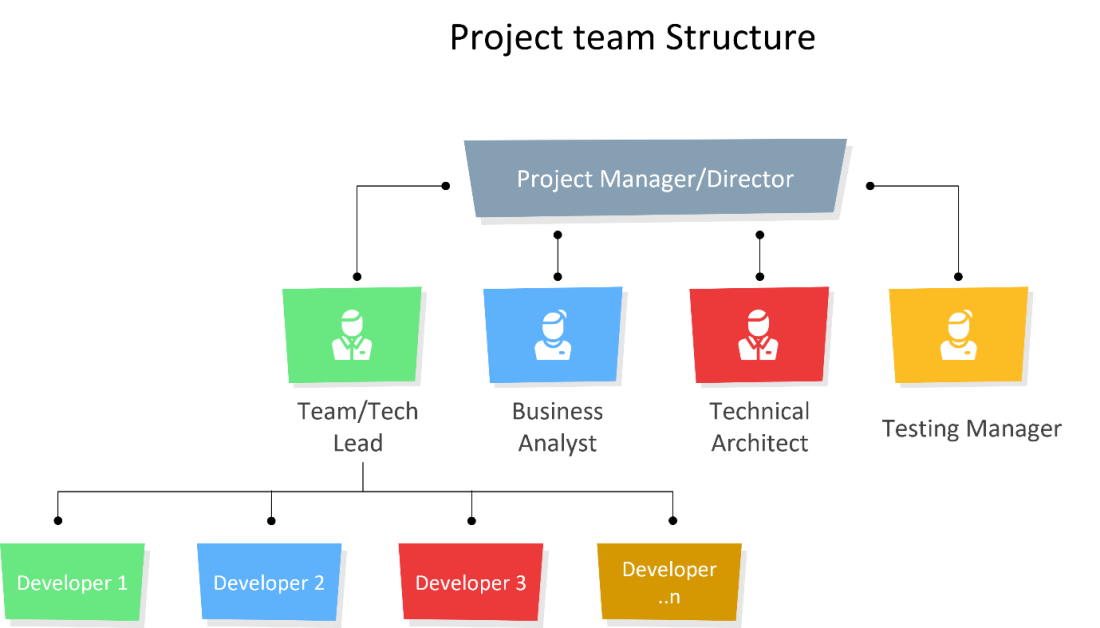
A BA is NOT a Project Manager (the PM manages timeline, budget, resources). A BA is NOT a Developer (developers write code; BAs write requirements). A BA is NOT a Tester (QA tests; BAs define what should be tested). Understanding this distinction prevents the most common confusion career-changers have when exploring the Business Analyst roles and responsibilities.
Business Analyst Roadmap 2026 — 7 Steps
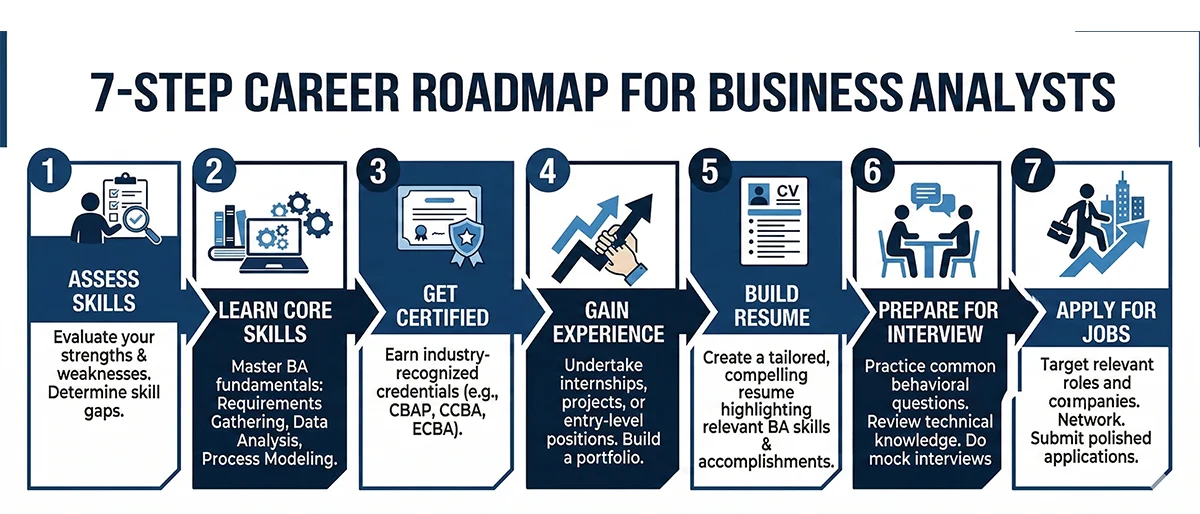
Step 1 — Assess Your Current Skills and Identify Gaps
Before investing in training or certifications, take stock of what you already have. Many professionals entering BA from non-IT backgrounds have transferable skills they don’t recognise as BA-relevant. A finance professional has data analysis and stakeholder reporting skills. A sales professional has client communication and requirement discovery skills. A teacher has facilitation and documentation skills.
Switching to BA — Background vs Skills to Leverage
| Background | Transferable Skills Already Present | Skills to Learn |
|---|---|---|
| Finance / Accounting | Data analysis, report creation, stakeholder reporting, process documentation | UML diagrams, software project lifecycle, JIRA/Confluence, agile methodology |
| Operations / Supply Chain | Process mapping, efficiency analysis, vendor management, cross-functional coordination | Requirements documentation, use cases, user stories, BA tools |
| Sales / CRM | Client communication, needs discovery, solution presentation, relationship management | Technical requirements, data modelling basics, software testing fundamentals |
| IT / Developer | Technical understanding, system architecture awareness, testing knowledge | Business communication, stakeholder management, requirements elicitation, BA documentation |
| Teaching / Training | Facilitation, documentation, communication, curriculum design | Domain knowledge, business process analysis, technical tools |
Step 2 — Learn Core BA Skills and Tools
The core BA skill set has two layers: methodology skills (how BAs do their work) and tool skills (what BAs use to do it). Both are needed — methodology without tools creates undocumented analysis; tools without methodology creates data without insight.
Business Analyst Core Skills — What to Learn and Why
| Skill Area | What to Learn | Why It Matters |
|---|---|---|
| Requirements Elicitation | Techniques: interviews, workshops, observation, JAD sessions, surveys, prototyping | Every BA project starts here — the quality of requirements determines project success or failure. |
| Process Modelling | BPMN notation, UML (use cases, activity diagrams, sequence diagrams), flowcharting in Lucidchart/Visio | Process diagrams are a BA’s primary communication tool with both business and development teams. |
| Agile Methodology | Scrum framework, user stories, sprint planning, backlog grooming, acceptance criteria | Most IT projects now run on agile — BAs who understand Scrum are significantly more effective. |
| Data Analysis Basics | Excel (pivot tables, VLOOKUP, basic formulas), SQL basics (SELECT, WHERE, JOIN, GROUP BY) | BAs validate data requirements; basic SQL and Excel allow independent data verification. |
| Documentation Tools | MS Word (BRD/FRD templates), JIRA (requirements as stories/epics), Confluence (wiki documentation) | BA deliverables are documents — professional formatting and tool proficiency is a job requirement. |
| Visualisation Tools | Power BI or Tableau basics, Excel charts, prototype tools (Balsamiq, Figma for wireframes) | Reporting BAs need visualisation tools; even non-reporting BAs use prototypes for requirements validation. |
Step 3 — Get Certified
For entry-level candidates, the IIBA ECBA (Entry Certificate in Business Analysis) is the global standard. It validates foundational BA knowledge and is recognised by employers across India, the US, UK, Canada, and Australia. Unlike CBAP (which requires 5 years of experience), ECBA has no experience requirement — making it the right starting point for career changers and freshers.
Top Business Analysis Certifications — Global Standards
| Certification | Body | Level | Experience Required | Best For |
|---|---|---|---|---|
| ECBA | IIBA | Entry Level | None | Freshers and career changers starting their BA journey |
| CCBA | IIBA | Intermediate | 2 years of BA work experience | BAs with 2+ years looking to validate mid-level competency |
| CBAP | IIBA | Senior | 5 years of BA work experience | Experienced BAs targeting senior roles and leadership positions |
| PMI-PBA | PMI | All levels | Varies | BAs working in PMI/PMP-aligned organisations and project environments |
Techcanvass’s ECBA Training course is designed specifically for career changers and freshers — covering all BABOK knowledge areas with practical exercises and mock exams. ECBA-certified BAs earn 20-30% more than non-certified candidates at entry level.
Step 4 — Gain Hands-On Experience
Experience is the most common barrier for career changers — ‘how do I get experience without a job and how do I get a job without experience?’ There are three practical paths:
- Internal transitions — If you are currently in an IT company in operations, QA, or project coordination, approach your manager about involvement in BA activities on an upcoming project. Many BAs get their first BA experience by volunteering on internal projects.
- Internships — 6-month BA internships provide real project experience and dramatically improve resume quality. Even unpaid or low-paid internships are worth the trade-off at the entry level. Platforms: Internshala, LinkedIn, Indeed India, and direct outreach to small IT firms.
- Training projects — Quality BA training programmes include capstone projects on real or simulated datasets. Techcanvass’s ECBA training includes live project work that produces portfolio-ready BRD and FRD deliverables.

Step 5 — Build a BA-Optimised Resume
BA hiring in India and globally now involves ATS (Applicant Tracking System) screening before human review. Your resume must include exact keywords that ATS systems and recruiters search for. Key BA resume keywords: Business Requirements Document (BRD), Functional Requirements Specification (FRS/FRD), Use Case, User Story, Stakeholder Management, Gap Analysis, Process Flow, JIRA, Confluence, Agile, Scrum, UML, BABOK, ECBA (if certified), and any domain keywords (healthcare, banking, insurance, BFSI, e-commerce).
Step 6 — Prepare for BA Interviews
BA interviews test three things: domain knowledge (do you understand the industry?), methodology knowledge (do you understand how BA work is done?), and scenario judgment (can you think through a business problem in real time?). Prepare for these question types: ‘What is the difference between a BRD and an FRD?’, ‘How do you handle a stakeholder who keeps changing requirements?’, ‘Walk me through your requirements elicitation process’, ‘What is a use case? Give an example.’, ‘What is the difference between functional and non-functional requirements?’
Step 7 — Apply for BA Jobs Strategically
Target entry-level and junior BA titles: Junior Business Analyst, Associate Business Analyst, Business Analyst Trainee, Systems Analyst, Business Systems Analyst, Requirements Analyst. Don’t apply exclusively to ‘Business Analyst’ roles — many entry-level BA openings use adjacent titles. Job platforms by market:
BA Job Search Guide — Platforms and Keywords by Market
| Market | Primary Job Platforms | Search Terms to Use |
|---|---|---|
| India | LinkedIn, Naukri.com, Foundit (formerly Monster India), Shine.com, Freshersworld (for freshers) | Junior Business Analyst, Associate BA, Business Analyst Fresher, BA Trainee, Systems Analyst |
| USA | LinkedIn, Indeed, ZipRecruiter, Glassdoor, Dice (for tech roles) | Business Analyst, Junior BA, Business Systems Analyst, Product Analyst, Requirements Analyst |
| UK / Australia / Canada | LinkedIn, Indeed, Reed (UK), Seek (Australia), Workopolis (Canada) | Business Analyst, Business Systems Analyst, BA Consultant, Digital Business Analyst |
Skills Required to Become a Business Analyst in 2026
Business Analyst Skills & Priority Level (2026)
| Skill Category | Specific Skills | Priority Level |
|---|---|---|
| Core BA Methodology | Requirements elicitation (interviews, workshops, observation, JAD sessions), Use case writing, User story writing, Gap analysis, Scope definition, BRD/FRD documentation, Process modelling (BPMN, UML, flowcharts) | Essential — every BA role requires these |
| Communication and Soft Skills | Stakeholder facilitation, Active listening, Written communication (clear requirements documentation), Presentation skills, Negotiation (managing conflicting stakeholder needs), Critical thinking | Essential — BAs communicate more than they analyse |
| Agile and Project Methodology | Scrum framework, Sprint planning and backlog grooming, Acceptance criteria writing, Waterfall SDLC understanding, Hybrid agile approaches | Essential for IT BA — 80%+ of IT projects use agile |
| Data and Analytics | Excel (pivot tables, data validation, basic formulas), SQL basics (SELECT/WHERE/JOIN/GROUP BY), Data modelling concepts, Basic statistics for data interpretation | Required for data analytics BA; strongly preferred for IT BA |
| Visualisation and Prototyping | Power BI or Tableau (basic level), Wireframing tools (Balsamiq, Figma), Process diagram tools (Lucidchart, Visio, Draw.io) | Required for reporting BA; useful for all BA types |
| Domain Knowledge | Banking/BFSI domain, Healthcare domain, Insurance domain, E-commerce/retail — choose one based on career target | Good to have at entry level; essential for senior BA roles — domain-specific BAs earn 15-25% more |
| Tools | JIRA (project and requirements tracking), Confluence (documentation wiki), MS Office Suite (Word, Excel, PowerPoint), SharePoint, Slack or Teams | Employers assume proficiency — listed in 90%+ of BA job descriptions |
Want the complete 2026 BA career guide in one document? Download the free PDF — covers roadmap, skills, certifications, and salary data.
How to Become a Business Analyst in 2026: A Complete Guide
A step-by-step guide — roadmap, core skills, and how AI changes the BA role.
Types of Business Analysts in 2026
Business Analyst Specialisations — Comparison
| Type | Primary Focus | Skills Required | Coding Required? | Certification |
|---|---|---|---|---|
| IT Business Analyst (most common) | Requirements gathering, BRD/FRD documentation, stakeholder management, process modelling — working with software development teams to deliver IT projects | Core BA methodology, UML, agile, JIRA, domain knowledge | No — non-programming role | ECBA/CCBA/CBAP (IIBA) |
| Data Analytics Business Analyst | Working on data analytics and data science projects — defining analytics requirements, interpreting model outputs, translating data insights into business actions | Excel, SQL, Python basics, machine learning concepts, Power BI/Tableau | Yes — Python and SQL required | CBDA (IIBA) or DA certifications |
| Reporting Business Analyst | Defining and delivering reporting requirements — from simple KPI dashboards to complex data warehouses and BI analytics platforms | Power BI or Tableau (intermediate), data warehouse concepts, ETL basics, SQL | SQL required; Python optional | Power BI PL-300 or Tableau Desktop Specialist |
For career changers: Start with IT Business Analyst. It is the most common type, has the lowest technical bar, is what ECBA/CBAP certifications primarily cover, and offers the broadest range of industries (banking, healthcare, insurance, e-commerce, manufacturing). Once you have 2-3 years of IT BA experience, specialising into data analytics or reporting BA significantly increases your earning potential.
Does a Business Analyst Need to Know Coding?
The short answer: No, coding is NOT required for most Business Analyst roles. But the longer answer depends on which type of BA you are targeting.
Coding Requirements by Business Analyst Type
| BA Type | Coding Requirement | Why |
|---|---|---|
| IT Business Analyst |
❌ No coding required
|
IT BAs write requirements documents — they describe WHAT the system should do, not HOW to build it. Developers write the code; BAs write the specification. |
| Data Analytics Business Analyst |
✅ Python and/or R required
|
Data analytics BAs need to understand machine learning models, interpret statistical outputs, and sometimes write data processing scripts alongside data scientists. |
| Reporting Business Analyst |
⚠️ SQL required; Python optional
|
Reporting BAs need SQL to query databases and validate report data. Python is useful for automating data preparation but not always mandatory. |
| Business Systems Analyst |
⚠️ Basic SQL preferred
|
BSAs work closely with database-driven systems — understanding SQL SELECT queries helps validate system behaviour against database records. |
For the majority of people reading this article — those targeting an IT Business Analyst role — the answer is a clear no. You do not need to learn Python, Java, or any programming language. What you DO need is enough technical literacy to communicate effectively with developers: understanding APIs at a conceptual level, reading a database table structure, interpreting an error message. This is not coding — it is technical awareness.
Is coding useful to learn even if not required? Yes — BAs who understand basic SQL can independently verify data requirements, which makes them significantly more effective. Basic SQL (SELECT, WHERE, GROUP BY, JOIN) takes 2-4 weeks to learn at a functional level and pays dividends throughout a BA career. It is not required but strongly recommended for long-term career growth.
How to Become a Business Analyst with No Experience
The most common barrier for aspiring BAs is the experience paradox: employers want experience, but you need a job to get experience. We have a dedicated guide on how to crack a BA job with no experience — but here is the core framework at every stage.
If You Are a Complete Fresher (0 Experience, Non-IT Background)
Target smaller IT companies and startups first — they are more willing to train entry-level BAs than large IT service firms (TCS, Infosys, Wipro) who prefer lateral hires with 2+ years experience.
Focus on ECBA certification first — it signals to employers that you have taken formal training even without work experience. Many entry-level BA job postings in India explicitly state ‘ECBA preferred’ alongside ‘0-2 years experience’.
Do a training programme that includes capstone projects — your training project becomes your ‘experience’. A BRD you wrote for a fictional banking system during training is still a BRD you can discuss in interviews.
Apply for BA Trainee and Junior BA roles explicitly — these are designed for entry-level candidates and do not expect prior BA work experience.
If You Are a Career Changer (Experience in Another Field)
Network within your current industry — companies in your existing industry are more likely to give you a BA role because they value your domain knowledge. Internal transfer to a BA role is often easier than external BA job search.
Frame your existing work as BA experience — a sales manager who gathered customer requirements and documented solution proposals has done requirement elicitation. Rewrite your experience in BA language on your resume.
Target domain-adjacent BA roles — a finance professional should target BFSI (Banking, Financial Services, Insurance) BA roles where their domain knowledge compensates for lack of formal BA title. A healthcare administrator should target healthcare IT BA roles.
If You Are an IT Professional (Developer, QA, Project Coordinator)
Developer-to-BA is the most common transition path in India — IT companies frequently move developers with good communication skills into BA roles. Speak to your project manager or HR about this possibility.
You already have the technical literacy advantage — your gap is methodology and documentation skills. ECBA training closes this gap specifically.
Transition via ‘BA activities on your current project’ — volunteer to write user stories, facilitate requirements meetings, create process diagrams. One sprint of BA activities on your current project becomes legitimate BA experience.
Business Analyst Salary in India and Globally (2026)
Business Analyst Salary in India — By Experience Level
| Experience Level | Average Annual Salary (India) | City Premium | Notes |
|---|---|---|---|
| Entry Level (0-2 years) | ₹4–7 LPA | Bengaluru, Hyderabad, Pune: +20-30% above average | ECBA certification adds ₹50K-1L premium at entry level |
| Mid Level (3-5 years) | ₹8–14 LPA | Mumbai, Delhi NCR: slightly above Bengaluru for BFSI domain | Domain specialisation (banking, healthcare) commands ₹1-3L premium |
| Senior Level (6-10 years) | ₹15–25 LPA | All metros roughly equal at senior level | CBAP certification strongly preferred at this level — adds 15-25% salary premium |
| Lead / Principal BA (10+ years) | ₹25–45 LPA | Bengaluru and Hyderabad for IT; Mumbai for BFSI | Head of BA / BA Practice Lead roles in large IT firms |
Source: Glassdoor India, LinkedIn Salary Insights, Naukri.com salary data — 2024-2025. Data represents median; actual compensation varies by company, domain, and skills.
Business Analyst Salary — Global Comparison
| Country | Entry Level | Mid Level | Senior Level | Source |
|---|---|---|---|---|
| India | ₹4–7 LPA (~$5K-8K USD) | ₹8–14 LPA (~$10K-17K USD) | ₹15–25 LPA (~$18K-30K USD) | Glassdoor India 2025 |
| United States | $65,000–$80,000 | $85,000–$105,000 | $110,000–$140,000 | BLS / LinkedIn US 2024 |
| United Kingdom | £35,000–£45,000 | £50,000–£65,000 | £70,000–£90,000 | Glassdoor UK 2024 |
| Canada | CAD $60,000–$75,000 | CAD $80,000–$100,000 | CAD $100,000–$130,000 | LinkedIn Canada 2024 |
| Australia | AUD $75,000–$90,000 | AUD $95,000–$120,000 | AUD $120,000–$150,000 | Seek Australia 2024 |
ECBA-certified Business Analysts in India earn 20-30% more than non-certified candidates at the entry level, according to IIBA’s 2024 Global Salary Survey. Techcanvass’s ECBA Training prepares you for the ECBA exam with structured study, mock exams, and live mentoring.
Business Analyst Certifications — Which One for Beginners?
Global BA Certifications — Prerequisites and Exam Details
| Certification | Issuing Body | Level | Prerequisites | Exam Format | Best For |
|---|---|---|---|---|---|
| ECBA — Entry Certificate in Business Analysis | IIBA (International Institute of Business Analysis) | Entry | None — no experience required | 75 multiple choice questions, 2 hours, online proctored | Freshers and career changers with 0 BA experience — the recommended starting point |
| CCBA — Certification of Competency in Business Analysis | IIBA | Intermediate | 3,750 hours (2 years) of BA work experience | 130 multiple choice questions, 3.5 hours | BAs with 2+ years of experience ready to validate mid-level skills |
| CBAP — Certified Business Analysis Professional | IIBA | Senior | 7,500 hours (5 years) of BA work experience | 120 multiple choice questions, 3.5 hours | Experienced BAs targeting senior roles, consulting, and leadership positions |
| PMI-PBA — Professional in Business Analysis | PMI (Project Management Institute) | All levels | Education + 4,500 hours of BA experience (or 7,500 without degree) | 200 questions, 4 hours | BAs in organisations using PMI/PMP framework — complements PMP certification |
| CBDA — Certification in Business Data Analytics | IIBA | Intermediate | Varies | Online exam | Reporting and data analytics BAs who work with BI tools and data-driven requirements |
For 2026 beginners: Start with ECBA training. It is the only entry-level IIBA certification with no experience requirement. Study time: 3-4 months with a structured programme. The BABOK Guide v3 is the primary study material. After 2 years of work experience, CCBA is the natural next step.
Is Business Analysis a Good Career in 2026?
Business Analysis is consistently ranked among the top 10 most in-demand IT roles in India, the US, and the UK. Three structural trends make the BA role increasingly valuable rather than at risk from automation:
Business Analyst Trends and Opportunities (2026)
| Trend | Impact on BA Role | Opportunity |
|---|---|---|
| AI and automation adoption | Every AI and automation project requires a BA to define what should be automated, document the requirements, manage stakeholder expectations, and validate that the automated system does what was intended. | AI implementation projects are creating MORE BA demand, not less — AI systems need detailed requirements specification that AI itself cannot provide. |
| Digital transformation across sectors | Banking, healthcare, retail, manufacturing, and government are all undergoing digital transformation — each project in each organisation needs BA skills. | India alone has thousands of digital transformation projects underway — BA demand in BFSI, healthcare, and e-commerce is at an all-time high. |
| Data-driven decision making | Organisations investing in data analytics need BAs who can bridge the gap between business questions and data solutions — defining what data to collect, what reports to build, and what decisions the data should support. | The rise of Power BI and Tableau adoption creates specific demand for Reporting BAs and Data Analytics BAs alongside the traditional IT BA. |
Career longevity: Unlike many technology roles where specific tools become obsolete (a developer who only knows COBOL has limited options), BA skills are fundamentally human and transferable — stakeholder communication, requirements analysis, and problem structuring are not automatable. BAs who add domain expertise and data analytics skills alongside their core methodology knowledge have exceptionally strong career prospects through the 2030s.
Conclusion
Becoming a Business Analyst in 2026 is achievable from any background — IT or non-IT, engineering or arts, experienced professional or recent graduate. The path is consistent: assess your transferable skills, learn core BA methodology, earn your ECBA certification, gain practical experience through training projects or internships, and apply strategically to entry-level roles.
The most common mistake aspiring BAs make is waiting until they feel ‘ready’. The BA role is learned primarily through doing — the sooner you begin, the sooner you have the project experience that makes employers want to hire you. Start with ECBA training, get your certification, and take the first role that gives you BA responsibilities even if it isn’t titled exactly ‘Business Analyst’.

