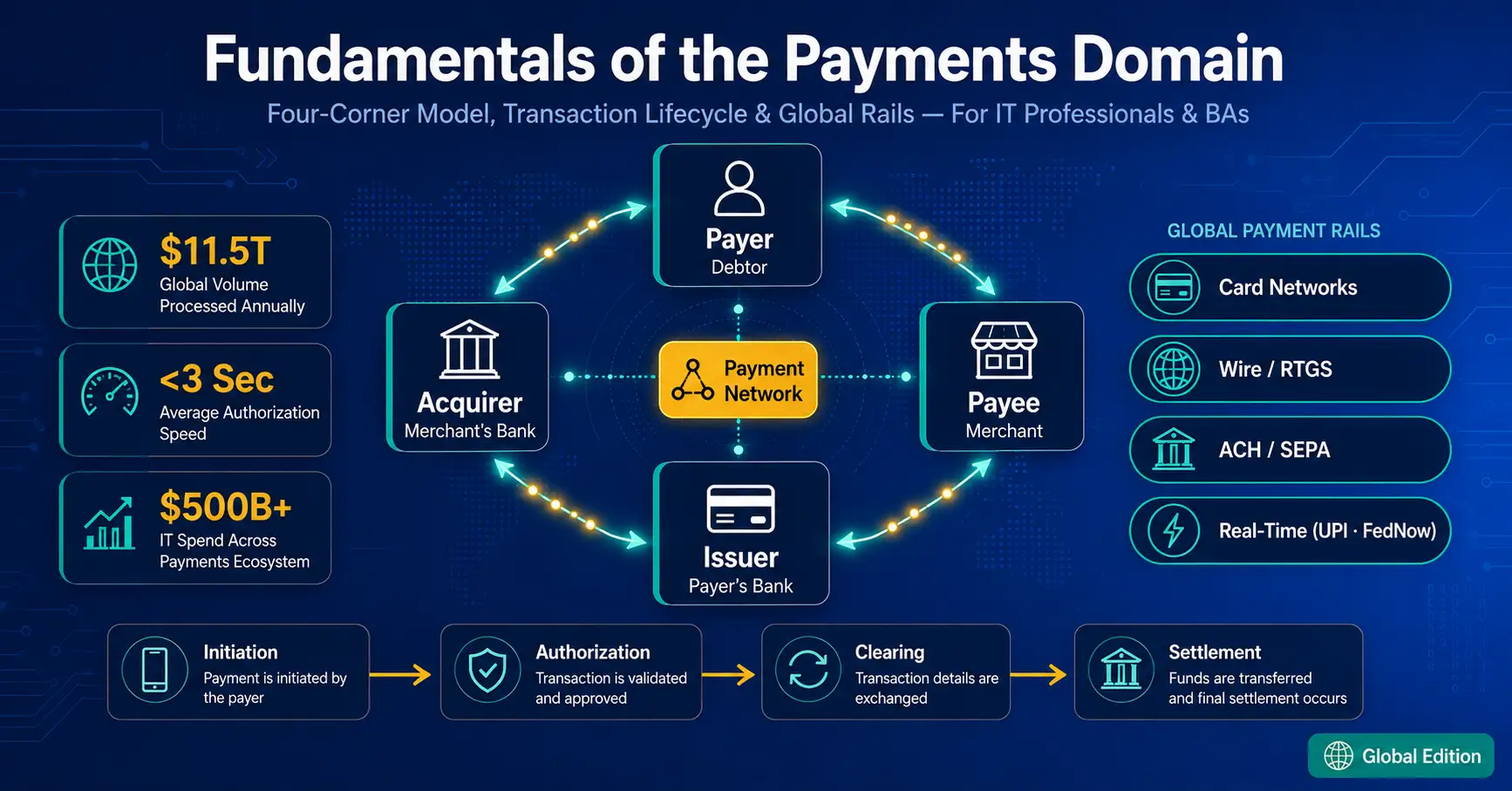
The payments domain refers to the ecosystem of systems, participants, processes, and regulations that enable money to move from one party to another. For IT professionals and Business Analysts, payments domain knowledge means understanding how payment transactions are initiated, processed, cleared, and settled — and how the technology, regulations, and business rules governing those transactions work. It is one of the core sub-sectors of the BFSI domain.
In This Article
What is the Payments Domain?
The payments domain is the industry sector encompassing all systems, institutions, technologies, and regulations involved in transferring money between parties. It sits within the broader BFSI (Banking, Financial Services, and Insurance) sector and represents one of the most technology-intensive and innovation-driven areas of financial services.
In IT and Business Analysis, the payments domain refers to a specific area of expertise — the knowledge of how payment transactions are initiated, processed, and settled; who the key participants are; what the regulatory requirements are; and what technology systems power the process. This knowledge is essential for anyone working on payments IT projects.
| Payments Domain at a Glance | |
|---|---|
| Global digital payments market size (2024) | $11.5 trillion (Statista) |
| India UPI transactions (FY 2023-24) | 131 billion transactions (NPCI) |
| Global payment industry IT spend | $500+ billion annually |
| Key India regulators | RBI, NPCI, SEBI (capital markets) |
| Key global regulators | Federal Reserve (US), FCA (UK), ECB (Europe) |
| Primary IT roles in payments | Business Analyst, Systems Architect, QA Engineer, Product Manager, Data Analyst |
The Payments Ecosystem — Key Participants
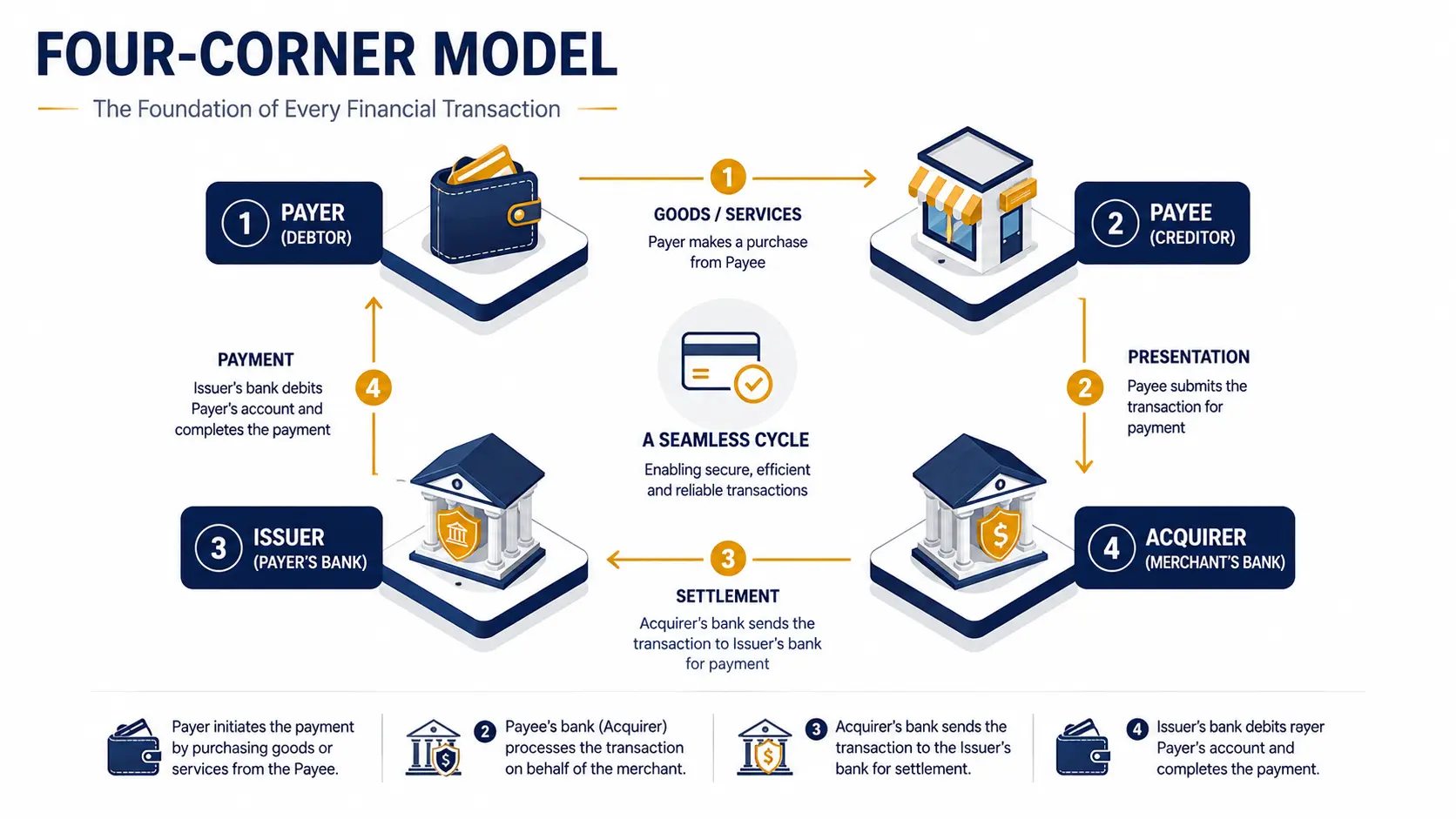
Every payment transaction involves multiple participants working together. Understanding who does what in the payment’s ecosystem is foundational knowledge for any IT professional or BA working on a payments project.
| Participant | What They Do | IT/BA Relevance |
|---|---|---|
| Cardholder / Payer | The individual or business initiating the payment — via card, app, bank transfer, or cash | End-user of payment systems; user journey starting point for digital payment projects |
| Issuing Bank (Issuer) | The bank that issued the cardholder’s card or account. Authorises transactions. Bears credit risk. | Issuer systems: card management, authorisation engine, fraud detection, statement generation |
| Acquiring Bank (Acquirer) | The merchant’s bank. Accepts payment requests on behalf of merchants and routes them through networks. | Acquirer systems: merchant management, settlement, chargeback processing, reconciliation |
| Payment Network / Card Scheme | Visa, Mastercard, RuPay, Amex — operate the network connecting issuers and acquirers. Set the rules. | Network connectivity: ISO 8583 messaging, switching, clearing, scheme compliance |
| Payment Gateway | Technology layer that securely captures and transmits payment data from merchant to acquirer | Gateway systems: API integration, tokenisation, 3DS authentication, encryption |
| Payment Processor | Handles the technical processing — routing transactions between gateway, network, and banks | Processing platforms: transaction routing, authorisation, clearing, settlement engines |
| Payment Service Provider (PSP) | Aggregates payment methods for merchants — often includes gateway + processing + settlement | PSP integration projects: merchant onboarding, multi-method routing, reconciliation dashboards |
| NPCI / Central Infrastructure | In India, NPCI operates UPI, RuPay, IMPS, NACH, FASTag — the national payments infrastructure | NPCI integration: UPI APIs, NACH mandates, IMPS routing — common in Indian banking projects |
| Merchant | Business or individual accepting payment. Has acquirer relationship and payment terminal/gateway. | Merchant management systems, POS integrations, e-commerce gateway connections |
| Regulator | RBI (India), FCA (UK), Federal Reserve (US) — sets rules, licences participants, enforces compliance | Regulatory reporting modules, compliance monitoring systems, audit trail requirements |
For Business Analysts: When you join a payments project, the first question to answer is ‘which participants does this system interact with?’ A payment gateway project has different requirements from an issuer card management project. Understanding the ecosystem map is what lets you ask the right questions from day one.
How Payment Processing Works — Authorization, Clearing, and Settlement
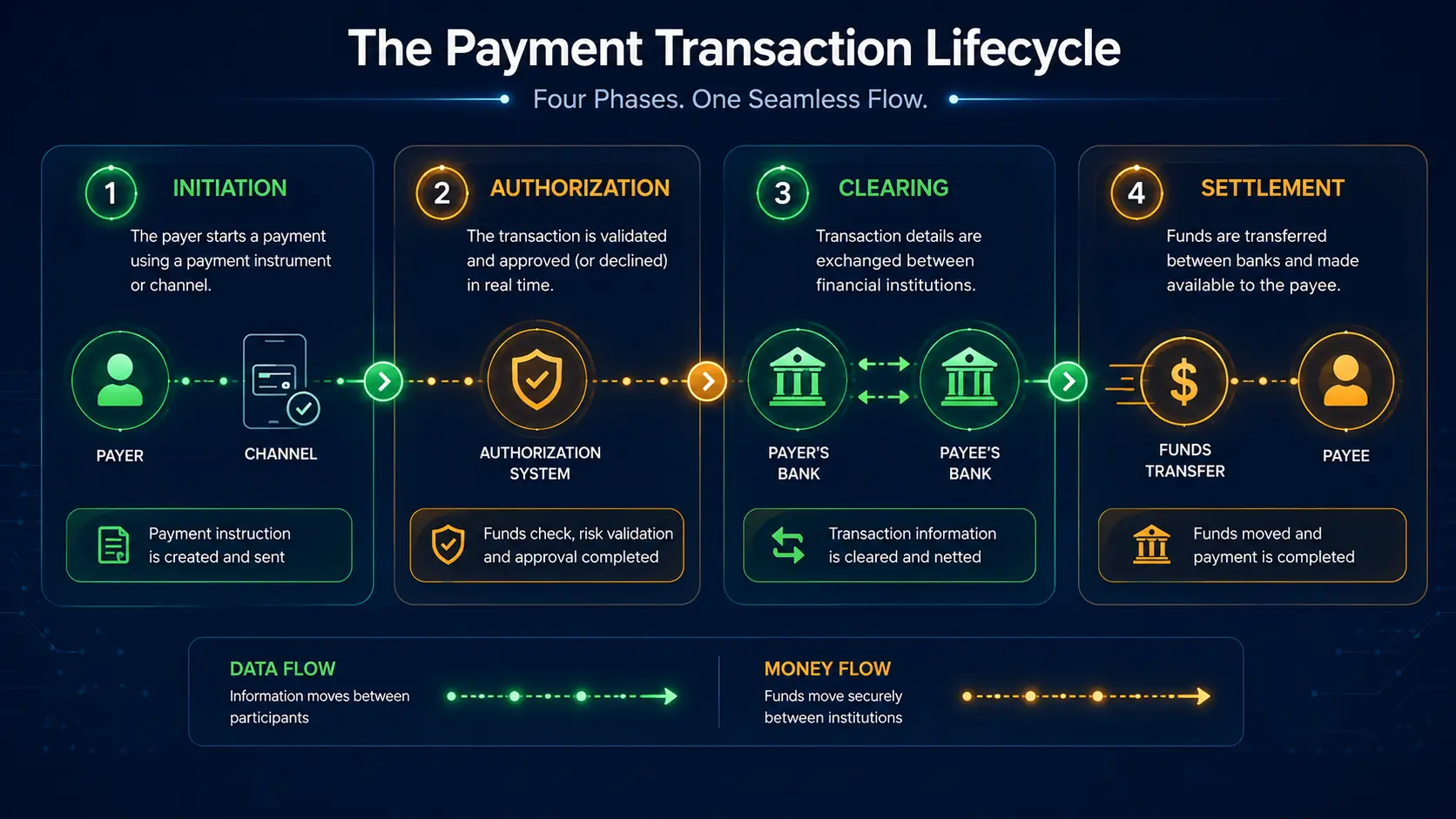
Every card payment — whether swiped at a POS terminal, entered online, or tapped via NFC — goes through three distinct phases: Authorization, Clearing, and Settlement. Understanding this three-phase flow is the most important piece of payments domain knowledge for an IT/BA professional.
Phase 1 — Authorization (Real-Time, seconds)
| Step | What Happens | System Involved |
|---|---|---|
| 1. Transaction Initiation | Cardholder presents card at POS / enters card details online | POS terminal / Payment gateway |
| 2. Gateway Capture | Gateway encrypts card data, creates authorization request (ISO 8583 message) | Payment gateway, tokenisation vault |
| 3. Routing to Network | Acquirer routes request through Visa/Mastercard/RuPay network to issuer | Payment switch, card network |
| 4. Issuer Authorization | Issuer checks: Is card valid? Sufficient funds/credit? Fraud flags? CVV match? | Issuer authorisation engine, fraud detection system |
| 5. Response | Issuer sends Approve/Decline back through same chain in milliseconds | Same path reverse — network → acquirer → gateway → merchant |
Phase 2 — Clearing (Same Day / Next Day)
After authorization, the transaction details are submitted for clearing — the process of exchanging financial information between the issuer and acquirer through the card network to calculate what each party owes.
Clearing happens in batches. Merchants submit their authorized transactions in bulk. The card network processes these, calculates interchange fees, and prepares settlement instructions. In India, the National Financial Switch (NFS) and NPCI handle clearing for domestic transactions.
Phase 3 — Settlement (T+1 or T+2)
Settlement is the actual movement of money — the acquirer receives funds (minus interchange fees) from the issuer via the card network, and then credits the merchant’s account (minus the merchant discount rate). In India, UPI and IMPS settle in real-time (T+0), while card transactions typically settle T+1 or T+2.
| Payment Type | Authorization | Clearing | Settlement | IT/BA Note |
|---|---|---|---|---|
| Credit/Debit Card (India) | Real-time (< 3 sec) | Same day batch | T+1 or T+2 | Chargeback window up to 120 days — disputes processing is complex BA territory |
| UPI | Real-time (< 2 sec) | Real-time | Real-time (T+0) | NPCI UPI switch; VPA resolution; mandate processing — largest payments IT segment in India |
| NEFT | N/A (bank transfer) | Hourly batches | Same day (T+0) | RBI-operated; bulk salary disbursement; outward/inward remittance processing |
| RTGS | N/A (bank transfer) | Real-time gross | Immediate (T+0) | High-value transactions > Rs 2 lakh; used in treasury and corporate payments |
| IMPS | Real-time | Real-time | Real-time (T+0) | 24×7 interbank; mobile number + MMID or account + IFSC; NPCI-operated |
For BA Interview Preparation: ‘Explain the end-to-end flow of a card transaction’ and ‘What is the difference between clearing and settlement?’ are the two most frequently asked payments domain questions in BA interviews. The tables above give you complete answers to both.
Types of Payment Systems
Payment systems are the infrastructure and rules that enable money transfer. For IT professionals, understanding the classification of payment systems is the starting point for understanding which technology stack a project involves.
1. Card-Based Payment Systems
| Card Type | How It Works | IT/BA Relevance |
|---|---|---|
| Credit Card | Purchase on credit up to a limit. Billed monthly. Issuer provides short-term financing. | Credit limit management, billing cycle, interest calculation, minimum payment rules — all PAS/CMS configuration |
| Debit Card | Directly linked to bank account. Funds debited immediately at point of transaction. | Real-time balance check, hold management, overdraft rules — core banking integration with card switch |
| Prepaid Card | Value loaded in advance. Spent until balance exhausted. No bank account required. | Prepaid card management system, load/unload workflows, expiry handling, KYC-lite requirements |
| Virtual Card | Digital card number generated for a specific transaction. No physical card. | Tokenisation systems, virtual card issuance APIs, single-use number generation — common in corporate payments |
| Charge Card | Full balance must be paid each cycle. No revolving credit. | Simplified billing — no interest calculation required; stricter spend controls in card management system |
2. Electronic Fund Transfer Systems (India)
| System | Full Form | Best For | Key Characteristics |
|---|---|---|---|
| RTGS | Real-Time Gross Settlement | High-value transfers (> Rs 2 lakh) | Immediate settlement; RBI operated; no upper limit; business hours only (currently extended to near 24×7) |
| NEFT | National Electronic Fund Transfer | Any value transfers, salary payments | Hourly batches; 24×7 since 2019; RBI operated; widely used for bulk payments |
| IMPS | Immediate Payment Service | Instant transfers any time | Real-time; 24x7x365; NPCI operated; uses MMID or account+IFSC; Rs 5 lakh limit |
| UPI | Unified Payments Interface | Person-to-person and person-to-merchant | Real-time; 24×7; NPCI operated; VPA-based; largest volume payment system in India |
| NACH | National Automated Clearing House | Bulk recurring payments (salaries, EMIs, utility bills) | Batch processing; mandate-based; used by banks for ECS migration; NPCI operated |
3. Mobile-Based Payment Systems
- UPI (Unified Payments Interface): India’s dominant mobile payment system — 131 billion transactions in FY2023-24. Bank account linked via VPA (Virtual Payment Address). Used for P2P, P2M, bill payments, and merchant QR payments. NPCI-operated.
- Digital Wallets: PayPal, Paytm, PhonePe, Google Pay — store value or link to bank accounts. Require payment aggregator licence in India. Wallet-to-wallet and wallet-to-bank workflows are common IT projects.
- NFC/Contactless Payments: Near Field Communication enables tap-to-pay at POS terminals. ISO 14443 standard. Tokenisation (HCE) is the key security mechanism — the card number stored on device is a token, not the real PAN.
- QR Code Payments: Static and dynamic QR codes used for merchant payments. UPI QR, Bharat QR — two main standards in India. QR code generation and scanning are standard features in payment gateway integrations.
4. Paper-Based and Cash-Based Systems
While declining in volume, paper-based instruments (cheques, demand drafts, banker’s cheques) remain important in corporate and high-value transactions. CTS (Cheque Truncation System) in India digitised the cheque clearing process — a significant IT project in the banking payments space. Cash-based payments are outside the scope of IT systems but understanding cash management is relevant for ATM and cash recycler projects.
Cards and Payments Domain Knowledge
Cards and Payments is a specific sub-domain within the broader payments space. It covers the complete lifecycle of card products — from card issuance and activation through transaction processing, dispute management, and card product management. For IT professionals, cards and payments is one of the most technically complex and highest-demand domain areas.
Key Areas of Cards & Payments Domain
| Area | What It Covers | Typical IT Projects |
|---|---|---|
| Card Issuance & Management | New card applications, credit assessment, card production, activation, PIN management, card replacement | Card management system, credit engine, PIN mailer system, instant issuance |
| Transaction Processing | Authorisation, clearing, settlement for card transactions. ISO 8583 messaging. Switch routing. | Payment switch, authorisation system, host-to-host (H2H) connections with networks |
| Fraud & Risk Management | Real-time fraud scoring, velocity checks, 3DS authentication, CVV validation, block/unblock | Fraud detection engine, 3DS server, case management for fraud investigations |
| Dispute & Chargeback Management | Cardholder disputes, merchant chargebacks, arbitration with card networks (Visa/Mastercard rules) | Dispute management system, chargeback processing, retrieval request workflows |
| Loyalty & Rewards | Points accrual on spend, redemption workflows, tier management, partner reward integrations | Loyalty management platform, points calculation engine, redemption portal |
| Card Product Management | Defining card products — interest rates, fees, limits, benefits, insurance covers | Card product configurator in card management system, rate tables, fee billing |
| Regulatory Compliance | PCI DSS compliance, RBI card guidelines, tokenisation mandate (CoF tokenisation), EMV chip migration | PCI DSS compliance projects, tokenisation implementation, EMV upgrade programmes |
For Business Analysts: The cards domain has its own vocabulary — BIN (Bank Identification Number), PAN (Primary Account Number), CVV, magnetic stripe vs EMV chip, contactless limit, co-branded cards, affinity cards. Learning this vocabulary is essential before joining any cards IT project.
Want to master Cards and Payments domain knowledge? Explore Techcanvass’s Payment Domain Training — specifically designed for IT and BA professionals.
Payment Domain for Business Analysts
Payments is one of the most technically complex domains a Business Analyst can work in. Payment transactions happen in milliseconds, involve multiple systems and participants, are subject to strict regulatory requirements, and carry significant financial and fraud risk. Domain knowledge is not optional — it directly determines the quality of requirements and the success of the project.
| BA Responsibility | Without Payments Domain Knowledge | With Payments Domain Knowledge |
|---|---|---|
| Requirements elicitation | Misses critical business rules — settlement timing, chargeback windows, interchange fee logic | Asks precise questions about transaction flows, exception handling, regulatory constraints |
| User story writing | Generic stories miss payment-specific scenarios — failed authorisation, partial settlement, reversal | Writes stories covering the full transaction lifecycle including edge cases and failure modes |
| Stakeholder communication | Needs explanation of every term — PAN, BIN, merchant category code, acquirer, chargeback | Speaks the language of payments product managers, treasury teams, and card operations teams |
| System integration mapping | Cannot identify which system owns which function in the payments chain | Maps requirements to the correct system — gateway vs switch vs issuer vs acquirer |
| Regulatory requirements | Misses PCI DSS scope implications, RBI reporting requirements, tokenisation mandate | Identifies regulatory drivers for each requirement; flags compliance risks proactively |
Common Payments IT Projects BAs Work On:
- Payment Gateway Implementation — Integrating a payment gateway for an e-commerce platform or mobile app
- UPI Integration — Adding UPI as a payment method; building collect flows, mandate management, auto-debit
- Card Management System (CMS) Implementation — Core card issuing platform — credit cards, debit cards, prepaid cards
- Dispute & Chargeback System — Building or upgrading dispute management for a card issuer or acquirer
- Payment Reconciliation System — Automating settlement reconciliation between gateway, acquirer, and merchant
- NACH/ECS Migration — Migrating legacy ECS mandates to NACH — a major recurring payments project
- PCI DSS Compliance Programme — Scoping, gap assessment, and remediation across cardholder data environment
- Tokenisation Implementation — Implementing RBI’s Card-on-File (CoF) tokenisation mandate across payment channels
Key IT Systems in the Payments Domain
| System | What It Does | Who Uses It / Common Vendors |
|---|---|---|
| Payment Gateway | Secure capture and transmission of payment data from customer to acquirer. Handles 3DS, tokenisation, encryption. | E-commerce, apps; Vendors: Razorpay, PayU, Stripe, Adyen, CCAvenue |
| Payment Switch / Transaction Processor | Routes transactions between banks, card networks, and PSPs. Real-time message processing (ISO 8583). | Banks, processors; Vendors: ACI Worldwide, FIS, Fiserv, Temenos Payments |
| Card Management System (CMS) | Manages the complete card product lifecycle — issuance, activation, limit management, billing, rewards. | Card issuers; Vendors: TSYS, FIS, Euronet, Finacus (India) |
| Payment Hub | Centralises all payment types (RTGS, NEFT, IMPS, SWIFT, cards) into a single orchestration layer. | Large banks; Vendors: TCS BaNCS, Finastra, Oracle FLEXCUBE Payments, Temenos |
| Fraud Detection System | Real-time scoring of transactions for fraud risk using rules and ML models. | All payment participants; Vendors: FICO Falcon, SAS, Featurespace, ThreatMetrix |
| Reconciliation System | Matches transactions across systems — gateway, processor, bank, merchant — to identify breaks. | Acquirers, merchants, PSPs; Often custom-built or using tools like AutoRek, SmartStream |
| Dispute Management System | Manages end-to-end chargeback and dispute lifecycle — intake, investigation, resolution, network filing. | Card issuers and acquirers; Often module within CMS or standalone |
| NPCI Integration Layer (India) | Connects banks to NPCI rails — UPI, RuPay, IMPS, NACH, FASTag, BBPS. | All Indian banks; NPCI provides specifications; implementation via payment switch or hub |
- Related: Learn More About Core Banking System
Payments Regulatory Landscape
The payments industry is one of the most regulated sectors globally. Every IT project in payments has regulatory implications — from data security to consumer protection to systemic stability. Business Analysts in payments must understand the key regulatory frameworks in their market.
| Regulation / Framework | Market | What It Covers | IT Project Implication |
|---|---|---|---|
| RBI Payment Vision 2025 | India | Roadmap for India’s payment ecosystem — UPI growth, CBDC, interoperability, security | Projects implementing RBI mandates: tokenisation, positive pay, CBDC pilot systems |
| PCI DSS (v4.0) | Global | Security standard for all entities handling cardholder data. 12 requirements across 6 control objectives. | PCI DSS compliance projects — scoping, gap assessment, penetration testing, audit preparation |
| RBI Card Tokenisation Mandate | India | All Card-on-File (CoF) tokens must replace actual card numbers across payment channels | Tokenisation implementation across e-commerce, app, and merchant file systems |
| NPCI UPI Circulars | India | Operational rules for UPI — transaction limits, merchant categories, interoperability rules | UPI integration projects must follow NPCI technical and operational specifications |
| PSD2 / Open Banking (EU/UK) | Europe / UK | Requires banks to open APIs to third-party providers (TPPs). Strong Customer Authentication (SCA). | Open banking API development, SCA implementation, TPP onboarding systems |
| GDPR / DPDP Act | EU / India | Data protection regulations affecting storage and processing of payment and customer data | Data minimisation, consent management, right to erasure — affect all payment data systems |
| AML / KYC | Global | Anti-money laundering and Know Your Customer requirements for payment participants | KYC onboarding systems, transaction monitoring, suspicious activity reporting |
Payment Domain Interview Questions for Business Analysts
The following questions are commonly asked in Business Analyst interviews for payments domain roles. Understanding the answers to these questions demonstrates payments domain knowledge to interviewers.
Fundamentals
The following questions are commonly asked in Business Analyst interviews for payments domain roles — expand each to reveal a complete answer.
What is the difference between clearing and settlement in a card transaction?
Clearing is the exchange of transaction information between issuer and acquirer through the card network to calculate net obligations. Settlement is the actual movement of funds based on those cleared positions. Clearing typically happens same-day in batches; settlement follows on T+1 or T+2.
Explain the role of an acquirer vs an issuer.
The issuer is the cardholder’s bank — it issues the card, sets the credit limit, authorises transactions, and bears credit risk. The acquirer is the merchant’s bank — it accepts payment requests from the merchant and routes them to the card network for processing. The card network connects the two.
What is PCI DSS and why does it matter in payments IT projects?
PCI DSS (Payment Card Industry Data Security Standard) is the global security standard for any entity that stores, processes, or transmits cardholder data. Every payments IT project must define its PCI scope — what systems are in scope — and ensure those systems meet all 12 PCI DSS requirements.
Cards & Payments
The following questions are commonly asked in Business Analyst interviews for payments domain roles — expand each to reveal a complete answer.
What is tokenisation in the context of card payments?
Tokenisation replaces a card’s Primary Account Number (PAN) with a unique token — a surrogate value that has no exploitable relationship to the real card number. This token is used for transactions instead of the real PAN, protecting card data from compromise. RBI mandated CoF tokenisation for all Indian payment channels.
What is a chargeback and what triggers it?
A chargeback is a forced reversal of a payment initiated by the cardholder’s bank, typically because the cardholder disputes a transaction (unauthorised transaction, goods not received, duplicate charge). The acquiring bank must respond with evidence or accept the chargeback. Managing chargebacks is a significant back-office process in cards IT systems.
What is the difference between a credit card and a charge card from a systems perspective?
A credit card allows revolving balances — the cardholder can pay a minimum and carry the rest forward, with interest charged on the outstanding balance. A charge card requires full payment each cycle — there is no revolving balance, so no interest calculation is needed. The billing and collections modules in a card management system differ significantly between the two.
UPI & India Payments
The following questions are commonly asked in Business Analyst interviews for payments domain roles — expand each to reveal a complete answer.
How does a UPI transaction work?
The payer initiates a payment via a UPI app using the payee’s VPA (Virtual Payment Address). The payer’s PSP app sends a collect/pay request to NPCI’s UPI switch. NPCI routes the request to the payee’s PSP for VPA resolution, then to the payer’s bank for debit authorisation. On approval, funds are transferred via IMPS in real time. The entire flow completes in under 3 seconds.
What is NACH and where is it used?
NACH (National Automated Clearing House) is NPCI’s bulk payment system for recurring transactions — salary disbursements, EMI collections, utility bill payments, insurance premium collections. Organisations register a NACH mandate with the customer’s bank, which then authorises recurring debits. NACH migration from legacy ECS is a common banking IT project.
How to Build Payments Domain Knowledge
Building payments domain knowledge as an IT professional does not mean becoming a payments product manager or a regulatory expert. It means acquiring enough working knowledge of how payments operate — the participants, the flows, the systems, and the regulations — to be effective on payments projects. Here is a practical path:
Step 1 — Learn the Payments Ecosystem
Start with the participants (Section 2 of this article) — understand what an issuer, acquirer, network, and PSP each do. Then understand how they connect. Draw the ecosystem map from memory — if you can do that, you understand the fundamentals.
Step 2 — Understand the Processing Flow
Authorization → Clearing → Settlement is the backbone of all card payments knowledge. Understand each phase, what happens, which systems are involved, and what the BA implications are. This will come up in every payments interview.
Step 3 — Know Your Market’s Payment Rails
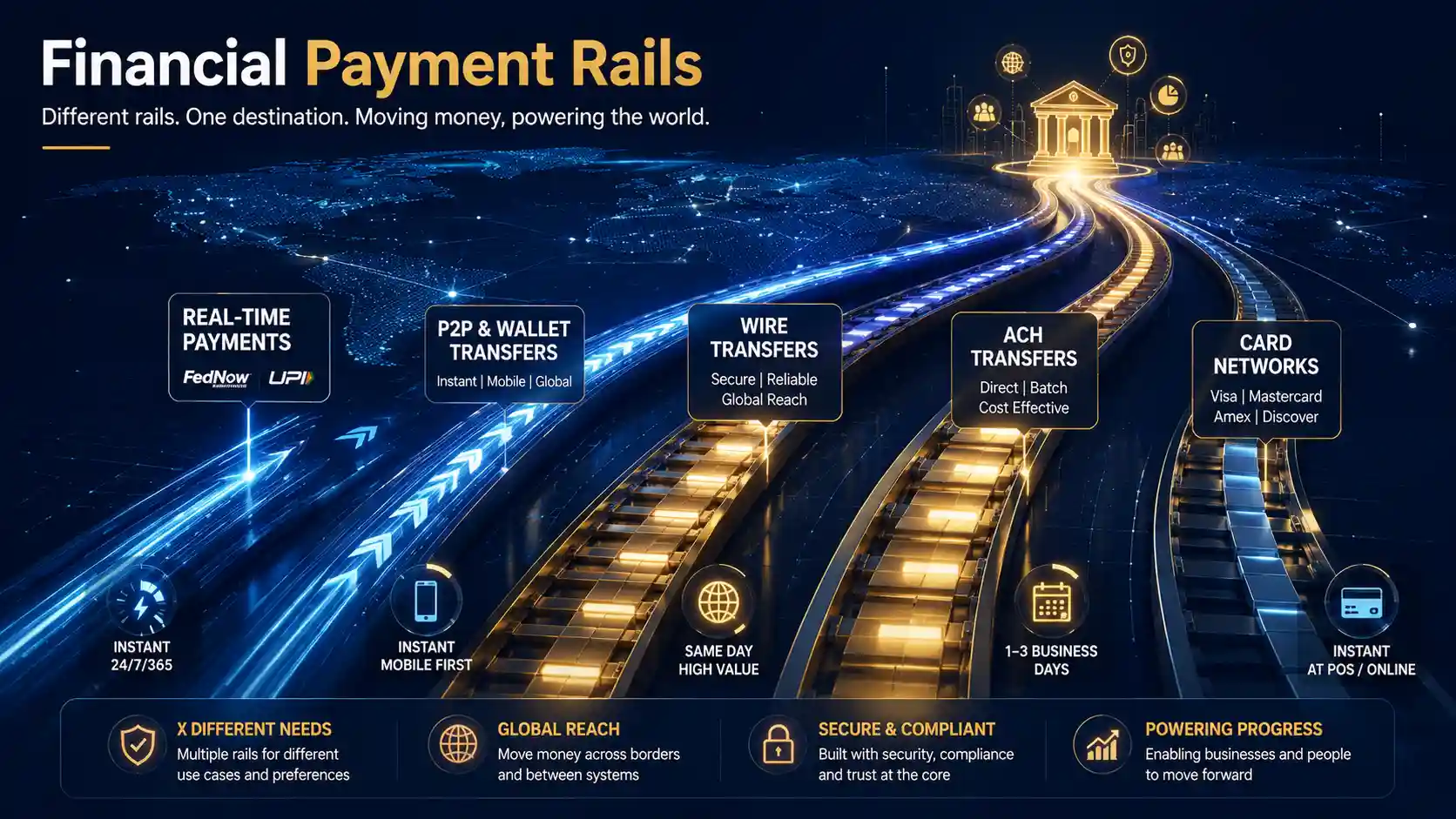
In India: UPI, IMPS, NEFT, RTGS, NACH, RuPay, FASTag, BBPS. Internationally: SWIFT, SEPA, Faster Payments (UK), ACH (US). Know what each does, who operates it, and what kind of IT projects involve it.
Step 4 — Learn Key Payment IT Systems
Know the difference between a payment gateway, a payment switch, a card management system, and a payment hub. Know what each system owns in the transaction lifecycle — this prevents scope confusion on projects.
Step 5 — Get Structured Domain Training
Self-study works but takes time and often misses project-relevant context. Structured payments domain training designed for IT/BA professionals closes the knowledge gap faster and ensures nothing critical is missed.
Techcanvass offers a Payment Domain Training built specifically for Business Analysts, Testers, and IT professionals — covering the payments ecosystem, processing flows, card systems, UPI architecture, and regulatory requirements. Learn payments domain knowledge with a focus on what you need for IT project work.
Conclusion
The payments domain is one of the most dynamic and technically demanding areas in financial services IT. Whether you are working on a UPI integration, a card management system implementation, a payment gateway project, or a regulatory compliance programme — payments domain knowledge is what enables you to deliver effectively.
The foundation is understanding the ecosystem (who the participants are), the processing flow (authorization, clearing, settlement), the payment rails (UPI, NEFT, RTGS, card networks), the key IT systems (gateway, switch, card management, payment hub), and the regulatory landscape (PCI DSS, RBI guidelines, tokenisation mandate). Build this knowledge systematically and you will be equipped for any payments project.