Top Essential AI Skills Every Business Analyst Needs in 2026
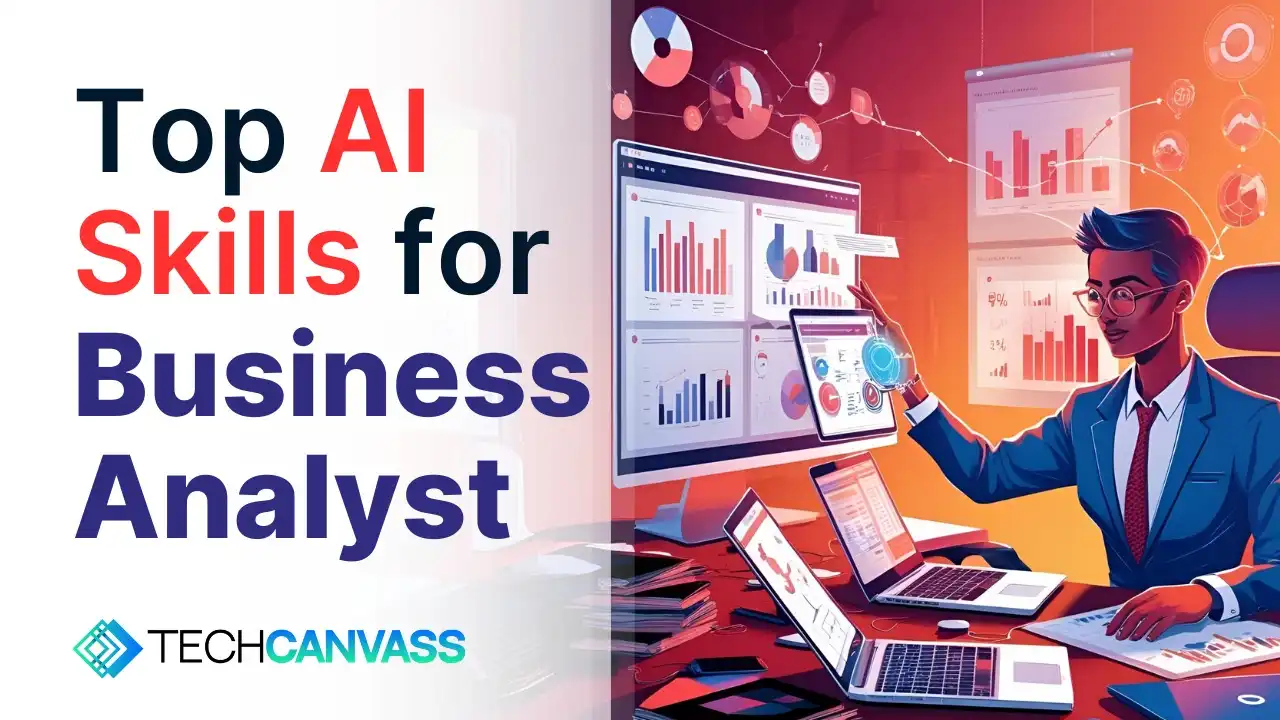
Table of Contents
Introduction
The quick advancement of Artificial Intelligence (AI) has a big impact on the business analysis landscape. Business Analysts (BAs) play a crucial role in ensuring AI initiatives deliver meaningful business value for any software company. To stay relevant and lead in this transformation, BAs must re-align themselves with AI. BAs need to develop some very specific and quite unique AI skills—skills which are not only AI-driven but bear the potential of complementing their core competence in requirement management, stakeholder communication, and problem-solving. AI technologies can help business analysts uncover insights, automate processes, and make more informed decisions.
The aim of this paper is to introduce six indispensable AI skills that the business analyst should develop. These AI skills for Business Analysts complement the broader technical, analytical, and soft skills required for the role. While core Business Analyst skills cover the overall capabilities needed to succeed as a Business Analyst, this guide focuses specifically on the AI-related capabilities that help BAs work effectively with generative AI, AI-powered tools, data, and AI-driven business solutions.
1. Prompt Engineering
As generative AI tools like ChatGPT, Gemini, and Copilot become integrated into day-to-day operations, Business Analysts are expected to know how to interact with them effectively. Prompt engineering is the skill of crafting clear, specific, and goal-oriented instructions to get accurate and valuable outputs from these AI systems & large language models.
Advance your business analyst career with our specialized AI Business Analyst Course. Read our article on why mastering AI is important for business analysts.
What to learn:
- Using prompts to analyse requirements, identify gaps, compare alternatives, and challenge assumptions.
- Writing structured prompts like context + instruction.
- Zero shot or Few shot prompting.
- Iterative refinement (chaining prompts to get better responses).
Why it matters:
- Helps BAs in preparing for stakeholder meetings, generate user stories & acceptance criteria.
- Supports faster requirement analysis through summarization & faster creation of documents.
- Assists in drafting stakeholder communication, testing scenarios, and building training materials
Prompt engineering is less about coding and more about logic, clarity, and asking the right questions—skills that are already second nature to many BAs. It is an important addition to the AI skills of a business analyst.
2. AI Risk, Bias and Responsible AI
With great power comes great responsibility. AI introduces new risks, including hallucination and drift where output is either fabricated by the AI or simply inaccurate. Overdependence on automation & AI poses great risks in terms of inaccurate decision making. Unquestioned use of AI can result in a gradual decline of quality of output.
BAs are often the bridge between technical teams and business stakeholders—and are thus well-positioned to identify, flag, and help mitigate such risks early in the software development lifecycle. This is one of the key AI skills a business analyst must possess.
Key risk areas BAs should be aware of:
- Bias in AI models: Unequal treatment due to skewed training data
- Model working: Difficulty in understanding how decisions are made
- Data privacy: Improper handling of sensitive personal or customer data
- Regulatory non-compliance: Violating laws like GDPR
What to develop:
- Validate AI-generated outputs before using them in requirements, analysis, or business decisions.
- A working knowledge of AI ethics and governance frameworks.
- The ability to write unbiased & ethical requirements.
- An understanding FATE i.e. of fairness, accountability, transparency and ethics principles.
Risk recognition is a vital skill, an important addition to a business analyst’s AI skills, not only for responsible AI use but also for building stakeholder trust.
3. Apply Domain Knowledge to AI Use Cases
AI solutions are only valuable when they address a genuine business problem. For Business Analysts, domain knowledge becomes particularly important when identifying where AI can create meaningful business value and where it may not be appropriate. A strong understanding of the business domain helps BAs assess whether an AI solution actually addresses a business need, rather than adopting AI simply because the technology is available.
Business Analysts serve as the contextual bridge between business needs and AI solutions. Domain knowledge enables them to define meaningful AI requirements, ask the right questions, identify suitable use cases, and prioritize features based on actual business value.
Why domain knowledge is crucial:
- Helps translate business problems into AI-ready requirements
- Prevents over-engineering solutions that may not deliver meaningful business value
- Enables faster validation of AI outputs and recommendations
How to build it:
- Study industry specific regulations, metrics, and use cases
- Analyse existing systems, reports, and workflows to identify gaps AI could fill
- Network with professionals, take relevant courses or certifications
- Study successful AI use cases and applications within your industry
Domain expertise turns BAs into strategic AI enablers who ensure that every initiative is grounded in real-world value. It is one of the most important AI skills for a business analyst.
4. AI Experimentation and Continuous Learning
AI is evolving rapidly, and new models, tools, and capabilities are introduced frequently. Business Analysts therefore need the ability to experiment with emerging AI technologies and understand how they can be applied to real business problems.
AI experimentation does not mean becoming an AI engineer. It means testing new approaches, comparing AI-assisted workflows with existing methods, understanding the limitations of different tools, and identifying practical ways AI can improve business analysis activities.
AI-focused BAs should:
- Experiment with different AI tools and approaches
- Test AI use cases within their business domain
- Compare AI-generated outputs with reliable business information
- Identify where AI improves productivity and where human judgement remains essential
How to build it:
- Follow developments in generative AI and AI for business
- Experiment with AI tools on low-risk BA tasks
- Take AI-focused courses and workshops
- Participate in AI communities and practical projects
Continuous experimentation helps Business Analysts stay adaptable as AI capabilities evolve and new opportunities emerge.
5. Communicating AI Capabilities and Limitations
AI introduces a new communication challenge for Business Analysts. Stakeholders may have unrealistic expectations about what AI can achieve, while technical teams may use AI-related terminology that business users may not fully understand.
Business Analysts need to communicate AI capabilities, limitations, uncertainty, and potential risks in clear business language. They also need to translate stakeholder needs into realistic AI requirements.
AI-specific communication responsibilities:
- Explaining what an AI tool or model does in business-friendly language
- Communicating uncertainty or confidence levels in AI predictions
- Translating stakeholder goals into feasible AI features
How to build it:
- Practice simplifying complex ideas without losing originality
- Use analogies and visual aids to explain AI concepts
- Develop empathy to understand stakeholder concerns
Strong interpersonal communication equips BAs to bridge the gap between AI capabilities and stakeholder expectations. It is this uniquely human skill that companies need, in addition to other AI skills.
6. AI Tool Proficiency and Workflow Integration
AI capabilities are embedded into almost all the tools’ BAs use every day. Whether it’s documenting requirements, managing backlogs, or communicating with teams, learning to leverage these tools with AI features will significantly boost productivity and insight generation for BA. This is one of the most practical and immediately useful AI skills.
Examples of AI-augmented tools:
- Integrated Meeting assistants: MS Teams Co-pilot, Fireflies.ai (write Minutes of stakeholder meetings)
- Backlog management: Click up, Jira with AI plugins
- Documentation tools: Gemini AI, Confluence with AI add-ons
What to focus on:
- Evaluate whether an AI feature genuinely improves a BA workflow before adopting it
- Understand what information can safely be shared with AI-enabled tools
- Learn what AI features exist in your current toolset
- Understand how to use integrations (e.g., connect Jira to Confluence summaries)
- Keep experimenting with emerging tools that helps in your work
Tool proficiency allows BAs to embed AI directly into their workflows. It helps to boost productivity in daily jobs and is an essential component of a business analyst’s AI skills.
7. AI Output Evaluation and Validation
AI can produce useful and convincing outputs, but those outputs are not always accurate or complete. Business Analysts therefore need to evaluate AI-generated information before using it in requirements, analysis, documentation, or business decisions.
This involves checking AI outputs against reliable data and stakeholder input, identifying unsupported assumptions, spotting missing requirements, and recognising when human judgement is required.
What BAs should validate:
- Factual accuracy
- Missing or ambiguous requirements
- Incorrect assumptions
- AI hallucinations
- Bias in recommendations
- Consistency with business rules
- Alignment with stakeholder expectations
8. Identifying AI Use Cases and Business Value
Business Analysts do not simply use AI tools—they also help organisations identify where AI can solve meaningful business problems. An AI-skilled Business Analyst should be able to evaluate a business process and determine whether AI can improve efficiency, decision-making, customer experience, or automation.
However, not every business problem requires an AI solution. BAs need to consider the availability of relevant data, technical feasibility, expected business value, and potential risks before recommending an AI-based approach.
A simple framework for evaluating AI opportunities:
Business Problem → AI Opportunity → Data Availability → Feasibility → Business Value → Risk
At each stage, Business Analysts can ask:
- Business Problem: What specific business problem are we trying to solve?
- AI Opportunity: Can AI realistically help solve or improve this problem?
- Data Availability: Do we have sufficient, relevant, and reliable data?
- Feasibility: Can the proposed AI solution be implemented with the available technology, resources, and constraints?
- Business Value: Will the solution deliver measurable business benefits?
- Risk: What risks could arise from using AI, such as inaccurate outputs, bias, privacy concerns, or regulatory issues?
This approach helps Business Analysts move beyond simply adopting AI tools and instead focus on identifying AI solutions that are practical, valuable, and aligned with genuine business needs.
Conclusion
AI is becoming an important part of modern business analysis, but becoming an AI-enabled Business Analyst is about more than learning individual AI tools. BAs need to understand how to prompt AI effectively, identify suitable AI use cases, evaluate AI-generated outputs, recognise risks, apply domain knowledge, communicate AI limitations, and integrate AI responsibly into their workflows.
These capabilities complement the broader skills required of Business Analysts and can help professionals work more effectively in increasingly AI-driven organisations.