Business Analyst Interview Questions and Answers 2026
Prepare for Business Analyst interviews with core BA questions, technical questions, behavioural questions, and modern case-study based practice questions. Use the answers as guidance, but frame your final response in your own words.
Updated Interview Guide
Structured for BA interviews in 2026
Most Important Business Analyst Interview Questions
Are you preparing for a Business Analyst interview? To help you perform well, we have curated a list of frequently asked Business Analyst interview questions and answers. The interview generally includes questions across multiple skill areas.
The interview questions can be grouped under five skill types:
- Business Analysis Core Skills: Requirements gathering, documentation, stakeholder management, prioritisation and validation.
- Technical Skills: SQL, process modelling, system integrations, data mapping, validation, and tools like Jira.
- Agile/Scrum Skills: User stories, backlog refinement, sprint planning, acceptance criteria, Definition of Ready, Definition of Done, and UAT support.
- Behavioural and Scenario-Based Questions: Handling stakeholders, adapting to change, mistakes, ambiguity, and problem-solving situations.
- Case Study Based Questions: Modern interview assignments where you are expected to analyse a business problem, identify stakeholders, write requirements, and propose an approach.
How to Prepare for a Business Analyst Interview
Before you start reading questions, use this checklist to prepare in a structured way.
Business Analyst Interview Masterclass: Questions, Answers & Case Studies
Watch this Techcanvass masterclass before reading the questions below. It covers live walkthroughs of real Business Analyst interview questions, structured answers, and case-study practice, in 60+ minutes of expert-led preparation.
 Watch on YouTube
Business Analyst Interview Masterclass 2025: Questions, Answers & Case Studies
Techcanvass founder Abhishek Srivastava walks through the most important Business Analyst interview questions, structured answers, and case-study practice.
Business Analysis Core Skills Interview Questions
1. What is the role of a business analyst in an organization?
A business analyst is a bridge between different stakeholders in an organization. He/she is a liaison between the team and the customer and may act as a customer representative to the development team. The stakeholders have experience in different domains such as finance, business, and marketing. It is crucial for a business analyst to address stakeholders’ needs and concerns while achieving the business objectives.
2. How does your typical day look like?
You can prepare your answer based on what we have provided. If you are working on a greenfield project, your answer needs to be changed.
Right now, I am working on a maintenance project, and here is how I spend my day. On a typical day, I will be working on a change request sent by the customer or following up on other ongoing changes in the current sprint. This involves the following:
- Talking to the stakeholders to understand why the change is needed, the outcomes expected, the current process, and related details.
- Once the meeting is over, I prepare the minutes of meeting and send them to all attendees.
- Next, I analyze the details and discuss with the Product Owner to ensure that it aligns with the project and organizational goals.
- I also follow up with the team to track the progress of ongoing changes.
- Next, I create specifications for the proposed change including process diagrams, prototypes, and business rules.
- If a sprint is getting completed, I also perform functional testing of the deliverables.
3. So, you are working on Agile? Are you familiar with Waterfall also? How does Agile differ from Waterfall?
Waterfall is a sequential project approach where each stage is completed before moving to the next, so it suits projects with stable and clearly defined requirements.
Agile is an iterative approach where work is delivered in smaller increments, with regular feedback and changes built into the process. In simple terms, Waterfall focuses on upfront planning, while Agile focuses on adaptability and continuous improvement.
The choice between Waterfall and Agile depends on the nature of the project, the stability of requirements, and how much flexibility the business needs.
4. Do you think Agile is the best approach to executing software projects?
Not in absolute terms or not in a hundred percent of the cases. Agile methodologies are more suited for modern-day projects as they allow you to cater to changing requirements and the changing dynamics of the business. It has been designed with the ability to handle such frequent changes.
Horizontal expansion on modern implementation models is highly valuable to clear alignment hurdles.
5. Which all documents does a BA prepare?
A Business Analyst may prepare a variety of documents depending on the project, organization, and delivery methodology.
As far as I am concerned, I have prepared documents such as:
- System Requirements Specification (SRS)
- Use Case Specification Document
- Requirements Traceability Matrix (RTM)
- Change Request Document
- RACI Matrix
- Gap Analysis Document
- Stakeholder Management Plan
Apart from these, Business Analysts may also prepare important documents such as the Business Requirements Document (BRD), Business Case, functional requirements documents, process flow diagrams, and other project-related artifacts.
6. What are the key elements of an SRS?
Key elements of an SRS are shown below:
- Scope of Work
- Assumptions, Constraints, and Dependencies
- References used
- Functional Requirements
- Process Diagrams and Prototypes
- Non-Functional Requirements
- Acceptance Criteria
7. What are non-functional requirements? Did you capture them in SRS? Why are they important?
Non-functional requirements represent the characteristics of the application under development rather than the behaviour of the system.
These requirements are related to performance, user interfaces, security, auditing, and similar areas. We do capture them in the SRS document along with functional requirements, but in a different section.
They are important because they allow us to identify the need for skills and resources outside the project team.
8. What are acceptance criteria?
Acceptance criteria are the set of conditions or requirements that must be met for a solution to be accepted by the stakeholders. The acceptance criteria are defined during the requirements-gathering phase and should be agreed upon by the stakeholders.
The acceptance criteria can be written for the entire system or for one requirement as well. An example of acceptance criteria for the entire system could be that all the unit test cases should be run successfully by the development team, which can be checked and approved.
9. What is Gap Analysis?
Gap Analysis is a term used in the product implementation lifecycle.
In product implementation, we conduct an “AS IS” process study to understand the existing business processes in detail. The next step is to study the “TO BE” process. The “TO BE” processes represent the desired processes and explain why the project is underway.
Once the “TO BE” processes are studied, the product is configured to incorporate the desired processes wherever possible. Remaining processes are either developed as product customisation or custom-built processes. Finally, the configured product is demonstrated to the customer and the gaps are identified.
10. How did you make sure that requirements were good to go for the next stage?
This is generally a two-pronged approach.
Firstly, we conduct reviews on the requirements. In one of the projects, the review was conducted by another business analyst who had worked on similar projects in the past. He reviewed the documents and pointed out gaps such as logical errors, missing requirements, and subjectivity.
Secondly, the requirements were validated by the customer. We created a prototype to demonstrate the system to the customer and discussed each and every screen diligently.
11. What is requirements prioritisation and why is it important?
Prioritisation provides a framework for business analysts to facilitate stakeholder decisions and to understand the relative importance of business analysis information.
Requirements prioritisation is the process where we allocate requirements to different phases or iterations based on business urgency, schedule, cost, and related factors. Creating a prioritised requirements list helps in handling requirements in order of their importance to the customer.
There are multiple techniques used for requirements prioritisation, such as MoSCoW, the 100-dollar method, Requirements Ranking Method, Five Whys, Kano Analysis, and more.
12. What are the different techniques to capture requirements early on?
Two important and popular techniques are use cases and user stories.
A use case is a type of UML diagram and a visual way of capturing requirements. Use cases comprise actors and use cases. An actor is an external entity who may be a user of a software system or even an organization, but must be external to the system.
For example, a user can search and compare products, place an order, and view order history.
User stories are a format to represent a feature of a software system from the end user’s perspective. It is not a visual format, but rather a textual format.
13. What is the difference between BRD, FRD, and SRS?
A BRD, FRD, and SRS are all requirement documents, but they are used at different levels of detail.
A BRD explains the business need, business objectives, scope, stakeholders, and high-level business requirements. It answers why the project is needed and what business outcome is expected.
An FRD explains the functional behaviour expected from the system. It focuses on what the system should do to support the business requirements.
An SRS is usually a more detailed software requirements document. It may include functional requirements, non-functional requirements, assumptions, constraints, process flows, use cases, data rules, and acceptance criteria.
In simple terms, BRD is business-focused, FRD is functionality-focused, and SRS is system/specification-focused.
14. How do you identify stakeholders for a project?
I identify stakeholders by first understanding the business problem, the process being impacted, and the teams or users who are affected by the change.
I usually look at the following groups:
- People who use the current process or system
- People who approve or fund the change
- People who provide inputs or data
- People who receive outputs or reports
- Technology, operations, compliance, support, and testing teams
- External parties such as customers, vendors, or regulators, if applicable
After identifying stakeholders, I categorize them based on their influence, interest, and involvement. This helps me plan communication, elicitation, approvals, and expectation management.
15. How do you handle conflicting requirements from different stakeholders?
When stakeholders give conflicting requirements, I first avoid taking sides. I try to understand the business reason behind each requirement and the outcome each stakeholder is trying to achieve.
Then I compare the requirements against business goals, process impact, regulatory needs, customer impact, cost, timeline, and technical feasibility. If needed, I facilitate a discussion with the stakeholders and present the trade-offs clearly.
My goal is to help the stakeholders make an informed decision. If the conflict cannot be resolved at my level, I document the options, impact, assumptions, and risks, and escalate it to the Product Owner, sponsor, or decision-making authority.
16. What is a Requirements Traceability Matrix and why is it useful?
A Requirements Traceability Matrix, or RTM, is a document that helps track requirements throughout the project lifecycle. It links business requirements to functional requirements, design, development, test cases, defects, and final delivery.
It is useful because it ensures that every approved requirement is implemented and tested. It also helps identify missing test coverage, scope gaps, and the impact of requirement changes.
For example, if a stakeholder asks for a change in one requirement, the RTM helps us quickly identify which user stories, test cases, reports, screens, or interfaces may be affected.
17. What is the difference between business requirements and functional requirements?
Business requirements describe the business need or outcome expected from the project. They focus on what the business wants to achieve.
Functional requirements describe what the system should do to fulfill those business requirements. They are more detailed and solution-oriented.
For example, a business requirement could be: “Reduce loan application processing time.” A functional requirement could be: “The system shall allow customers to upload KYC documents online and notify the operations team when documents are submitted.”
So, business requirements explain the problem or objective, while functional requirements explain system behaviour needed to support that objective.
Technical Skills Related Interview Questions
1. What is the difference between use cases and user stories?
Both are used to represent system requirements from the user perspective.
Use cases are visual models. They demonstrate the relationships between different use cases with the help of extend and include dependencies.
Whereas a user story is a textual model and is written in a format which captures WHO, WHAT and WHY. However, a user story cannot show the relationships with other user stories.
- As a <User>
- I want <to search for flight tickets as per my schedule>
- So that I can <attend a business conference>
Generally, use cases are captured in use case specification documents along with scenarios. User stories are extended by creating user story cards.
2. Explain your experience with UML, BPMN, or data visualization tools.
I have used UML and BPMN mainly to make requirements and workflows easier for both business and technical stakeholders to understand. For example, I have created use case diagrams, activity diagrams, and process flows to represent system interactions and business processes. I have also used data visualization tools such as Excel, Power BI, or similar tools to present trends, exceptions, and business insights in a simple and actionable manner.
3. How do you analyze data to make recommendations?
I usually start by understanding the business problem and identifying the data needed to investigate it. Then I review the data for patterns, trends, gaps, or exceptions, and relate those findings back to the business objective. Based on that analysis, I prepare recommendations that are practical, evidence-based, and aligned with business goals.
4. What SQL queries have you used to validate data?
I have used SQL mainly for data validation, data comparison, and requirement verification. For example, I have used queries such as SELECT, JOIN, GROUP BY, COUNT, and WHERE clauses to check whether the data stored in the system matches the expected business rules. I have also used SQL to identify missing records, duplicate entries, and incorrect mappings during testing or analysis.
5. How comfortable are you working with databases?
I am comfortable working with databases from a Business Analyst perspective. While I may not work as a database developer, I am able to understand table structures, relationships, keys, and data flows well enough to validate requirements, support testing, and discuss issues with technical teams. This helps me bridge the gap between business needs and system data design.
6. Have you worked with APIs or system integrations? What was your role?
Yes, I have worked on projects involving system integrations. My role was typically to understand the business data being exchanged, define the requirements clearly, document field mappings, and coordinate with technical teams to ensure the integration supports the intended business process. I also helped validate whether the input and output data aligned with business expectations.
7. How do you validate that a technical solution meets business requirements?
I validate this by tracing the solution back to the documented requirements and acceptance criteria. I usually review process flows, functional behavior, business rules, and data outputs to confirm that the solution addresses the original need. I also work closely with users and testers to ensure the implemented solution delivers the expected business value.
8. What is your experience with process modeling?
I have used process modeling extensively to understand current-state processes and define future-state improvements. It helps in identifying inefficiencies, decision points, handoffs, and possible automation opportunities. I usually create process models because they make discussions more structured and reduce ambiguity among stakeholders.
9. How do you handle data discrepancies during analysis or testing?
When I find data discrepancies, I first verify whether the issue is due to data quality, requirement misunderstanding, or a system defect. Then I analyze the impact, document the findings clearly, and discuss them with the relevant stakeholders or technical team. My focus is always on identifying the root cause and ensuring the issue is resolved without affecting business objectives.
10. What technical tools have you used as a Business Analyst?
I have used tools for requirement documentation, process modeling, collaboration, and reporting. Depending on the project, this has included tools such as Jira, Confluence, Visio, Excel, SQL, Power BI, and wireframing or diagramming tools. My objective in using these tools is always to improve clarity, traceability, and communication across teams.
11. How do you work with technical teams if you are not a developer?
I work with technical teams by ensuring I understand the business need in enough detail to discuss it clearly and logically. I focus on translating business requirements into structured specifications, asking the right questions, and clarifying assumptions early. Even without being a developer, I can contribute effectively by connecting business goals, process understanding, and system behavior.
12. What is the difference between an API and a database from a BA perspective?
From a Business Analyst perspective, a database is where data is stored, while an API is a way for systems to exchange data or request an action from another system.
For example, in a loan application system, customer details may be stored in a database. But when the system needs to verify PAN, credit score, or payment status from another platform, it may use an API.
As a BA, I may not design the API technically, but I should understand what data is being sent, what response is expected, what business rules apply, and how errors should be handled.
13. What is the difference between front-end validation and back-end validation?
Front-end validation happens on the user interface before the data is submitted to the server. For example, checking whether an email field has the right format or whether a mandatory field is left blank.
Back-end validation happens on the server or application logic layer. It ensures that the submitted data follows business rules and system rules even if front-end validation is bypassed.
As a BA, I should define both types of validation clearly. Front-end validation improves user experience, while back-end validation protects data integrity and business rules.
14. How do you write requirements for system integrations?
For system integration requirements, I start by understanding the business purpose of the integration. Then I identify the source system, target system, trigger, data fields, business rules, frequency, error handling, and expected response.
I also document field mappings, mandatory and optional fields, validation rules, success and failure scenarios, and any security or audit requirements.
For example, if a CRM integrates with a payment gateway, I would define what payment details are sent, what confirmation is received, how failed transactions are handled, and how the status is updated in the CRM.
15. What is data mapping and why is it important in software projects?
Data mapping is the process of connecting fields from one system, file, database, or form to corresponding fields in another system.
It is important in migration, integration, reporting, CRM, ERP, banking, insurance, and analytics projects because incorrect mapping can lead to wrong reports, failed transactions, duplicate records, or compliance issues.
As a BA, I usually help define field names, source-to-target mapping, transformation rules, mandatory fields, default values, validations, and exception handling so that business meaning is preserved when data moves between systems.
Agile/Scrum Business Analyst Interview Questions
Agile/Scrum questions are common in BA interviews because many Business Analysts work with Product Owners, Scrum Masters, developers, testers, and stakeholders in iterative delivery teams.
1. What is the role of a Business Analyst in an Agile project?
In an Agile project, a Business Analyst helps the team understand business needs and convert them into clear backlog items, user stories, acceptance criteria, process flows, and business rules.
The BA works closely with the Product Owner, stakeholders, developers, testers, and UX teams. The BA may support backlog refinement, sprint planning, requirement clarification, UAT, and stakeholder communication.
The main value of a BA in Agile is to reduce ambiguity and ensure that the team is building the right solution for the right business problem.
2. What is the difference between a Product Owner and a Business Analyst?
A Product Owner is accountable for product vision, backlog prioritization, and maximizing product value. The Product Owner decides what should be built first and why.
A Business Analyst supports the Product Owner by analyzing requirements, understanding processes, working with stakeholders, writing user stories, clarifying acceptance criteria, and ensuring the team understands the business context.
In some organizations, the roles may overlap. But generally, the Product Owner owns priority and value decisions, while the BA supports detailed analysis and requirement clarity.
3. What is a user story and how is it different from a traditional requirement?
A user story is a simple way of expressing a requirement from the user’s perspective. It usually follows the format: “As a user, I want something, so that I can achieve some benefit.”
A traditional requirement may be more detailed and system-focused, whereas a user story is short, user-focused, and intended for conversation.
For example, a traditional requirement may say: “The system shall allow password reset through registered email.” A user story may say: “As a customer, I want to reset my password using my registered email so that I can regain access to my account.”
4. What are acceptance criteria and why are they important in Agile?
Acceptance criteria define the conditions that must be satisfied for a user story to be considered complete and acceptable.
They are important because they remove ambiguity, help developers understand expected behaviour, help testers design test cases, and help the Product Owner accept or reject the story.
Good acceptance criteria should be clear, testable, and aligned with business expectations. For example, if a user uploads a document, acceptance criteria should mention supported formats, size limits, error messages, and successful upload confirmation.
5. What is backlog refinement and what is the BA’s role in it?
Backlog refinement is the activity where the team reviews upcoming backlog items and makes them ready for future sprints.
A BA supports backlog refinement by clarifying requirements, splitting large stories, adding acceptance criteria, identifying dependencies, discussing business rules, and answering questions from developers and testers.
The goal is to ensure that stories are clear enough for estimation and development when they are picked up in a sprint.
6. How does a BA support sprint planning?
During sprint planning, a BA helps the team understand the stories being considered for the sprint. The BA explains the business context, expected outcome, business rules, assumptions, and acceptance criteria.
The BA may also help identify dependencies, open questions, data needs, edge cases, and stakeholder availability.
Even though the development team owns technical estimation, the BA contributes by making sure the scope and requirements are clear before the team commits to sprint work.
7. What is the INVEST principle in user stories?
INVEST is a guideline for writing good user stories. It stands for Independent, Negotiable, Valuable, Estimable, Small, and Testable.
A good user story should be independent enough to deliver separately, negotiable enough for discussion, valuable to the user or business, estimable by the team, small enough to complete within a sprint, and testable through clear acceptance criteria.
As a BA, I use INVEST as a checklist to improve the quality of user stories before they move into sprint planning.
8. How do you handle changing requirements in Agile?
In Agile, changing requirements are expected, but they still need to be managed carefully.
If a new requirement comes in, I first understand the reason for the change and its business value. Then I discuss the impact on scope, priorities, timelines, dependencies, and already planned work with the Product Owner and team.
If the change is important, it can be added to the backlog and prioritized. If it affects the current sprint, the Product Owner and team should decide whether to include it, defer it, or trade it with other work.
9. What is the difference between Definition of Ready and Definition of Done?
Definition of Ready means a user story is clear enough to be taken into a sprint. It may include a clear description, acceptance criteria, dependencies, business rules, mockups, and answers to key questions.
Definition of Done means the story is complete as per the team’s agreed quality standards. It may include development completed, code reviewed, testing done, acceptance criteria met, defects fixed, and Product Owner acceptance.
In simple terms, Definition of Ready checks whether work can start, while Definition of Done checks whether work is truly complete.
10. How does a BA support UAT in an Agile project?
A BA supports UAT by helping users understand what has been delivered, ensuring test scenarios are aligned with business requirements, and clarifying expected outcomes.
The BA may help prepare UAT scenarios, coordinate with business users, explain acceptance criteria, track feedback, analyze defects, and confirm whether reported issues are genuine defects, requirement gaps, or change requests.
In Agile projects, UAT may happen continuously or near release milestones, and the BA helps ensure that delivered features are usable and valuable from the business perspective.
Behavioural and Scenario-Based Questions
This section keeps a representative sample of behavioural and situation-based questions. For a dedicated deep-dive into scenario-based Business Analyst interview questions, use the dedicated guide linked in the resources section below.
1. Describe a case where you made a mistake and what you did to address that.
This is becoming an important question for business analysts as well as other professionals. Everybody makes mistakes, and as long as we show that we learnt from the mistake, it shows us in a positive light.
To answer this question, the best strategy is to describe the case while remaining neutral. The first step is to own the mistake. The next step is to explain what you did after that and what you did to prevent similar mistakes in the future.
Example Scenario: Very early in my career, I was part of a development team. My role was to develop reports on Oracle. We used to keep backups on local servers and transfer them to the central server one day prior to the build and UAT. During one release, I copied the files to the central server and went home. The next day, the build did not succeed because a script file was missing.
I realized that I had not copied the database script to create the new summary tables on the test database. I decided to create a checklist and a backup script. The checklist included exporting the latest database script. The backup script included all the GET/PUT commands to take care of the backup. The output was put in a log file, which was verifiable. The mistake was not repeated.
2. Have you faced a difficult stakeholder? If yes, how did you handle them?
This question checks your knowledge of stakeholder analysis and management. But it is not advisable to only explain the stakeholder management process. Add your personal experience to make it realistic.
Yes, I have handled a couple of difficult stakeholders in my career. My approach is to first understand the reasons for their negativity. It is important to understand the root cause rather than dismissing the stakeholder.
In one case, a manager always said that the software was not going to work and that the company was wasting money. I kept asking him why he thought so, but I remained polite. Eventually, he explained the reasons. Some of his reasons made sense, and we incorporated his feedback into the software.
Secondly, we must identify stakeholders and categorize them. This helps in assessing the mechanisms through which we can keep stakeholders engaged. Thirdly, if none of the above works, I believe in escalating the matter to senior management.
3. Give me a situation where you had to adapt to a new methodology, process, or technology.
This question checks your flexibility or adaptability to change. You can pick a simple situation related to projects, methodology, or working on a new tool.
For example, in a previous company, we used to manage requirements using a homegrown tool. In the new project, everyone was using a new tool mandated by the customer. The tool was custom-developed by the customer and was not easy to use, but learning it was necessary because it was a highly collaborative project.
So I spent extra time learning and practicing with the tool. I also asked one of my colleagues to give me a head start. These extra hours made me confident and helped me collaborate with the customer.
4. Tell me about a situation where you were given a simple issue, but it turned out to be a big issue. What did you do?
You may not have faced this situation in your career. In such cases, the interviewer may ask you to respond to a “What If” scenario. To answer this question, use a problem-solving approach:
- Find the problem using techniques like Five Whys or Root Cause Analysis.
- Define the problem by understanding context, stakeholders, risks, and constraints.
- Decompose a complex problem into smaller parts and gather more information.
- Use the data to find solutions.
- Measure the solution to ensure that the problem is resolved.
Example: I once received requirements from a customer that seemed similar to a previous requirement. To expedite feedback, I committed that it could be delivered. Later, while discussing with the SME, I realized that the requirement was different and needed a redesign of the module. It was a learning for me to follow best practices and ensure shared understanding before committing.
5. You are assigned to a project in a completely new domain, say Telecom. How will you approach it?
This is not an unprecedented situation. The first thing to check is whether you have time before the requirements phase starts. If yes, you can plan for it.
You cannot aim to become a domain expert quickly. Instead, your goal should be to understand key terms, concepts, relevant processes, and the industry context. You should also look at competitors and products if required. Around 30 to 40 hours of learning can help you gain enough familiarity to begin effectively.
Learning resources can come from search, internal documents, SMEs, or structured domain training courses.
6. Describe a time when you had to advise a client toward a different course of action.
The role of a Business Analyst is also to recommend objectives that are in the best interest of the client and the organization. There can be situations where the client is following a course of action that differs from your viewpoint. You should approach such situations with problem-solving and negotiation skills.
Example: In one project involving a database architecture change, the regular UAT process was not enough. We proposed using the PERF environment with cloned production data after filtering sensitive data. The client initially disagreed due to data sensitivity concerns. I explained the process carefully, including how sensitive data would be filtered and the environment would be restored after testing. Though it was difficult, the client agreed.
7. What problems have you solved as a Business Analyst?
As a Business Analyst and part of a project team, we develop software applications that help customers solve problems. Let me give you an example.
In one instance, the customer support team was getting many complaints about product support. The support team could not answer all questions by themselves and needed inputs from product specialists. As there was no tracking mechanism, many queries were not answered on time or were not answered at all. Customers were unhappy and product sales were impacted.
We developed a robust help desk software that helped manage customer queries and issues in a timely fashion. Negative feedback came down by 50% in the next couple of months.
8. Which project was the most challenging or interesting? Why?
Answering this question requires preparation. Reflect on your previous projects or assignments, especially if you are new to Business Analysis. Pick one project that was challenging and turned out to be successful.
It is better to choose a project that tested your skills and abilities and had a positive outcome. You can pick a project with difficult stakeholders, tough timelines, or an unexpected event.
9. Tell me about a situation where you got the requirements incorrectly. At what stage did you realize this and how did you fix it?
In traditional methodology, the best effort is to detect requirements issues before sign-off. But this may not always happen. The later a defect is found, the higher the cost of fixing it.
You can answer this question as follows: In my current project, we follow a review process where another Business Analyst reviews the requirements specifications before we present them to the customer. We also use a checklist and conduct a detailed walkthrough with the customer.
There have been instances where issues were discovered later by the design team or testers. In one case, the cost was not too high because the requirements document needed to change. In another, testers discovered inconsistent calculation formulas, which required changes in code as well as specifications.
10. How would you handle it if your team resisted a new idea you introduced?
Employers want to know how you sell unpopular ideas to others and how you maintain respect among the team.
I would first observe how the team reacts to my idea. If they disagree, I would understand the reason. They may be reluctant because they are used to the old way of doing things or because they have a valid alternative viewpoint.
Once I understand the reasoning, I would present the idea simply along with the benefits it brings. I would also remain open to suggestions and feedback. This shows that I am ready to incorporate valued inputs while still communicating the need for change.
Case Study Based Business Analyst Interview Questions
Case-study based assignments have become an important part of BA interviews. Below are 4 practice case studies. Interviewers may give you a short business situation and ask you to identify the problem, stakeholders, requirements, assumptions, risks, user stories, acceptance criteria, process gaps, or AI opportunities.
AI-enabled claims triage for an insurance company
An insurance company receives a high number of claims. Many claims are delayed because submissions are incomplete, manual triage is slow, and investigators get too many low-risk cases.
Practice questions
- What problem statement would you frame?
- Who are the key stakeholders?
- What data would you need before recommending AI-based triage?
- Write 2 user stories for the claims intake process.
- What acceptance criteria would you define for AI-based triage?
- What guardrails are required to avoid unfair claim decisions?
AI chatbot for banking customer support
A bank wants to reduce call-center load by introducing an AI chatbot for balance inquiries, card blocking, loan eligibility, and service-request status. Senior customers are struggling with the new self-service flow.
Practice questions
- What questions will you ask the business stakeholders?
- How will you identify which use cases are suitable for chatbot automation?
- What are the key functional and non-functional requirements?
- How will you handle escalation to human agents?
- What metrics will you use to measure success?
- What risks should be considered for senior citizen users?
AI-assisted lead scoring for a training company
A training company gets leads from Google Ads, webinars, YouTube, referrals, and organic search. The sales team wants AI to prioritize leads that are more likely to enroll.
Practice questions
- How will you understand the current lead management process?
- What data fields are needed for AI-assisted lead scoring?
- What business rules should be documented before AI model design?
- How will you validate whether the AI recommendation is useful?
- What user stories would you write for sales counselors?
- What ethical or business guardrails are needed?
AI-supported requirements review for an Agile team
An Agile team wants to use AI to review user stories before sprint planning. The goal is to detect ambiguity, missing acceptance criteria, duplicate stories, and unclear business value.
Practice questions
- What is the business value of this AI use case?
- What inputs should the AI tool review?
- What output should the AI tool generate for the BA and Product Owner?
- How will you prevent the team from blindly accepting AI suggestions?
- What acceptance criteria would you write for this feature?
- How will you measure improvement in story quality?
Questions to Ask the Interviewer
At the end of the interview, ask thoughtful questions to understand the BA role better.
- What kind of projects will I work on in this role?
- Will this role be more business-facing, technical, product-focused, or process-focused?
- Which methodology does the team follow: Agile, Waterfall, or hybrid?
- Which tools does the BA team use for requirements, backlog, documentation, and collaboration?
- What are the biggest challenges currently faced by the BA team?
- How is success measured for a Business Analyst in this role?
- Will I get an opportunity to work on AI, automation, analytics, or digital transformation projects?
Everything you need to prepare for a Business Analyst interview
This guide is the main pillar for BA interview preparation. Use the three resources below alongside it for complete coverage across experience levels and question types.
Entry Level Business Analyst Interview Questions
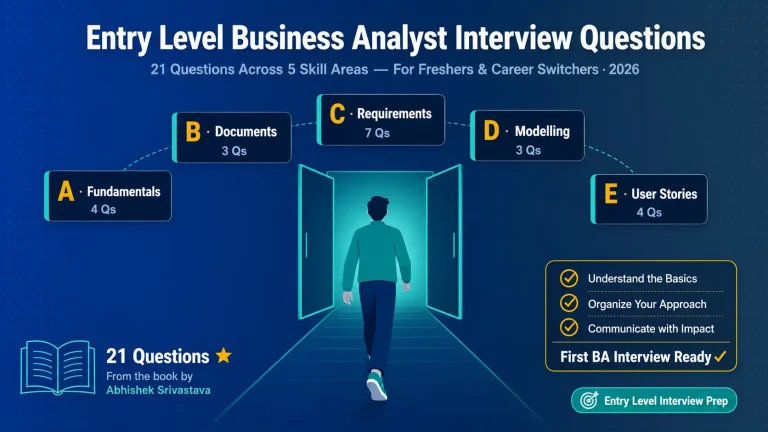
If you are a fresher or making your first move into business analysis, start here before reading this pillar guide. It covers 21 entry level Business Analyst interview questions across five sections: BA fundamentals, documents and deliverables, requirements engineering, modelling techniques, and user stories with acceptance criteria. Answers are structured for someone with no prior BA job title.
- 21 questions structured for beginners and career switchers
- Covers BA fundamentals, SRS, use cases, user stories, and acceptance criteria
- Based on the book by Techcanvass founder Abhishek Srivastava
Scenario-Based Business Analyst Interview Questions
This dedicated guide goes deeper on scenario-based Business Analyst interview questions, the type where the interviewer gives you a business situation and expects you to walk through your approach. Covers situation framing, logical reasoning, and structured responses using the STAR method and BA problem-solving frameworks. Use this after you are comfortable with the core questions on this page.
- Dedicated to scenario and logical question types
- Covers problem-solving approach, STAR method, and stakeholder scenarios
- Suitable for professionals preparing for senior BA or lead BA roles
Business Analyst Interview Questions and Answers Audiobook
The BA Interview Audiobook by Abhishek Srivastava gives you 150+ interview questions with expert-explained answers in audio format, available on web, iOS, and Android. Six chapters cover icebreaker questions, general BA questions, core BA skills, Agile and business analysis, additional BA skills, and 25 situational questions. Useful for commute preparation or if you prefer listening over reading.
- 150+ questions across 6 chapters in audio format
- Includes 25 situational questions and Agile BA topics
- Available on web, iOS, and Android with 1-year access
Business Analyst Interview Questions FAQs
What are the most common Business Analyst interview questions?
Common questions cover the BA role, requirements gathering, stakeholder management, BRD/SRS, user stories, acceptance criteria, Agile, SQL, tools, and project examples.
How should I prepare for scenario-based BA interview questions?
Practice problem-solving situations, stakeholder conflicts, unclear requirements, requirement changes, UAT issues, and project ambiguity. Use the STAR method and support your answer with a clear BA approach. See the dedicated scenario-based Business Analyst interview questions guide for deeper practice.
Are case-study based assignments common in BA interviews?
Yes, many organizations now use case-study based assignments to check whether candidates can analyze a business problem, identify stakeholders, write requirements, and think practically.
Do Business Analysts need SQL for interviews?
Many BA roles expect basic SQL awareness, especially for data validation, reporting, business rule validation, and system testing support.
Should I memorize Business Analyst interview answers?
No. Use sample answers to understand structure and expectations, but frame responses in your own words using your own project or practice examples.
Are there specific interview questions for entry level Business Analyst roles?
Yes. If you are a fresher or making your first move into BA, the questions will focus more on fundamentals: what business analysis is, types of requirements, documents a BA prepares, use cases, user stories, and basic Agile concepts. See the entry level Business Analyst interview questions guide for a structured starting point.