How to Transition from QA to Business Analyst: Skills, Steps, and Real Experience
Quick Answer
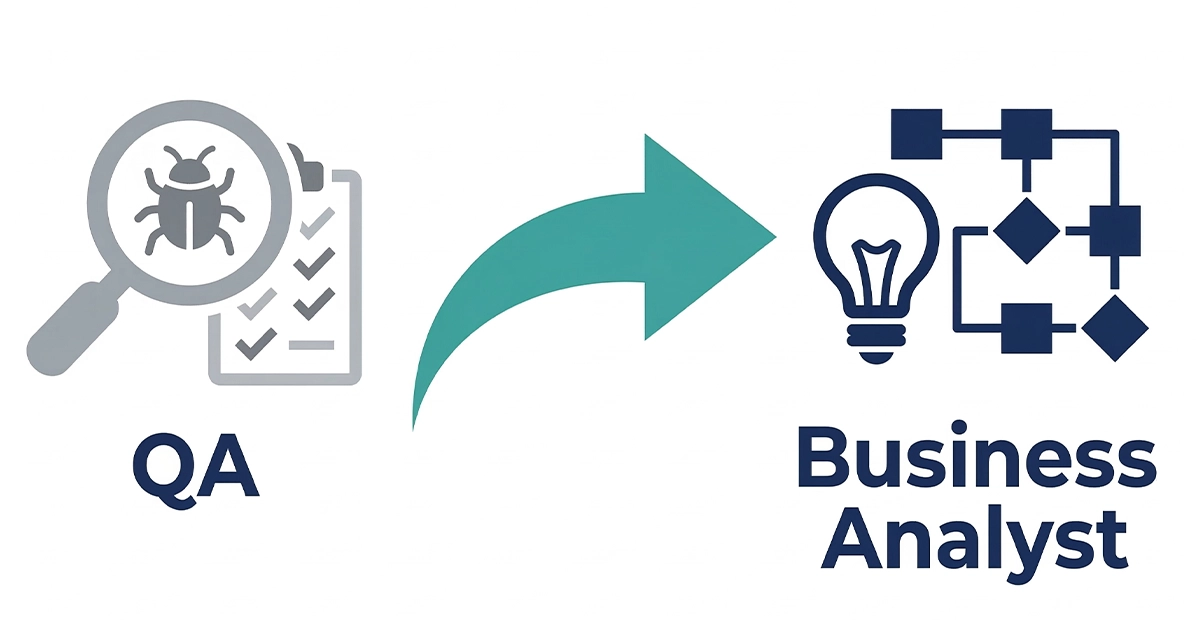
A QA to BA transition is highly achievable because quality assurance professionals already possess many of the analytical, process, and communication skills that business analysts use daily. The key steps are: mapping your transferable skills, gaining formal knowledge through an ECBA certification, building practical BA experience, and networking with working business analysts. Most QA professionals successfully complete this career shift within 6 to 12 months.
Introduction
If you work in quality assurance and are thinking about moving into business analysis, you are in a stronger position than you might realise. QA professionals bring a set of skills to the BA role that many candidates from other backgrounds simply do not have — including systematic thinking, deep knowledge of software development processes, and the ability to spot gaps between what a system does and what it should do.
This article covers the key differences between the two roles, the skills that transfer directly, the gaps you will need to fill, and the practical steps that real QA professionals have used to make the switch. We also share a genuine first-person account from a professional who made the transition, so you can see what the process looks like in practice.
However, as time went by, I realized that I wanted to be involved in bigger things. I needed to know why we were making some features and how they would help users. This curiosity led me to investigate the role of a Business Analyst.
In This Article
- What Is the Difference Between QA and BA?
- Why QA Professionals Make Strong Business Analysts
- 5 Steps to Transition from QA to Business Analyst
- Planning Your QA to BA Transition? Get the Free BA Career Roadmap
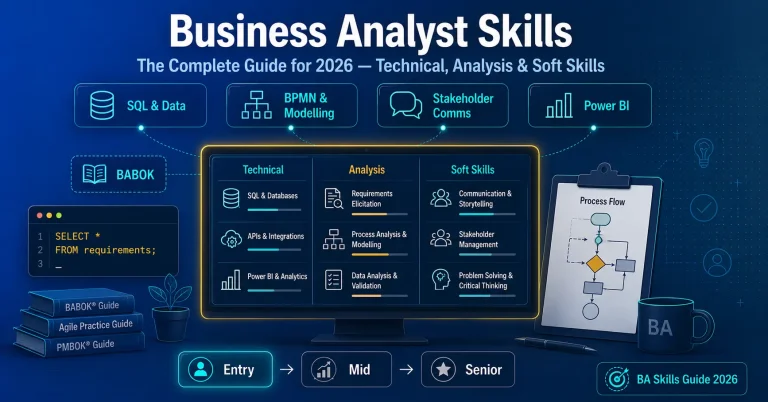
- Skills You Need to Develop as a Business Analyst
- Certifications That Help Your QA to BA Transition
- How Long Does the QA to BA Transition Take?
- Conclusion
- Frequently Asked Questions: QA to BA Transition
What Is the Difference Between QA and BA?
Before planning your transition, it helps to understand exactly where the two roles differ — and where they overlap. Quality assurance and business analysis share more common ground than most people expect.
| QA (Quality Assurance) | BA (Business Analyst) | |
|---|---|---|
| Primary focus | Finding defects and ensuring software quality | Understanding business needs and defining requirements |
| Main output | Test plans, defect reports, test cases | Requirements documents, user stories, process models |
| Key activities | Writing and executing tests, regression testing, UAT coordination | Stakeholder interviews, workshops, requirements elicitation, gap analysis |
| Primary stakeholders | Development team, test managers, project managers | Business sponsors, end users, project managers, development team |
| Analytical focus | Does the system work as specified? | Does the specification reflect what the business actually needs? |
| Overlap | Both require analytical thinking, attention to detail, strong communication, process understanding, and knowledge of the software development lifecycle. | |
Why QA Professionals Make Strong Business Analysts
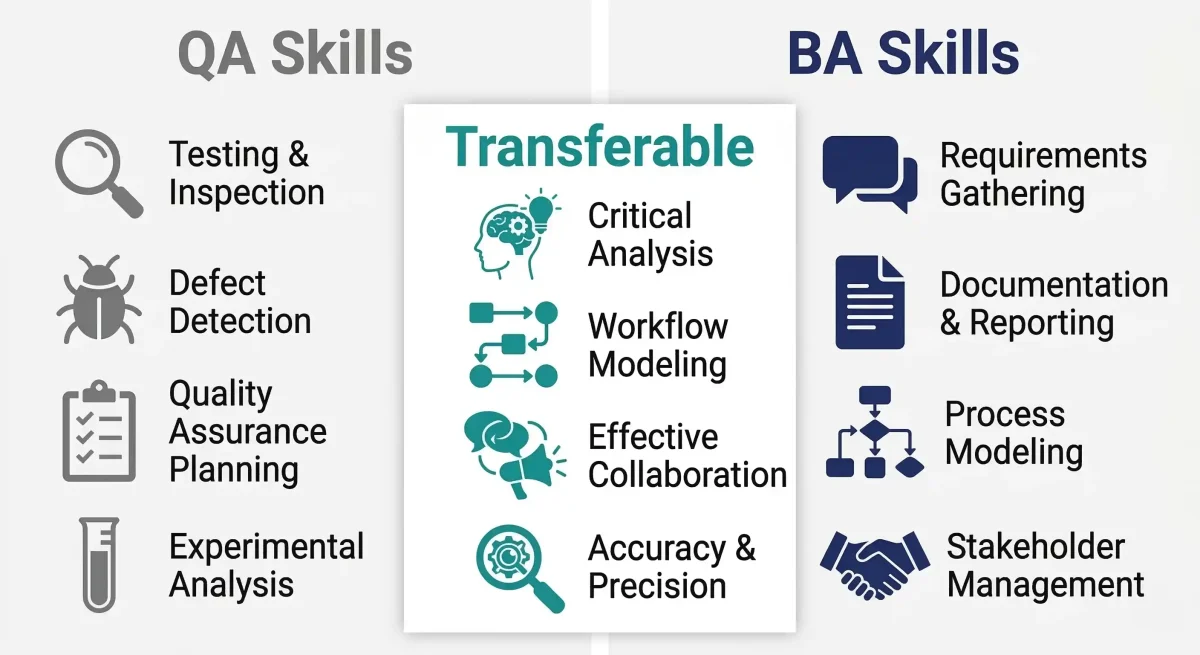
The skills you have built in QA are not just useful for business analysis — in several areas they give you a genuine head start over candidates coming from other backgrounds. Here is a structured view of what transfers directly:
| QA Skill | How It Transfers to BA | Strength Level |
|---|---|---|
| Analytical thinking | Identifying gaps between expected and actual behaviour is exactly what a BA does when analysing business processes | Direct transfer |
| Attention to detail | Writing precise requirements documents demands the same rigour as writing unambiguous test cases | Direct transfer |
| SDLC knowledge | Understanding how software is built, tested, and deployed makes you a more credible BA in technical conversations | Direct transfer |
| Stakeholder communication | QA professionals regularly communicate defects and risks to developers, PMs, and business users | Strong foundation |
| Process documentation | Test case documentation skills translate directly to writing use cases, user stories, and process flows | Strong foundation |
| Root cause analysis | Finding the root cause of a defect uses the same investigative approach as identifying the root cause of a business problem | Strong foundation |
| Business domain knowledge | If you have tested software in a specific domain (banking, healthcare, retail) you already have contextual knowledge that is valuable in BA roles in that domain | Varies by experience |
5 Steps to Transition from QA to Business Analyst
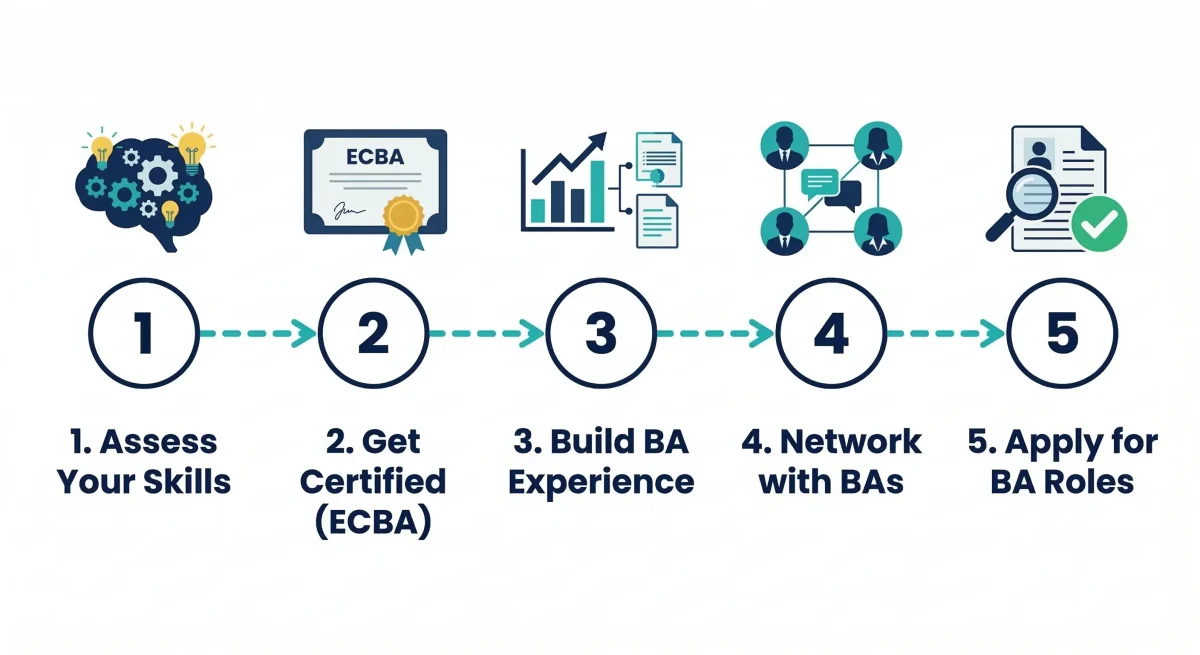
Based on the experience of professionals who have made this transition, here are the five steps that consistently lead to a successful QA to BA move:
Step 1: Map Your Transferable Skills
Start by listing every QA skill you have and writing next to each one how it applies to business analysis. Use the skills table earlier in this article as a starting point. This exercise does two things: it builds your confidence by showing how much you already know, and it gives you the raw material for your CV and interview answers. You will quickly see which skills transfer directly and which ones need development.
Step 2: Learn Business Analysis Fundamentals
QA and BA are related disciplines but the BA role has its own frameworks, terminology, and techniques that you will need to learn. The IIBA BABOK Guide is the standard reference for the profession. An ECBA (Entry Certificate in Business Analysis) course covers the core concepts systematically and is specifically designed for people new to the BA role. You do not need to memorise everything — you need to build enough foundational knowledge to have credible conversations with stakeholders and hiring managers.
Step 3: Get Your First BA Experience
The most common challenge in a QA to BA transition is the “no experience” gap — employers want BA experience but you cannot get it without a BA role. The practical solution is to find BA opportunities within your current QA role. Volunteer to document requirements for a new feature. Attend stakeholder meetings with your BA colleagues. Offer to write user stories for the next sprint. Even a few months of this type of involvement is enough to include on your CV as genuine BA experience.
Step 4: Build Your BA Network
LinkedIn is the most useful platform for this. Connect with business analysts in your industry. Join BA communities and forums. Follow IIBA chapters in your region. Tell your network that you are making the transition — many BA roles are filled through referrals. If your current organisation has BAs, ask one of them if they would be willing to answer a few questions about their role. Most experienced BAs are willing to help people who are genuinely motivated to transition into the field.
Step 5: Apply Strategically
When you start applying for BA roles, target positions that specifically mention a QA or testing background as a plus. These roles exist — particularly in software companies and consultancies that value hybrid QA/BA skill sets. Tailor your CV to lead with your analytical and process skills rather than your testing tools. Your cover letter should explicitly frame your QA background as an advantage for the BA role, not as something to apologise for or minimise.
Planning Your QA to BA Transition? Get the Free BA Career Roadmap
A free step-by-step guide used by thousands of professionals transitioning into business analysis.
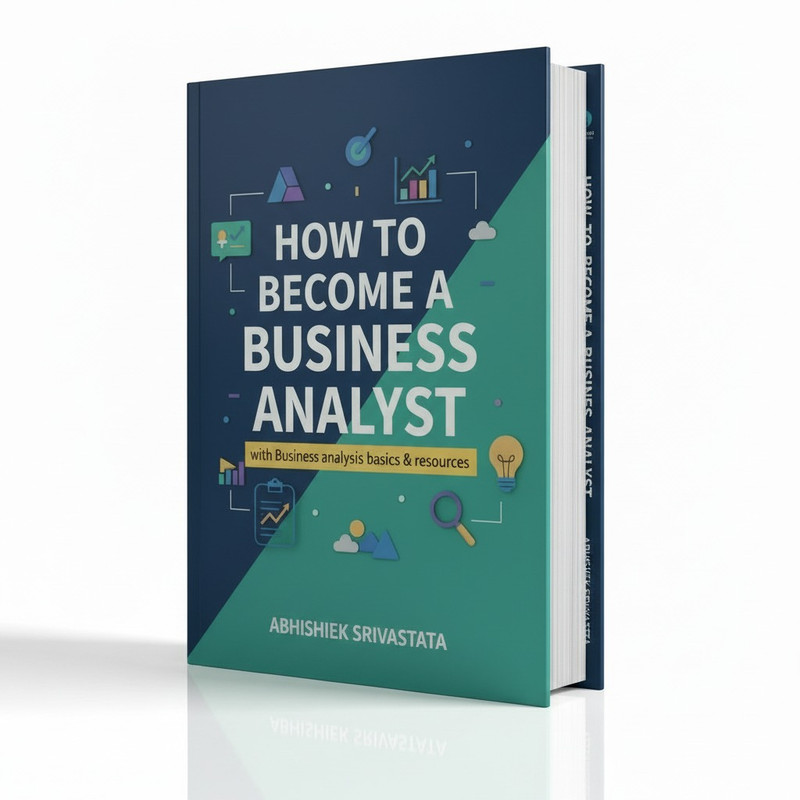
Starting Your QA to BA Transition? This Free Guide Has Your Roadmap
Written by Abhishek Srivastava — 30+ years in BA, Project and Program Management. Covers the BA skills roadmap, certifications, and how AI is changing the role.
Skills You Need to Develop as a Business Analyst
Alongside your transferable skills, there are areas where most QA professionals will need deliberate development before or during their first BA role:
| Skill Gap | Why It Matters | How to Develop It |
|---|---|---|
| Requirements elicitation techniques | Interviewing stakeholders, running workshops, and using techniques like MoSCoW prioritisation are core BA activities that QA professionals rarely practise | ECBA course covers elicitation techniques. Practise by leading requirement discussions in your current role. |
| Business process modelling | Drawing As-Is and To-Be process maps using BPMN notation is a standard BA deliverable | Free online BPMN tools (Lucidchart, draw.io). Practice by mapping a process you already test. |
| Use case and user story writing | Writing structured requirements documents is different from writing test cases — the audience and purpose are different | Read examples of real user stories. Rewrite one of your existing test cases as a user story for practice. |
| Stakeholder management | BAs spend more time managing competing stakeholder priorities than QAs do — this requires a different type of communication | Volunteer to facilitate a requirements meeting or lead a sprint review. Seek feedback from your BA colleagues. |
| Business case development | Understanding how to structure a business case for a proposed change is a senior BA skill that sets you apart | Study business case templates. Offer to support your organisation’s next change initiative at the early stages. |
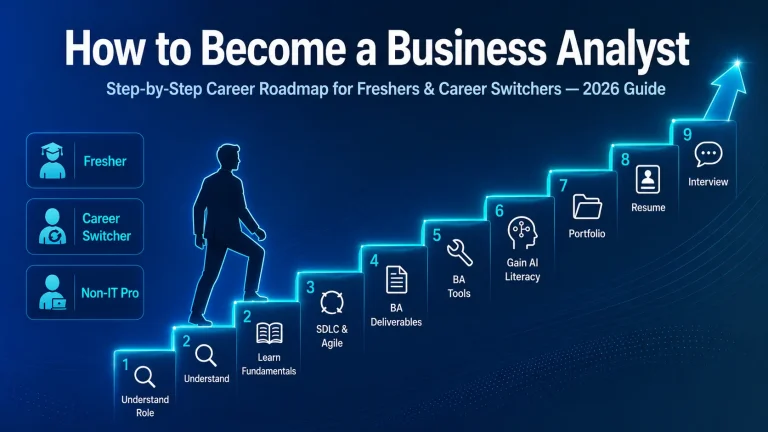
How to Become a Business Analyst in 2026
Explore our ultimate, step-by-step roadmap designed specifically for freshers and non-IT career switchers. Master the essential skills, tools, and certifications required to land your first BA role.
Certifications That Help Your QA to BA Transition
While no certification is mandatory to become a business analyst, formal qualifications significantly strengthen your application when you are transitioning from another discipline. Hiring managers use certifications as a proxy for commitment and foundational knowledge.
| Certification | Issued By | Best For | Notes |
|---|---|---|---|
| ECBA (Entry Certificate in Business Analysis) | IIBA | QA professionals entering BA for the first time | No prior BA experience required. Covers core BA concepts, BABOK framework, and elicitation techniques. |
| CCBA (Certification of Competency in Business Analysis) | IIBA | QA professionals with some BA experience | Requires 3,750 hours of BA experience. A strong next step after ECBA. |
| CBAP (Certified Business Analysis Professional) | IIBA | Experienced BAs seeking senior roles | Requires 7,500 hours of BA experience. Long-term goal for the transition journey. |
Ready to start your QA to BA transition? Enrol in Techcanvass’s ECBA training — an IIBA-endorsed course designed for professionals entering business analysis from adjacent roles.
How Long Does the QA to BA Transition Take?
The honest answer is: it depends on your starting point and how actively you pursue the transition. Based on the experiences of professionals who have made this move, here is a realistic timeline:
| Timeframe | What You Can Achieve |
|---|---|
| Months 1-3 | Complete ECBA training. Begin mapping transferable skills. Identify BA opportunities within your current role. |
| Months 3-6 | Start gaining practical BA experience. Document requirements, attend stakeholder meetings, shadow a BA. Build LinkedIn connections in the BA community. |
| Months 6-9 | Begin applying for BA roles. Target hybrid QA/BA positions or BA roles in your existing domain. Sit the ECBA exam if not already done. |
| Months 9-12 | Receive your first BA job offer. Most motivated QA professionals who follow a structured approach make the transition within this window. |
Conclusion
Transitioning from QA to business analysis is one of the most natural career moves in the technology industry. You already think analytically, you understand software systems, and you know how to communicate technical information to non-technical stakeholders. The gap between where you are and where you want to be is smaller than it looks from the outside.
The fastest path is a combination of formal learning (ECBA certification), practical experience (BA activities within your current role), and deliberate networking (connecting with working BAs who can give you honest guidance). Most professionals who follow this approach make the transition within a year.
See our Free Business Analyst course for beginners guide if you want a broader overview of how to enter the business analysis profession.