Best 5 Elicitation Techniques for Business Analyst

Table of Contents
Introduction
Elicitation is unarguably one of the most important activities by a business analyst. It describes the tasks performed by a business analyst to obtain information from all required stakeholders. however, It includes Requirements Elicitation Techniques to involve extracting or drawing forth information from stakeholders or other sources, primarily on business needs and requirements. Business analysts perform elicitation activities through direct communication with stakeholders. To carry out research or experimentation or they may simply hands over the required information.
Elicitation can be planned, unplanned, or both. Planned elicitation is structured and organized in nature whereas unplanned elicitation happens without any prior notice. Information gathered through unplanned elicitation needs to be further analyzed and authenticated during planned elicitation. It would not be correct to perceive elicitation as a one-time activity. Analysis carried out through elicitation may trigger additional elicitation for details to fill in gaps or substantiate understanding.
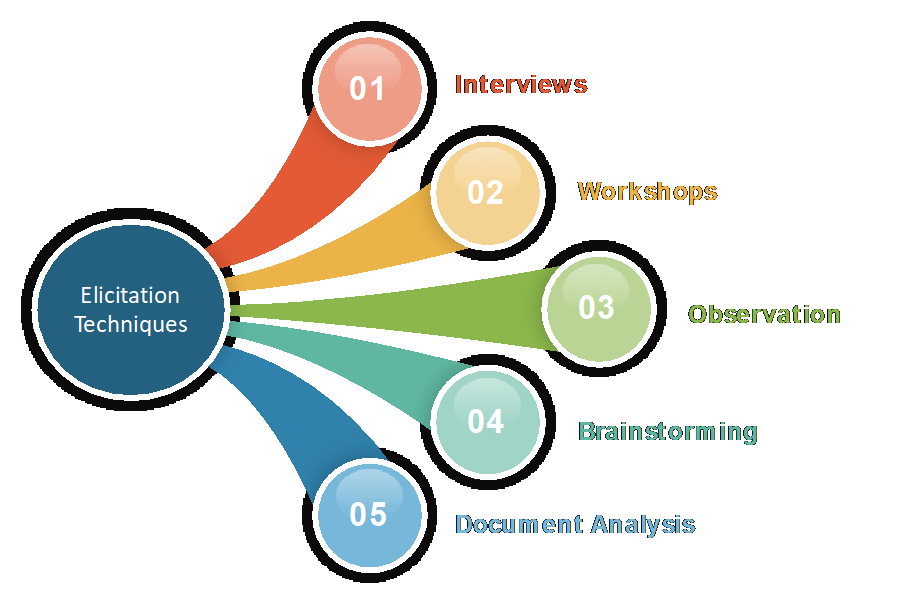
Successful business professionals need to have strong leadership skills. There are many different ways that one can improve their leadership skills. The best way is by earning a certification in business analysis. We offer an Entry Certificate in Business Analysis (ECBA) an IIBA certification to help you become a business analyst. There is a multitude of techniques that a business analyst can employ to perform elicitation. It Involves few most effective and commonly used ones specified below –
Useful Links
Download CBAP/CCBA Preparation Guide
A complete study companion — exam strategy, practice questions, and a step-by-step study plan to help you pass CBAP or CCBA with confidence.
Interviews
An interview is an organized approach to elicit information from one or more stakeholders. It is by interacting with them, asking pertinent questions, and documenting the responses. It assists in building relationships with stakeholders that lead to increased involvement and support from their side. Interviews may be in a form of structure (predefine format and order of questions), unstructured (no predefined format and order of questions) or a combination of both. For an interview to yield desired results, the interviewer should possess the required domain/subject area knowledge, have the necessary experience & skills in conducting & documenting interviews, and share a good rapport with the interviewee. The interviewee’s readiness in providing the required information and his/her clarity of goal has significant effects on the interview outcome as well.
Key Benefits of Interviews
Interviews enable detailed discussions on questions & even observation of non-verbal actions, allows for follow-up questions to clarify doubts, and helps sustain the interviewee’s confidentiality if required.
Workshops
Workshops by a business analyst to elicit information in a collaborative and facilitated set-up where stakeholders. It teams up for a set period of time to achieve a pre-determined goal. workshops in a focused manner in accordance with ground rules like respecting each other’s opinions, limiting discussion on an off-topic, and reaching a shared agreement on decision making. A workshop includes a neutral third-party facilitator who establishes the purpose, desired outcomes, session agenda and put the ground rules in force; a scribe who documents the decisions and track deferred items; participants who discuss the agenda items and share views. A business analyst may perform the role of a facilitator, scribe, or participant in the workshops.
Key Benefits of Workshops
Workshops foster collaboration and help the participants to develop and share understanding and reach decisions in quick time. As a result, It prevents any confusion which may result from having separate discussions with individual stakeholders in scenarios where mutual understanding and agreement is needed. It is more cost-effective as compared to carrying out multiple interviews.
Observation
Observation is an elicitation technique that helps in collecting information by observing process flows and work environments of stakeholders. It helps business analysts in situations where users are unable to explain requirements clearly. It is in an ACTIVE manner where the observer asks any questions to extract information. In leading to a quick understanding of rationale & hidden processes or the PASSIVE manner where the observer doesn’t intervene in activities by stakeholders & raise any queries once the observation is over.
Key Benefits of Observation
Observation provides practical insights into the actual real-world activities and even enables the identification of informally performed tasks. It also facilitates the identification of areas that can potentially be improved.
Brainstorming
Brainstorming is a technique because it promotes the creative thinking of a group to generate numerous thoughts/ideas/information. Generally, it takes a short period of time. It draws on the creativity and experience of a set of participants to generate information in an engaging environment. since participants build on each other’s ideas/opinions/thoughts/viewpoints to generate more information. This technique has the potential to discover information by encouraging the group to think out of the box. It generally involves a facilitator who takes up the task of ensuring that there is no judgment or criticism of ways of thinking of a participant and prevents any heated arguments.
Key Benefits of Brainstorming
Brainstorming creates a tension-free & non-judgemental environment thereby fostering creative thinking & complete participation. for instance, It leads to the elicitation of a wide amount of information in a short span of time and even helps discover and touch upon unexplored areas.
Document Analysis
Document Analysis is an elicitation technique to extract information by examining existing documentation. however It is beneficial in a scenario where the Subject Matter Experts are not available to participate in elicitation activities. Key activities carried out as a part of document analysis include evaluating whether the source document is relevant, current & credible, in other words, conducting a detailed document review & recording notes; performing review with subject matter experts to validate findings. Commonly used document types used for analysis are process documents, system specifications, contracts. It also involves statements of work, business cases, business plans, training manuals, meeting minutes.
Key Benefits of Document Analysis
Document analysis leverages reliable material that is already in place and available for use. It helps in clearly differentiating between what is current (and what is not) thereby serving as base for future analysis. It can be in conjunction with other elicitation techniques. as well, serving as preparatory material before performing other elicitation techniques or validate the results of other elicitation techniques.
Here are requesting comments from the business analysis community to share the various elicitation techniques. You applied in your business analysis career across your different work assignments.
Useful Links
About Techcanvass
We are an Information Technology certifications training Organization for professionals. It offers internationally recognized certifications in the fields of Project Management and Business Analysis. It is a premier Authorized training partner of Project Management Institute (PMI), USA and a premier Endorsed Education Provider (EEP) of International Institute of Business Analysis (IIBA), Canada. We provide CBAP Course, CCBA Course, Agile Analysis Certification (AAC) Courses, and PMP Certification Training. Founded by IT professionals, We are committed to making learning a more structured, practical, and goal-oriented exercise. We also provide consulting services in the fields of Project management and Business Analysis.
FAQs on Elicitation Techniques for Business Analyst
Q1. What is elicitation in business analysis?
Elicitation refers to the tasks a business analyst undertakes to draw out information from stakeholders or sources about business needs and requirements.
Q2. Why can elicitation be both planned and unplanned?
Elicitation may happen in a structured, organized fashion (planned) or spontaneously without prior notice (unplanned); the unplanned gathered information still needs validation and analysis.
Q3. What are interviews as an elicitation technique and when are they useful?
Interviews involve interacting with one or more stakeholders through questions and documentation, and they’re useful because they allow detailed discussion, follow-up questions and observation of non-verbal cues.
Q4. How do workshops help in requirement elicitation?
Workshops bring stakeholders together with a facilitator and scribe to collaborate, share views and reach agreement quickly, which can be more cost‐effective than many separate interviews.
Q5. Why is observation a valuable elicitation technique?
Observation lets a business analyst watch stakeholders’ workflows and environments—either actively or passively—to uncover hidden or informal processes that users may not verbally articulate.
Q6. What role does document analysis play in elicitation?
Document analysis examines existing artifacts like process documents, system specs or contracts to extract information—especially helpful when subject matter experts aren’t available.
Q7. Why is brainstorming included as an elicitation technique?
Brainstorming gathers many ideas quickly in a non-judgmental group setting, which helps discover wide-ranging information and explore areas that might otherwise remain hidden.