
| Key Facts | Details |
|---|---|
| Full name | Business Analysis Core Concepts Model (BACCM) |
| Defined in | BABOK Guide v3 — published by IIBA (International Institute of Business Analysis) |
| The 6 core concepts | Need, Change, Solution, Stakeholder, Value, Context |
| Purpose | Creates a common language and shared reference framework for all business analysis work |
| Exam relevance | Tested in CBAP, CCBA, and ECBA certification exams |
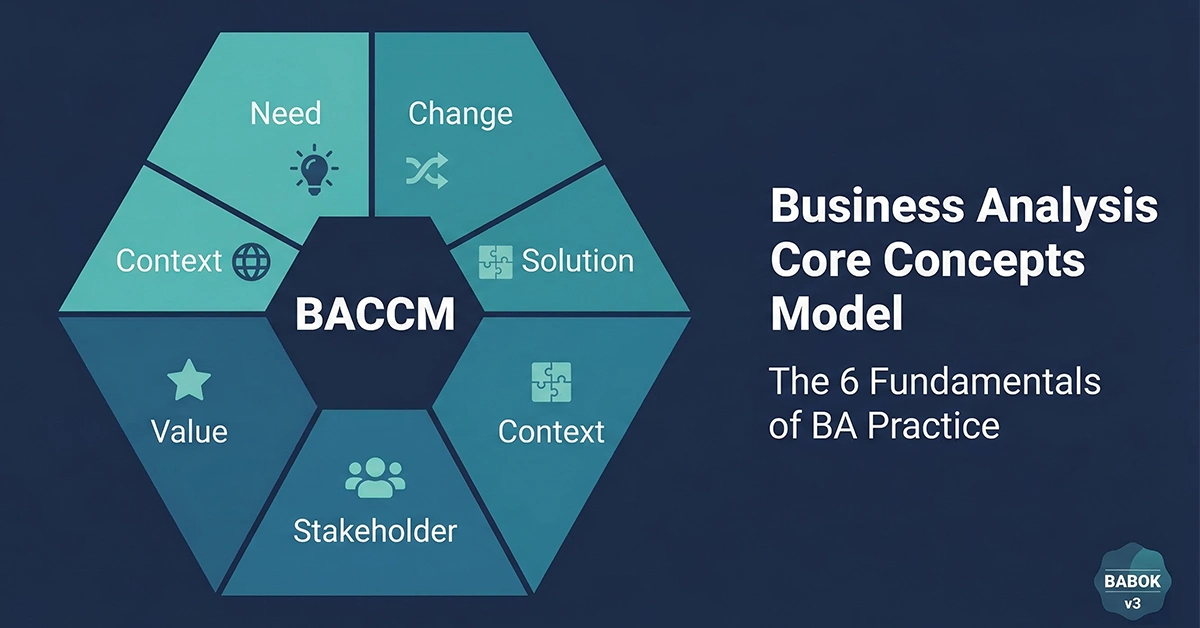
| Visual format | Hexagonal diagram showing all 6 concepts as equally important and interrelated |
| Who needs it | Business Analysts, Product Owners, Business Architects, BA certification candidates |
| Last updated | March 2026 |
In This Article
What is the BACCM Model?
The Business Analysis Core Concepts Model, known as BACCM, is the foundational framework that defines what business analysis is and what it works with. Introduced in BABOK Guide v3 by the IIBA, BACCM establishes six core concepts that are fundamental to every business analysis activity, regardless of industry, methodology, or project type.
Before BACCM, business analysts across different organisations and methodologies often used inconsistent terminology for the same ideas. A ‘requirement’ in one team might be a ‘need’ in another. BACCM resolves this by providing a shared vocabulary — a common language that allows business analysts to communicate precisely with each other and with stakeholders.
The six core concepts are: Need, Change, Solution, Stakeholder, Value, and Context. These are not sequential steps or phases in a process. They are fundamental categories that describe everything a business analyst works with in any engagement. Every elicitation session, every requirements document, every stakeholder conversation can be mapped back to one or more of these six concepts.
- Related: If you are new to the field, our business analyst career guide covers the foundational skills and steps needed to start your BA journey.
What is the Purpose of the BACCM Model?
The BACCM serves three primary purposes in business analysis practice:
- Common language: It gives business analysts a universally agreed vocabulary so that practitioners across different organisations, industries, and methodologies can understand each other without ambiguity.
- Framework for knowledge areas: BACCM provides the conceptual underpinning for the six BABOK knowledge areas. Every task in every knowledge area can be described in terms of how it transforms or analyses the six core concepts.
- Foundation for certification: BACCM is the lens through which IIBA designs exam questions for CBAP, CCBA, and ECBA. Understanding how the six concepts relate to each other is tested directly in all three certification exams.
In practical terms, BACCM helps a business analyst walk into any engagement — a digital transformation, a regulatory compliance project, a product launch — and apply the same analytical lens consistently. The concepts remain constant even as the methods and tools change.
Preparing for CBAP, CCBA, or ECBA certification?
BACCM is a foundational topic tested across all three IIBA certification exams. Techcanvass offers structured certification training programmes designed by IIBA-endorsed trainers.
The 6 Core Concepts of BACCM — Definitions and Examples
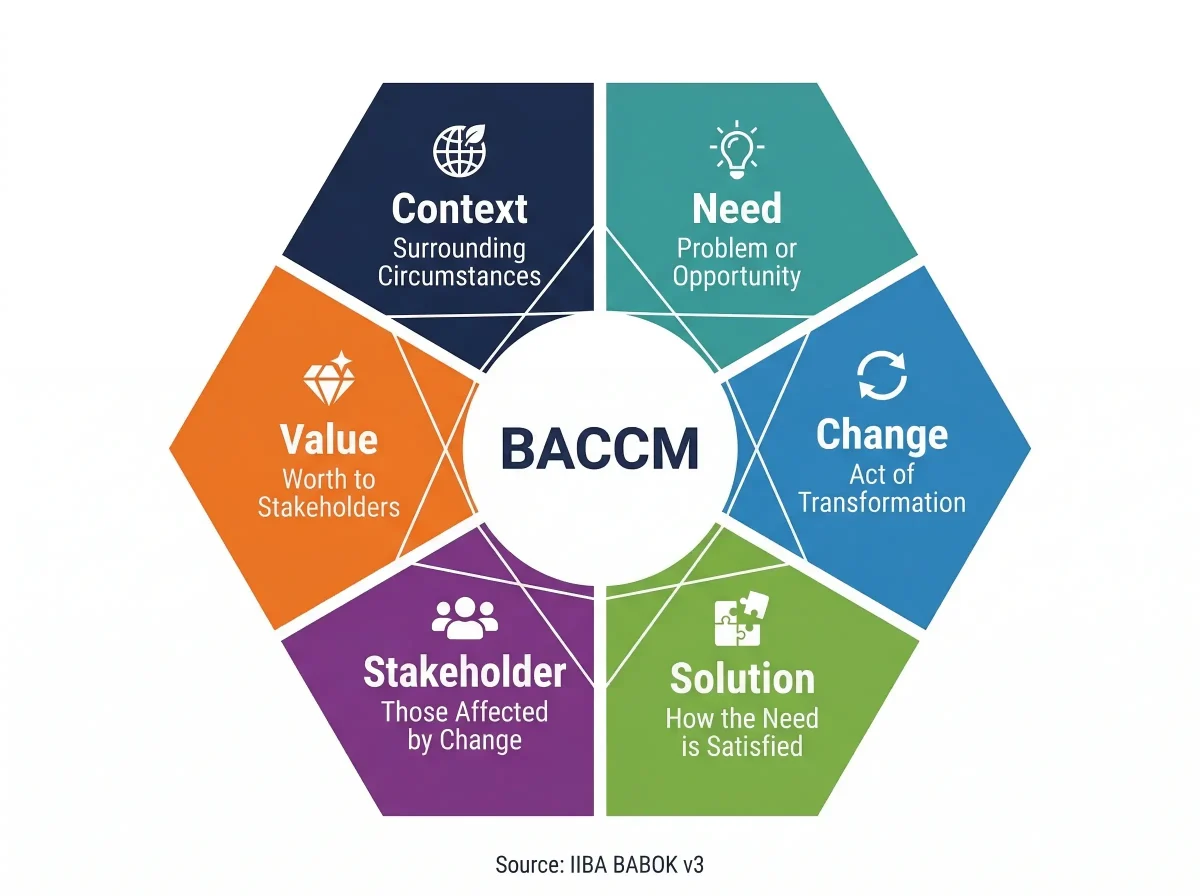
The six core concepts of BACCM are presented as a hexagonal model because they are equally important — none is more fundamental than another — and they are all interrelated. Changing any one of them has implications for the others.
1. Need — The Business Problem or Opportunity
Definition: ‘A need is a problem or opportunity to be addressed.’
Need is the starting point of every business analysis engagement. Before defining a solution, before analysing stakeholders, before thinking about value — the business analyst must first establish what need is being addressed. A need can be a problem (something is broken, inefficient, or non-compliant) or an opportunity (a new market, a technology improvement, a strategic advantage available to be captured).
Example: A bank’s customer onboarding process takes 14 days. The need is ‘reduce customer onboarding time to remain competitive with digital-native competitors.’ This is a problem-type need driven by competitive pressure.
Common mistake: confusing a need with a solution. ‘We need a new CRM system’ is a solution statement. ‘We need to improve sales team visibility into customer interactions’ is a need statement. Business analysts must constantly push back to the actual need.
2. Change — The Act of Transformation
Definition: ‘Change is the act of transformation in response to a need.’
Change is what happens as a result of addressing a need. In BACCM, change is deliberate and purposeful — it is the transformation an organisation undergoes to move from its current state to a desired future state. Business analysis is fundamentally the discipline of managing change by understanding it, defining it, and enabling it to happen successfully.
Example: The bank digitises its onboarding process. The change includes new technology, revised processes, updated staff training, and changed customer interactions. The business analyst’s role is to understand the full scope of this change and ensure all aspects are addressed in the requirements.
Change always creates risk and resistance. A key BA responsibility is identifying who is affected by the change (stakeholders) and what value it is expected to create — which is why all six BACCM concepts are interconnected.
3. Solution — The Means of Satisfying the Need
Definition: ‘A solution is a specific way of satisfying one or more needs in a context.’
A solution is what is built, implemented, or changed to address the identified need. Solutions are not necessarily software or technology — they can be process changes, organisational restructuring, policy updates, or any combination. Critically, BACCM emphasises that solutions must satisfy needs within a specific context — the same solution may work in one context and fail in another.
Example: The bank’s solution is a digital onboarding portal with electronic document verification and real-time credit checks. This solution satisfies the need (faster onboarding) within the specific context (regulated banking environment with KYC compliance requirements).
A well-defined solution is traceable back to a need. If a proposed solution cannot be connected directly to an identified need, the business analyst should question whether it should be in scope.
4. Stakeholder — Those With a Relationship to the Change
Definition: ‘A stakeholder is a group or individual with a relationship to the change, the need, or the solution.’
In BACCM, ‘stakeholder’ has a broader meaning than the everyday usage. It is not just executive sponsors and end users — it includes anyone who has a relationship to the change. This includes those who are affected by the change without knowing it, those who enable the change, and those who might obstruct it. Business analysts must identify the full stakeholder landscape, not just the obvious ones.
Example: For the digital onboarding portal, stakeholders include: new customers (direct users), compliance officers (regulators of the process), IT infrastructure team (builders), call centre agents (whose role changes when onboarding becomes digital), and the bank’s external KYC data providers (whose APIs enable the solution).
5. Value — The Worth or Importance of Something
Definition: ‘Value is the worth, importance, or usefulness of something to a stakeholder within a context.’
Value is the reason any business analysis activity is justified. It is not the same as financial return — value is whatever is important to the relevant stakeholders. Reducing risk is value. Improving compliance is value. Saving time is value. Increasing revenue is value. The definition of value is always relative to who is receiving it and in what context.
Example: The digital onboarding portal delivers different value to different stakeholders: customers receive faster account opening (time value), the compliance team receives a more consistent audit trail (risk reduction value), the bank receives higher conversion rates from applications started online (financial value).
Business analysts must define value explicitly — not assume it. A solution that delivers value to one stakeholder group while destroying value for another is not a net positive outcome.
6. Context — The Circumstances That Influence the Change
Definition: ‘Context is the circumstances that influence, are influenced by, and provide understanding of the change.’
Context is everything surrounding the change that shapes how it must be approached. It includes the organisation’s culture, regulatory environment, technology landscape, competitive market, project history, geographic factors, and the relationships between these. Context is what makes a solution that works brilliantly in one situation fail completely in another.
Example: The bank’s digital onboarding solution must account for the regulatory context (KYC/AML requirements), the technology context (existing core banking system integration), and the cultural context (older customer segments who may be less comfortable with fully digital processes).
Context is one of the most underestimated concepts in practice. Many failed BA projects can be traced to solutions designed without sufficient understanding of context — particularly regulatory, cultural, or organisational context that was not properly surfaced during requirements elicitation.
How the 6 Core Concepts of BACCM Are Interrelated
The BACCM is presented as a hexagon rather than a linear framework deliberately. Each of the six concepts occupies one point of the hexagon, and every concept is connected to every other concept by a line. This visual design communicates a fundamental principle: you cannot change one concept without affecting all the others.
Consider a change in Need. If the business need changes mid-project, the Solution must be re-evaluated. The Stakeholders affected by the solution may change. The Value delivered shifts. The Context may need to be re-examined. Even the nature of the Change itself transforms.
This interconnectedness is why BACCM is used as a thinking tool in design reviews and requirements sessions — by asking ‘how does this decision affect each of the six concepts?’, a business analyst can systematically identify blind spots and unintended consequences before they become costly problems in delivery.
What is the BACCM Canvas?
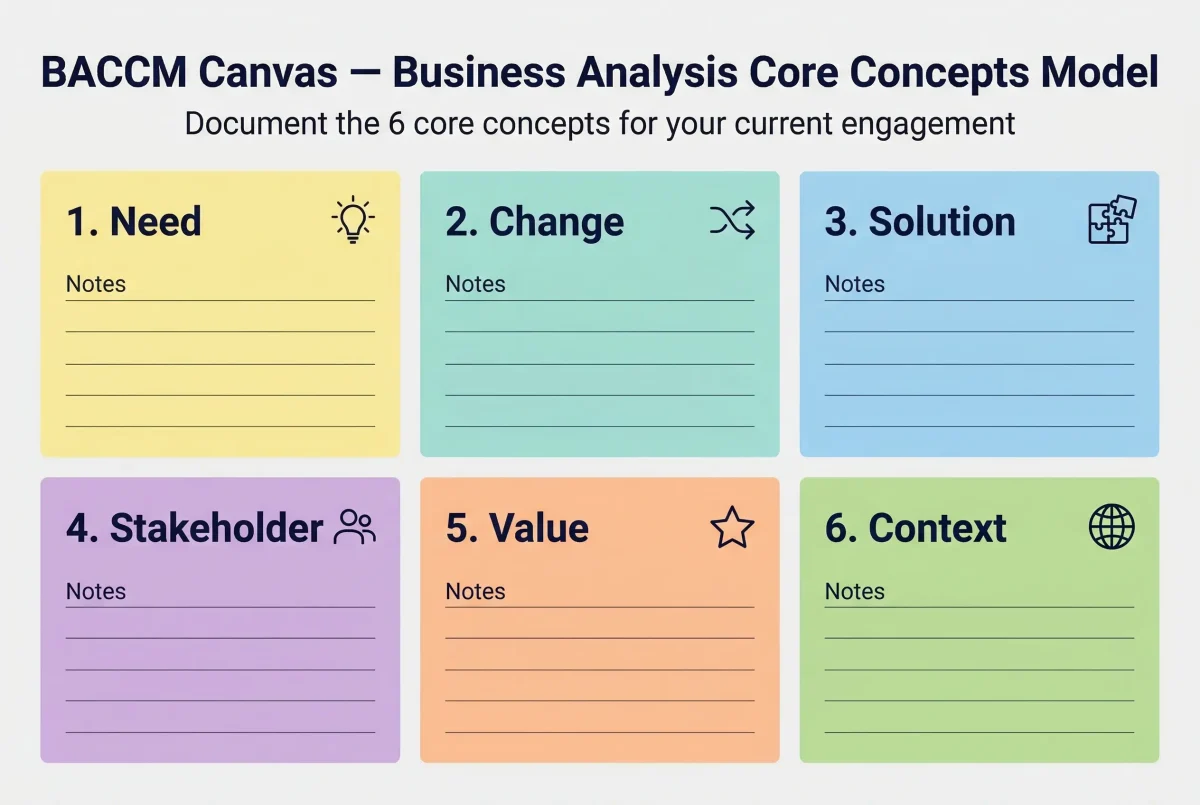
The BACCM Canvas is a visual facilitation tool that applies the six core concepts of BACCM to a specific engagement or project. Where the BACCM model describes the concepts in abstract, the BACCM Canvas provides a structured template where business analysts document each concept as it relates to a particular change initiative.
A typical BACCM Canvas has six sections — one for each concept. For each section, the business analyst documents: what the need, change, solution, stakeholder landscape, value, and context looks like for this specific project. The completed canvas gives the entire project team a single-page summary of the business analysis perspective on the initiative.
The BACCM Canvas is particularly useful at the start of an engagement during project initiation or discovery, when the team needs to align on the fundamental parameters of the change before detailed requirements work begins. It is also used in CBAP and CCBA exam preparation as a structured way to practise applying the six concepts to case study scenarios.
BACCM in BABOK v3 — Context and Significance
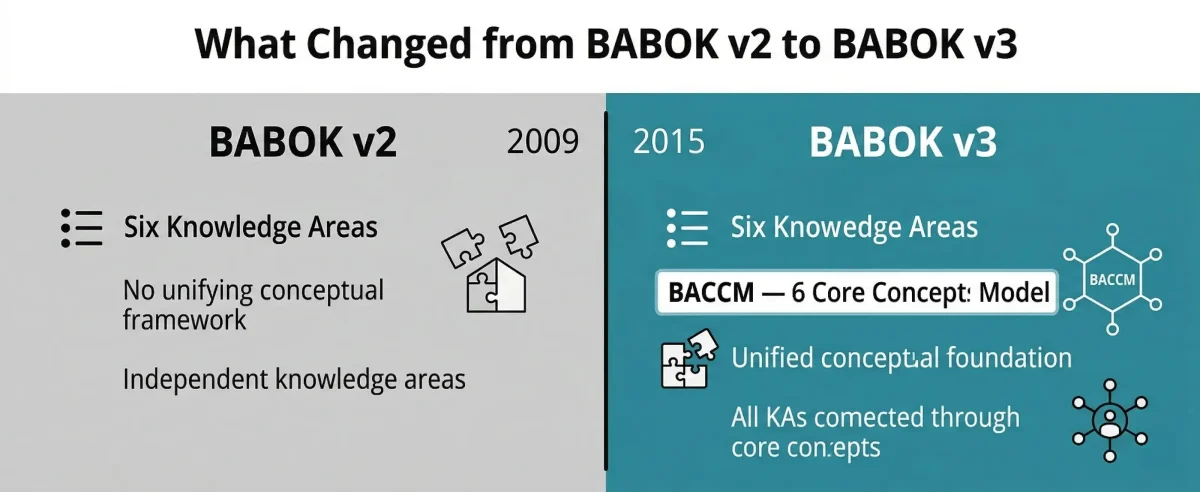
BACCM was introduced in BABOK Guide v3, published by the IIBA in 2015. It was a significant addition compared to BABOK v2, which did not include this foundational framework. In BABOK v3, BACCM appears at the very beginning of the guide — in Chapter 2 — before any of the six knowledge areas are introduced. This positioning signals that BACCM is not a technique within business analysis, but the conceptual foundation on which all techniques rest.
BABOK v3 states that the core concepts are ‘fundamental to the practice of business analysis.’ Every task in every knowledge area — from Business Analysis Planning and Monitoring to Strategy Analysis to Solution Evaluation — is described in terms of how it uses, transforms, or analyses one or more of the six BACCM concepts.
For certification candidates: Understanding the relationship between BACCM and BABOK v3 is tested directly in CBAP and CCBA examinations. Questions typically ask candidates to identify which core concept is being addressed in a given scenario, or to explain why a specific BA task relates to a particular core concept.
BACCM and BA Certifications: What Exam Candidates Need to Know
BACCM is foundational knowledge for all three entry and professional level IIBA certification exams. Understanding it is not optional for exam success.
ECBA — Entry Certificate in Business Analysis
For ECBA candidates, BACCM provides the conceptual scaffolding for all other BA knowledge covered in the exam. The six core concepts appear in the BABOK knowledge area descriptions that ECBA questions draw from. ECBA candidates should be able to define each of the six concepts and give a basic example of each.
CCBA — Certification of Competency in Business Analysis
CCBA questions test the application of BACCM concepts to intermediate-level scenarios. Candidates should understand how the six concepts relate to each other and how changes in one concept affect the others. The BACCM Canvas is a useful study tool at this level.
CBAP — Certified Business Analysis Professional
CBAP examination questions require deep application of BACCM thinking to complex, multi-stakeholder scenarios. Candidates must be able to analyse a case study and identify which core concepts are at play, how they interact, and what the business analyst’s responsibilities are in managing each. BACCM mastery is expected, not just familiarity.
Ready to earn your IIBA certification?
Techcanvass is an IIBA-endorsed education provider. Our certification courses are designed to take you from BACCM fundamentals to full exam readiness.
Frequently Asked Questions: BACCM Model
BACCM stands for Business Analysis Core Concepts Model. It is the foundational framework defined in BABOK Guide v3 by the International Institute of Business Analysis (IIBA).
BACCM describes six core concepts that underpin all business analysis work: Need, Change, Solution, Stakeholder, Value, and Context. These concepts are not sequential steps — they are fundamental categories that every business analyst works with in every engagement. BACCM was introduced in BABOK v3 in 2015 as a significant enhancement over BABOK v2, appearing in Chapter 2 before any knowledge areas are introduced.
The six core concepts of BACCM are: (1) Need — a problem or opportunity to be addressed; (2) Change — the act of transformation in response to a need; (3) Solution — a specific way of satisfying one or more needs in a context; (4) Stakeholder — a group or individual with a relationship to the change, the need, or the solution; (5) Value — the worth, importance, or usefulness of something to a stakeholder within a context; and (6) Context — the circumstances that influence, are influenced by, and provide understanding of the change.
These are presented in a hexagonal model reflecting the fact that they are all interrelated.
BABOK (Business Analysis Body of Knowledge) is the complete guide to business analysis practice, covering six knowledge areas, 30+ tasks, and hundreds of techniques. BACCM (Business Analysis Core Concepts Model) is a specific framework within BABOK v3 that describes the six fundamental concepts underpinning all that work.
Think of it this way: BABOK is the entire guide to the profession; BACCM is the conceptual foundation that ties the guide together. Every task in every BABOK knowledge area can be described in terms of how it uses or transforms the six BACCM concepts.
In CBAP and CCBA examinations, BACCM is tested through scenario-based questions that ask candidates to identify which core concept is at play in a given situation (e.g., whether a regulatory requirement is a ‘need’ or ‘context’).
CBAP questions expect candidates to analyse how changes in one core concept ripple through the others. CCBA tests application to intermediate-complexity scenarios. For ECBA, questions focus on definition and basic application. The BACCM Canvas is a useful exam preparation tool for this.
The BACCM Canvas is a visual facilitation template that applies the six core concepts to a specific business analysis engagement. It has six sections where the BA fills in how each concept manifests in the current project.
Completing the canvas gives the team a single-page alignment document that frames the engagement. It is most valuable at the start of a project before detailed requirements work begins, and is also widely used as a study tool for IIBA certification preparation.
In BACCM, a Need is defined as ‘a problem or opportunity to be addressed.’ It is the starting point of every engagement. A need can be a problem (inefficiency, non-compliance) or an opportunity (a new market, strategic advantage).
The critical distinction is between a need and a solution. ‘We need a new CRM system’ is a solution statement. ‘We need to improve sales team visibility to reduce cycle length’ is a need statement. BACCM positions Need as foundational because all other concepts only have meaning in relation to it.
Context is defined as ‘the circumstances that influence, are influenced by, and provide understanding of the change.’ It encompasses the organisation’s culture, regulations, competitive landscape, technology, and geography.
Context is often underestimated. Many failed projects trace their root cause to solutions designed without adequate understanding of context (e.g., regulatory or cultural factors). Context is also dynamic; a solution that works in one context may fail in another.
The six concepts are depicted in a hexagonal model where every concept is connected to every other concept by a line. This communicates that no concept exists in isolation.
Every change is driven by a need. Every solution must satisfy a need within a context. Every solution affects stakeholders and creates/destroys value. You cannot fully understand one concept without considering its relationship to the others, making BA a holistic discipline.
BACCM was introduced in BABOK Guide v3 in 2015. It was not present in v2. In v2, knowledge areas were relatively independent without an overarching conceptual framework.
BABOK v3 added BACCM specifically to address this gap, providing a unifying model. For certification candidates using older study materials, understanding that BACCM is a v3-only concept is crucial, as exam questions will reference it regularly.
Yes — BACCM is explicitly methodology-agnostic. It applies equally to waterfall, agile, iterative, and hybrid environments. The core concepts describe what business analysis works with, not how it does the work.
In agile, the Sprint Goal addresses the Need, the Sprint Backlog defines the Solution, Value is measured through working software, Context factors into Definition of Done, and Change is managed through backlog refinement. It provides a universal language for all project types.
