Fundamentals of the Telecom Domain: How the Industry Works
A practical guide to how telecommunications operators run their business, covering the basic communication model, network infrastructure, core services, OSS and BSS systems, industry frameworks, and key business processes. For IT professionals and Business Analysts worldwide.
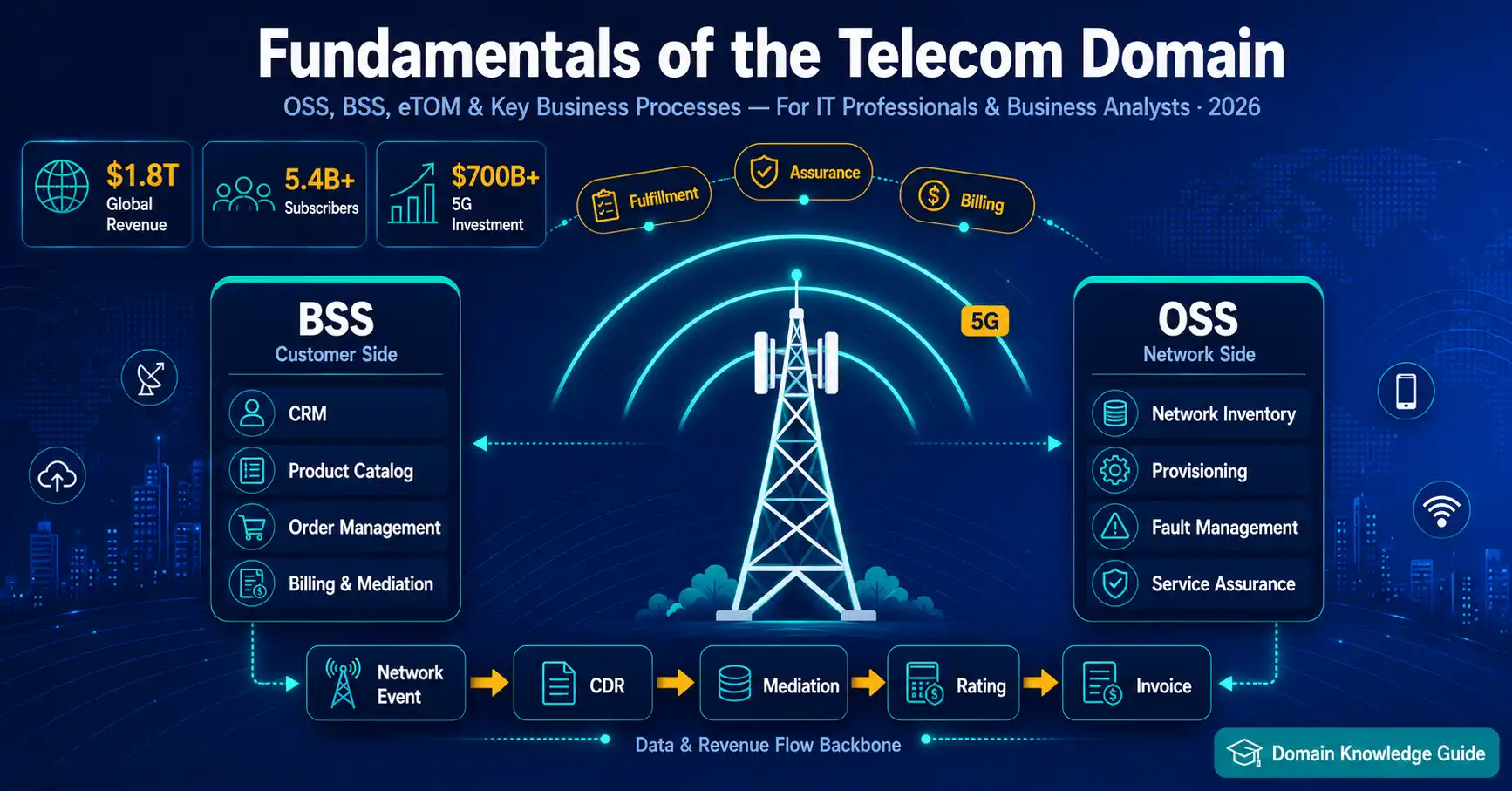
What is the telecom domain?
The telecom domain is the industry sector encompassing all technologies, systems, and business processes that enable voice calls, mobile data, fixed-line broadband, IPTV, and enterprise connectivity. It includes network operators, equipment vendors, and the software systems that run every part of the business.
For IT professionals and Business Analysts, working in this sector means knowing how operators run their networks and serve customers well enough to gather requirements and deliver technology projects. It is one of the two largest IT verticals globally alongside BFSI.
What this guide covers
- 1Communication model and network infrastructure
- 2Core services: mobile, broadband, enterprise, VoIP
- 3BSS (customer systems) and OSS (network systems)
- 4TM Forum: eTOM, SID, Open APIs
- 5Key business processes: Lead-to-Cash, Trouble-to-Resolve
What Is the Telecom Sector?
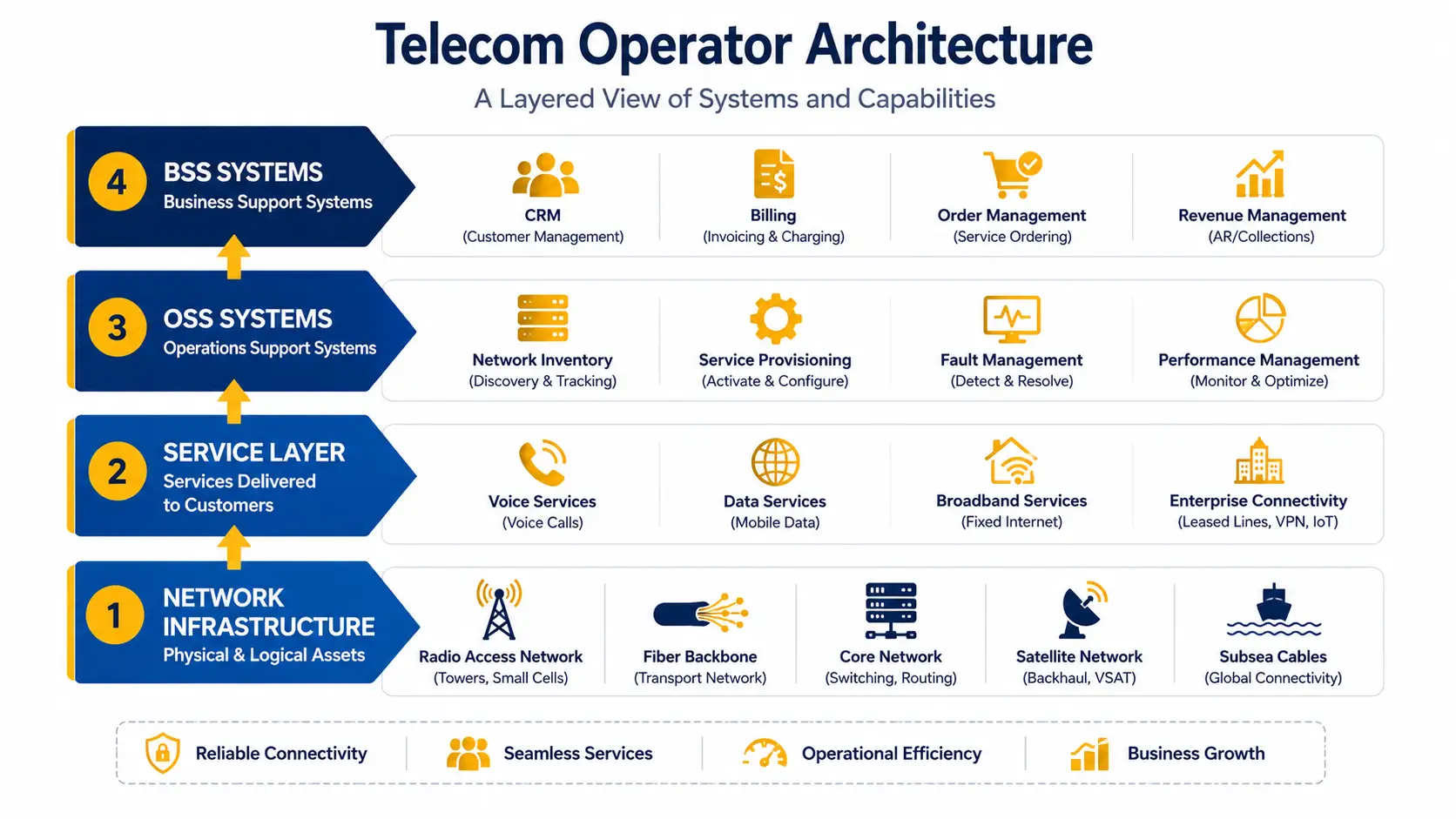
Every phone call, video stream, and business VPN connection depends on the telecommunications industry working correctly. Telecom operators build and run the physical infrastructure (towers, fiber cables, undersea cables, satellites) and the software systems that provision services, bill customers, and keep the network running.
The sector is global and deeply interconnected. In the US, AT&T, Verizon, and T-Mobile collectively serve over 400 million wireless subscribers and operate under FCC regulation. In the UK, BT Group and Vodafone run both consumer and enterprise networks under Ofcom oversight. In Australia, Telstra and Optus dominate mobile while NBN Co operates fixed broadband infrastructure, all under ACMA and ACCC regulation. In Canada, Bell, Rogers, and Telus form the big three. In India, Jio, Airtel, and Vi together serve over 1.1 billion subscribers under TRAI regulation. Globally, the market exceeds $1.8 trillion in annual revenue.
From an IT perspective, telecom operators are among the most complex technology environments to work in. They run real-time systems processing billions of events daily, integrate hundreds of network elements, and must meet strict regulatory obligations across every market they operate in.
Global telecom revenue (2024)
Total telecommunications market worldwide (Statista, 2024).
Mobile subscribers globally
Total unique mobile subscribers worldwide, across all network generations (GSMA, 2024).
5G capex investment to 2030
Cumulative global operator investment in 5G network infrastructure through 2030 (GSMA).
The Basic Communication Model
At the heart of every telecommunications system is the same fundamental model, regardless of whether the signal travels over fiber, radio waves, or copper wire. Understanding this model tells you why telecom infrastructure is designed the way it is.
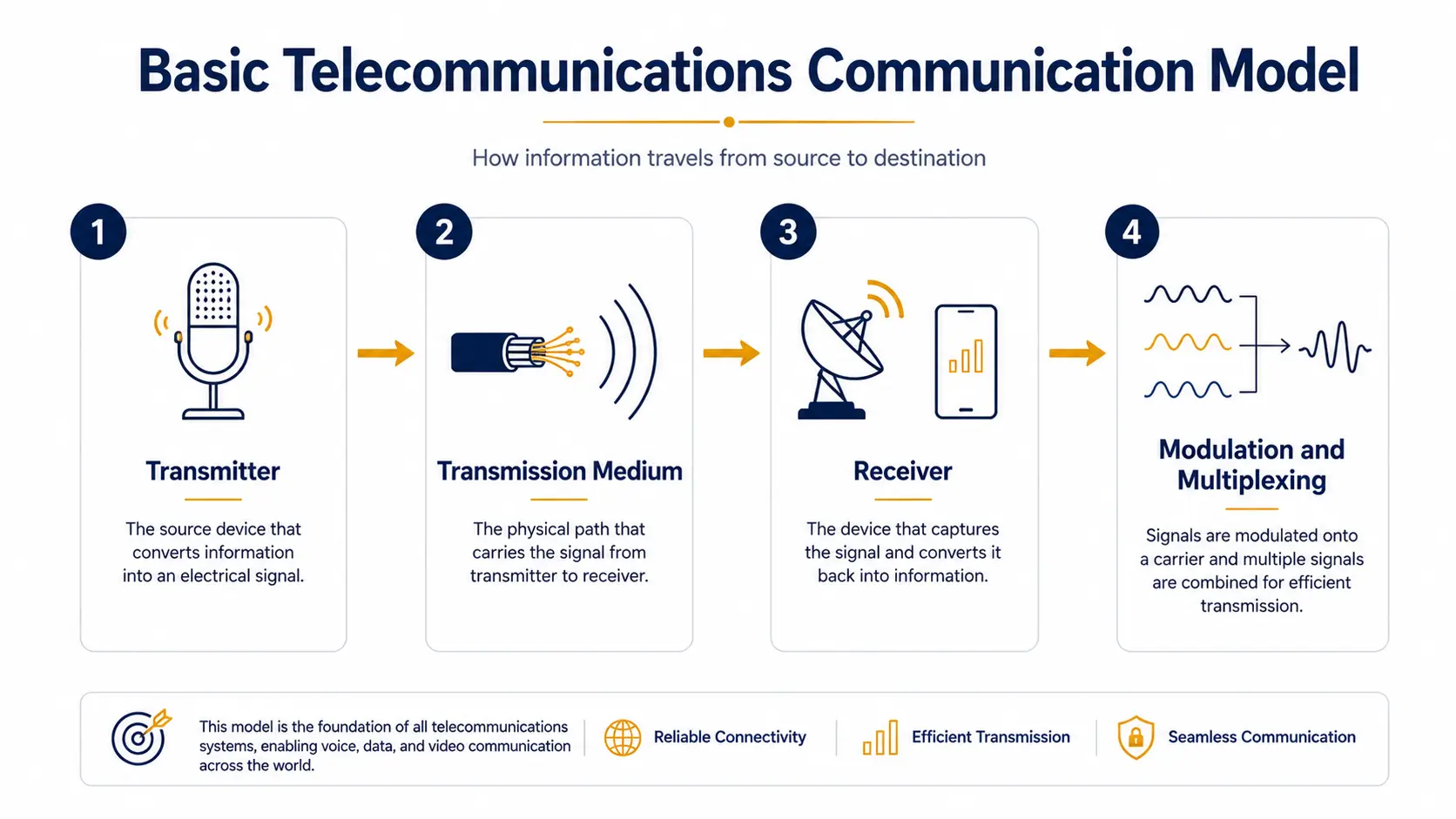
Transmitter
Converts information (voice, video, text, data) into a signal suitable for transmission. A mobile phone, a fiber transceiver, or a network router all act as transmitters.
Transmission Medium
The physical path through which the signal travels: copper wire, optical fiber, or radio waves (licensed spectrum). Each medium has different capacity, distance, and interference characteristics.
Receiver
Captures the transmitted signal and converts it back into the original information. A mobile handset, a fiber ONT (optical network terminal), or a customer router all act as receivers.
Modulation and Multiplexing
Modulation alters the carrier wave so it can efficiently carry data. Multiplexing combines multiple signals into one transmission channel, enabling thousands of calls and data sessions to share the same fiber or radio spectrum simultaneously.
For IT and BA professionals: You do not need to understand the physics. What matters is knowing that every telecom service depends on this chain, and that faults can occur at any point in it. When a customer reports a service fault, the OSS fault management system traces which element in the chain has failed.
Network Infrastructure: Core, Access, and CPE
Telecommunications networks are built in three primary segments, each serving a different function and managed by different IT systems.
Core Network
The backbone of the operator’s network. It connects different subnetworks, handles high-speed data routing, and switches information using packet-switching and circuit-switching technologies. The core network carries traffic between cities, countries, and continents. IT projects here involve network planning, traffic engineering, and routing system integrations.
Access Network
The “last mile” infrastructure connecting end-user devices to the core network: cellular towers (for mobile), fiber drop cables (for FTTH), DSL equipment (for copper broadband), and fixed wireless nodes (for areas without cable or fiber). Access network planning and inventory management are major OSS project areas.
Customer Premises Equipment (CPE)
The hardware at the subscriber’s physical location: routers, modems, optical network terminals (ONTs), set-top boxes, and enterprise edge devices. CPE provisioning (remotely configuring devices after installation) is one of the most common OSS provisioning project types, and CPE lifecycle management is a significant BSS product catalog challenge.
Mobile Network Generations: 2G to 5G
Mobile networks are categorised by generation. Each generation introduced new capabilities that created new IT system requirements.
| Generation | Key Capabilities | Global Status | IT/BA Relevance |
|---|---|---|---|
| 2G (GSM) | Circuit-switched voice, SMS, basic data (GPRS/EDGE) | Still active in rural areas globally; being decommissioned in many markets | Legacy BSS billing; SMS platforms; network sunset projects |
| 3G (UMTS/HSPA) | Packet data, video calling, mobile broadband | Largely decommissioned in US/AU/UK; still active in parts of Asia and Africa | Data rating; shutdown OSS projects; spectrum refarming |
| 4G (LTE) | High-speed data, VoLTE, low latency; dominant standard | Primary network in most markets worldwide | VoLTE provisioning; LTE inventory; core BSS billing |
| 5G (NR) | Ultra-high speed, network slicing, massive IoT, edge computing | Deployed in US, UK, Australia, Canada, India; rapid rollout globally | 5G inventory; network-slicing BSS; IoT connectivity platforms; 5G BSS readiness |
| 6G (emerging) | Terahertz bands, AI-native network, sensing convergence | Research phase; standards expected post-2030 | Early framework work; edge computing integrations |
Elements of the Telecom Domain
Understanding the telecom sector from an IT perspective means knowing five interconnected elements. Together they define what an IT professional or Business Analyst needs before stepping onto a telecom project.
1. Core Telecom Services
Operators offer services across four categories, each with distinct billing models, provisioning processes, and customer journeys.
Mobile and Wireless
Voice, SMS, 4G/5G data plans across prepaid and postpaid models. The highest-volume, most competitive segment globally.
Fixed-Line and Broadband
FTTH, xDSL, fixed wireless, cable. Includes legacy Plain Old Telephone Systems (POTS) still in active transition in many markets.
Enterprise Connectivity
MPLS, SD-WAN, leased lines, SIP trunking, managed services. High ARPU, complex SLA requirements, bespoke contracts.
VoIP and SIP
Session Initiation Protocol (SIP) and Voice over IP standards for routing voice calls over data networks. Now the default voice technology for enterprise and increasingly residential.
2. Core Telecom Business Systems (OSS and BSS)
Operators rely on two major software pillars to run every aspect of their business. Every telecom IT project maps to one or both.
BSS (Business Support Systems)
The customer-facing systems that handle commercial operations: CRM, product catalog, order management, billing and revenue management. If it touches the customer relationship or the invoice, it is BSS.
OSS (Operations Support Systems)
The network-facing systems used by engineers and operations teams: network inventory, service provisioning, fault management, service assurance, and performance monitoring. If it touches the network, it is OSS.
3. Industry Standards and Frameworks
Telecom ecosystems are highly complex, so organizations rely on standardised architectures to integrate different systems. TM Forum provides the most widely adopted set.
Enhanced Telecom Operations Map
The standard business-process framework. Maps all telecom processes hierarchically across Fulfillment, Assurance, and Billing.
Shared Information/Data Model
The standard data model for all telecom entities and their relationships. Used as reference when designing BSS and OSS data schemas.
Telecom Application Map
Maps capabilities to application categories. Used for system landscape assessment and gap analysis.
TM Forum Open APIs
Standardised REST APIs for common telecom functions. The basis for BSS and OSS interoperability, enabling operators to launch digital services faster.
4. Residential vs Enterprise: Why the Distinction Matters
| Dimension | Residential | Enterprise |
|---|---|---|
| Customer base | Millions of individual consumers | Thousands of business accounts, each complex |
| Services | Mobile plans, home broadband, IPTV, Wi-Fi calling | MPLS, SD-WAN, SIP trunking, IoT connectivity, managed security |
| Billing model | Standardised tariffs, high volume, automated | Negotiated contracts, complex pricing, CPQ required |
| SLA obligations | Best-effort or standard | Guaranteed uptime SLA with penalty clauses |
| Key IT systems | Consumer CRM, retail billing portal, self-service app | Enterprise CRM, CPQ, contract management, B2B billing |
Build your telecom knowledge with structured training
Techcanvass’s Telecom Domain Training covers OSS and BSS systems, core services, the eTOM framework, and real project context for IT professionals and Business Analysts worldwide.
BSS: Business Support Systems
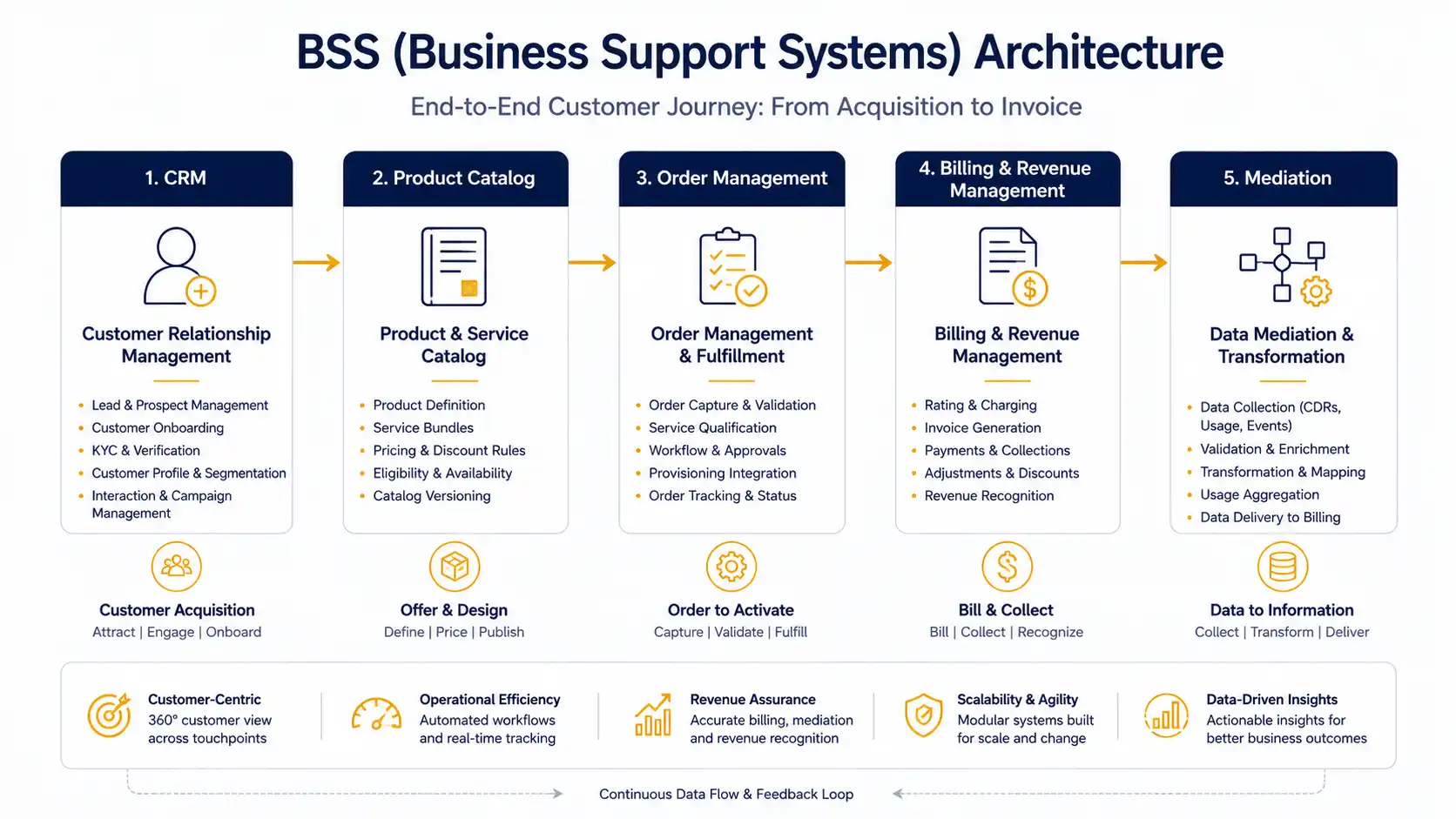
BSS handles the commercial interactions between the telecom operator and the customer. Every touchpoint from the moment someone becomes a subscriber to the moment they receive and pay their bill goes through BSS. From an IT perspective, BSS systems are the most business-facing telecom projects, making them the most accessible starting point for Business Analysts entering the sector.
| BSS System | What It Does | IT/BA Project Types |
|---|---|---|
| CRM (Customer Relationship Management) | Manages customer profiles, service requests, complaints, and interactions. The single view of the customer across all channels. | CRM implementation, customer 360, churn prediction, loyalty programs |
| Product Catalog | A centralised database of all products, plans, devices, and bundled services with their pricing, eligibility, and configuration rules. | Catalog implementation, promotion engine, tariff management, bundle configuration |
| Order Management (OMS) | Captures customer orders and orchestrates their fulfilment through to service activation. The bridge between BSS and OSS. | Order-to-Activate automation, fallout management, order-to-cash workflow |
| Billing and Revenue Management | Generates invoices, processes payments, manages collections, and handles refunds. Covers both prepaid real-time charging and postpaid batch billing. | Billing platform, rating engine, bill presentment, payment gateway integration |
| Mediation | Collects raw Call Detail Records (CDRs) from the network and transforms them into billable events before passing them to the rating engine. | Mediation platform, CDR processing, data reconciliation, format transformation |
| Revenue Assurance | Identifies revenue leakage: usage events that were generated but not billed, or charges raised but not collected. | RA controls implementation, CDR reconciliation, leakage analysis dashboards |
The CDR flow is the foundation of BSS: every billable event (call, SMS, data session) generates a CDR on the network. Mediation collects and normalises it. The rating engine prices it. Billing produces the invoice. Understanding this chain is the single most valuable piece of BSS knowledge for a BA or QA professional in the sector.
OSS: Operations Support Systems
OSS is utilized by the telecom operator’s technical and engineering teams to build and maintain the network. While BSS faces the customer, OSS faces the infrastructure. OSS projects are the largest single category of telecom IT work, and they require working knowledge of how networks are built and managed.
| OSS System | What It Does | IT/BA Project Types |
|---|---|---|
| Network Inventory | Tracks all physical assets (routers, towers, cables) and logical assets (IP addresses, phone numbers, circuit IDs). The source of truth for what exists on the network. | Inventory system build, GIS fiber mapping, data migration, reconciliation |
| Service Provisioning and Activation | Activates services when a customer orders by configuring and allocating network resources automatically. | Provisioning platform, Order-to-Activate, CPE remote configuration, fallout handling |
| Fault Management | Detects, isolates, and logs network errors and outages via alarms from network elements. Correlates alarms to identify root cause. | NMS integration, alarm correlation, trouble-ticket system, automated dispatching |
| Service Assurance | Ensures network performance meets Service Level Agreements (SLAs) and Quality of Service (QoS) commitments for individual customers and services. | Service assurance platform, SLA monitoring, proactive fault detection, customer impact analysis |
| Performance Management | Monitors network KPIs: throughput, latency, packet loss, cell congestion, and coverage, then feeds planning tools. | KPI dashboards, capacity planning tools, radio optimization |
| Workforce Management | Schedules and dispatches field engineers for installations, fault resolution, and infrastructure maintenance. | Field force management app, job scheduling, SLA-driven dispatch, mobile workforce integration |
Industry Standards and Frameworks
Telecom ecosystems are highly complex, with hundreds of interconnected systems across multiple vendors. Organizations rely on standardised architectures to integrate everything reliably. TM Forum is the global industry association that provides these frameworks.
TM Forum and eTOM
TM Forum is a global industry association that provides standardised frameworks to streamline operations and ensure interoperability across the telecom IT ecosystem. Its frameworks are the common language of telecom IT projects worldwide, used by operators in the US, UK, Australia, India, and across Europe and Asia.
The eTOM (Enhanced Telecom Operations Map) is the business-process framework. It maps all telecom processes in a hierarchical structure, giving BAs and project teams a shared reference for scoping work. Its three operational process areas are the most practically useful:
Fulfillment
All processes involved in delivering a service after a customer places an order, including order capture, design, provisioning, and activation. Most OSS provisioning and OMS projects map here.
Assurance
All processes that monitor and maintain service quality, including fault management, performance management, service assurance, and SLA reporting. OSS monitoring and NOC projects map here.
Billing
The end-to-end revenue process from mediation through rating, invoicing, payment, and collections. Every BSS billing project maps here.
Open APIs
TM Forum standardised REST APIs allow disparate telecom systems to communicate efficiently, enabling operators to rapidly launch new digital services and integrate with third-party platforms. Open APIs are increasingly specified in BSS and OSS RFPs as a mandatory interoperability requirement, making them important for BAs writing integration requirements.
Key Business Processes in the Telecom Sector
Three end-to-end business processes come up on nearly every telecom IT project. Understanding them by name tells you immediately which systems are in scope and which teams you need to involve.
Lead-to-Cash
The complete commercial cycle from the first point of marketing contact to collecting payment. It spans CRM (lead capture), sales and quoting, order management (order-to-activate), provisioning, billing, and payment collection. In eTOM terms, it cuts across the Market/Sales and Fulfillment/Billing layers. Any end-to-end BSS transformation project will cover this process.
Trouble-to-Resolve
The lifecycle of a customer complaint or network outage, from the first ticket raised through fault isolation, technician dispatch, resolution, and customer notification. It spans CRM (complaint capture), OSS fault management, workforce management, and SLA tracking. Projects involving NOC systems, field force apps, and service assurance platforms all touch this process.
Churn Management
The strategies, analytics, and operational processes used to predict and prevent customers from switching to a competitor. It involves churn propensity modelling (data analytics), targeted retention offers (CRM and product catalog), and proactive outreach workflows. Churn is the primary commercial KPI in mature markets like the US, UK, and Australia where operator switching is easy.
Other important process flows for IT and BA professionals
- Order-to-Activate: The specific sub-process from order capture in OMS through provisioning on the network to service activation confirmation. The most technically complex provisioning workflow a BA encounters.
- CDR-to-Invoice: From network event generation through mediation, rating, and invoicing. The revenue-critical flow that BSS billing projects must get exactly right.
- Number Portability (MNP): The regulatory process allowing customers to keep their number when switching operators, requiring coordination between operators, a central porting database, and network routing changes.
What IT Professionals and Business Analysts Need to Know
Telecom is technically complex and commercially dynamic. The combination of real-time network operations and high-volume billing makes domain knowledge a direct determinant of requirements quality.
| Activity | Without Domain Knowledge | With Domain Knowledge |
|---|---|---|
| OSS/BSS scope definition | Cannot determine whether a requirement belongs in OSS or BSS | Maps requirements correctly: activation is OSS, billing is BSS, OMS bridges both |
| Requirements elicitation | Does not know what a CDR is or why billing separates mediation from rating | Asks precise questions about CDR format, rating logic, proration, and plan configuration |
| User story writing | Happy-path only, missing prepaid vs postpaid, roaming charges, mid-cycle plan change | Covers the full lifecycle including SLA breach, bundle expiry, and partial provisioning fallout |
| Stakeholder communication | Needs ARPU, CDR, churn, MVNO, mediation explained at every session | Communicates as a peer with network, billing, product, and compliance teams |
Common IT Projects in the Telecom Sector
- BSS Transformation: replacing or upgrading billing, CRM, or order management. The most common large telecom IT project globally.
- OSS Inventory Implementation: building or replacing network inventory management; critical for FTTH rollout and 5G deployment programmes.
- Provisioning Automation: automating service activation from order capture to network configuration; reduces fallout and manual intervention.
- Product Catalog Implementation: centralised catalog enabling faster product launch and consistent pricing across channels.
- Digital Self-Care Portal: customer app for bill payment, plan change, usage monitoring, and fault reporting.
- Revenue Assurance Programme: identifying and closing leakage between network usage and billing output.
- 5G BSS Readiness: adapting billing and CRM for network slicing, IoT connectivity, and edge computing service models.
- Number Portability (MNP): regulatory-mandated porting system with complex routing and inter-operator coordination.
Telecom Terminology Glossary
These terms appear in almost every telecom IT project and stakeholder conversation. Knowing them before the first meeting avoids the credibility gap that slows initial engagement on any telecom project.
Commercial and Customer Terms
ARPU
Average Revenue Per User: the headline commercial metric for measuring operator revenue per subscriber.
Churn
The percentage of subscribers who cancel or switch to a competitor in a given period. The primary retention metric in competitive markets.
MNO / MVNO
Mobile Network Operator (owns spectrum and towers) vs Mobile Virtual Network Operator (resells another MNO’s capacity).
Prepaid / Postpaid
Pay-before-use vs pay-after-use billing models. Each has different real-time charging, credit, and provisioning system logic.
Network and Operations Terms
CDR
Call Detail Record: the data record generated by the network for every billable event (call, SMS, data session).
OSS / BSS
Operations Support Systems (network management) vs Business Support Systems (customer management).
Mediation
The system that collects raw CDRs from network elements and transforms them into structured billable events.
Provisioning
The process of activating a service on the network after an order: allocating resources and configuring equipment.
NMS
Network Management System: provides real-time visibility into network element status, alarms, and performance.
FTTH
Fiber to the Home: highest-speed fixed broadband, delivered via optical fiber to the customer’s premises.
Service, Quality, and Framework Terms
eTOM
Enhanced Telecom Operations Map: TM Forum’s standard business-process framework, covering Fulfillment, Assurance, and Billing.
SLA / QoS
Service Level Agreement: contractual uptime and performance commitments. QoS (Quality of Service) is the technical mechanism enforcing them.
VoIP / VoLTE / SIP
Voice over IP, Voice over LTE, and Session Initiation Protocol: the standards powering modern packet-based voice services.
Interconnect / Roaming
Interconnect: agreements allowing calls between different operators’ networks. Roaming: using another operator’s network when abroad.
MPLS / SD-WAN
Multiprotocol Label Switching (dedicated private WAN) vs Software-Defined WAN (intelligent, flexible enterprise connectivity over internet).
Revenue Assurance
The controls and processes that identify revenue leakage between network usage generation and billing collection.
How to Build Your Telecom Knowledge
You do not need an engineering background. A structured, project-oriented approach works for IT and BA professionals entering the sector from any starting point.
Start with the communication model and network layers
Understand transmitter, medium, receiver, and the difference between core network, access network, and CPE. This gives you the physical context for every OSS project.
Learn OSS versus BSS
Know clearly which systems manage the network (OSS) and which manage the customer (BSS). Learn the CDR-to-invoice flow as the backbone of BSS knowledge.
Learn the eTOM framework
Fulfillment, Assurance, and Billing cover every category of telecom IT project. Map your project to one of these process areas from day one.
Know the key business processes
Lead-to-Cash, Trouble-to-Resolve, Order-to-Activate, and CDR-to-Invoice are the process flows that come up in almost every stakeholder conversation.
Take a structured training course
A focused telecom training program teaches the full sector context, terminology, and system landscape in a sequence that self-study cannot replicate, with real project scenarios.
Ready to work on telecom IT projects with confidence?
Explore Techcanvass’s domain guides and training for IT professionals and Business Analysts entering or growing in the telecom sector.
Frequently Asked Questions
What is the telecom domain?
What is the difference between OSS and BSS?
What is a CDR in telecom?
What is eTOM and how do Business Analysts use it?
What are the key business processes in telecom?
How can I build telecom knowledge without an engineering background?
Explore Related IT Domain Guides
Telecom and BFSI together account for the majority of IT services projects globally. These guides connect the full picture for IT professionals and Business Analysts.
What Is the BFSI Domain? Full Form, Meaning and Complete Guide
How banking, financial services, and insurance connect, and what IT professionals need to know about each sector.
Read guide BankingBanking Domain Fundamentals: How the Industry Works
CBS, the lending lifecycle, payment rails, and regulatory frameworks for banking IT projects globally.
Read guide PaymentsFundamentals of the Payments Domain: How Money Moves
The Four-Corner Model, authorization-clearing-settlement lifecycle, payment rails, and ISO 20022 explained.
Read guide InsuranceInsurance Domain Fundamentals: How the Industry Works
Core principles, product categories, claims lifecycle, IT systems, and global regulations for insurance projects.
Read guide Career GuidanceWhich BA Domain Should You Choose?
A structured comparison of telecom, banking, insurance, payments, and healthcare to help IT professionals decide.
Read guide TrainingTelecom Domain Training for IT and BA Professionals
OSS, BSS, core services, eTOM framework, and key business processes with real project context.
View training