How to Develop Product Sense: The Secret Skill That Gets You Hired at Top Tech Companies

Table of Contents
Introduction
Building products that genuinely help people is one of the hardest challenges in the tech industry. People are complex. They often cannot articulate what they truly need. To solve this, top tech companies have rallied around a deceptively simple concept: Product Sense. If you have applied for Product Management roles at companies like Netflix, Airbnb, Google, or Stripe, you have almost certainly seen product sense listed as a core requirement. Interviewers at these companies use it as the ultimate litmus test — a filter to separate candidates who look great on paper from those who will actually thrive in the role.
So what is product sense in reality? It is not a degree you earn or a certificate you display.
Product Sense is the ability to look at a pile of human problems and intuitively know which one is worth solving — and then solve it in a way that feels obvious in hindsight.
It is sometimes called product thinking, product intuition, or product judgment. Whatever you call it, product sense is the difference between a product that works and a product that people love.
In this article, we take a deep dive into how to develop product sense as a skill — and why mastering it will help you get hired at top-tier tech companies and excel in the product management career you are building.
-
01
Product Sense is not a degree or certificate — it is the intuitive ability to identify which human problems are worth solving and how to solve them in a way that feels obvious in hindsight.
-
02
Top tech companies like Google, Meta, and Stripe use Product Sense interviews to filter candidates who can empathize with real users — not just build feature lists.
-
03
Product Sense is built on three pillars: the Jobs to Be Done framework, reducing user friction and mental load, and understanding the emotional delta of delight.
-
04
You can actively develop product intuition through three techniques: the Deconstruction Habit, the Art of Observation, and the Magic Wand Technique.
-
05
As AI commoditizes technical skills, Product Sense becomes your most irreplaceable asset — because human irrationality, emotion, and context are things machines cannot yet understand.
What Is Product Sense? (And Why Most PMs Don’t Have It)
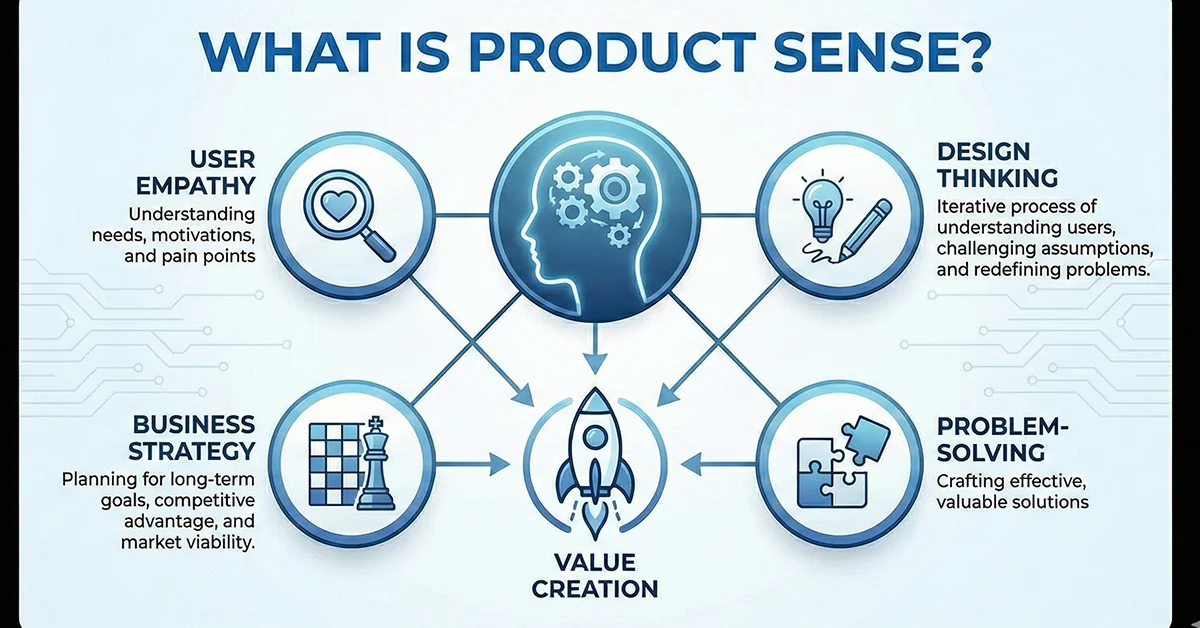
For someone outside of product management, product sense can look like a gut feeling. For the seasoned professional, it is more like a high-speed mental calculation. It is the intersection of user empathy, design thinking, and business strategy — applied simultaneously, in real time.
PMs with strong product sense scan for three specific things whenever they encounter a product:
1. The Jobs to Be Done Framework
This foundational theory, popularized by Clayton Christensen, states that people do not buy products — they hire them to get a job done. If you are building a fitness app, the job is not simply “tracking calories.” For one user, the job is feeling less guilty after dinner. For another, it is proving discipline to their social circle. A PM with strong product sense identifies which job they are truly competing for — and builds accordingly.
2. Friction and Mental Load
Humans naturally gravitate toward the path of least resistance. Every extra click, confusing icon, or unnecessary form field is a tax on the user’s attention. Product sense is the ability to spot this friction before it is ever built. It is the intuition that says: if a user has to think for more than two seconds about how to save their work, the product has already failed.
3. The Delta of Delight
This is the hardest element to teach. It is an understanding of what will actually make a user smile. Consider the first iPhone — when you scrolled to the bottom of a list, the screen would bounce. That bounce added zero functional value. But it made the device feel alive and organic. That is product intuition at work: understanding that humans are emotional creatures, not just data-processing units.
Why Most Tech Professionals Lack Product Sense (And How It Costs Them)
As tech professionals, we are trained to be analytical. We are taught to look to data for insights, run A/B tests, and follow structured process frameworks. While these tools are important, they are often used as crutches — a way to avoid the harder, messier work of developing genuine product intuition.
Consider the infamous Juicero press: a $400 Wi-Fi-connected juicer that raised $120 million in venture capital. It was a marvel of engineering — custom motors, sleek design, cutting-edge hardware. But it failed spectacularly because its creators lacked product sense. They engineered a solution to squeeze a juice packet that a human hand could squeeze in ten seconds. They solved a problem that did not exist.
At top-tier tech firms, the product sense interview is specifically designed to make sure they never hire someone who would have built the Juicero. They are not looking for the best engineer or the most process-driven PM. They are looking for the person with the product judgment to say: “Just because we can build this, doesn’t mean we should.”
How Product Sense Shaped the Giants: Real-World Case Studies
The clearest way to understand product sense in action is to look at the strategic decisions of successful companies. These are not stories about data or frameworks — they are stories about human intuition applied at scale.
Case Study 1: The Elevator Close Door Button
Have you noticed that in many modern elevators, the Close Door button does nothing? It is often disconnected or on a significant delay. Functionally, it is useless. But from a product sense perspective, it is brilliant. It gives passengers a sense of control in a small, confined space. It solves a psychological need — impatience, anxiety, the desire for agency — rather than a mechanical one. That is human-centered design at its finest.
Case Study 2: Slack’s Pivot from a Failing Game
Slack, now one of the world’s leading workplace communication platforms, began life as an internal tool built while its team was developing a multiplayer online game called Glitch. When the game failed, a lesser team would have doubled down or shut down entirely. Instead, the founders applied their product intuition: they noticed their internal messaging tool was far more engaging than the product they had set out to build. They recognized a universal pain point across every corporate office in the world and pivoted accordingly. The result was a multi-billion dollar product born entirely from product sense.
How to Answer Product Sense Interview Questions at Google, Meta & Stripe
Companies like Google, Meta, and Stripe ask product sense interview questions such as “How would you improve the experience of finding a doctor?” or “Design a vending machine for the blind.”
The interviewer is not looking for a feature list. They are evaluating whether you can empathize deeply with a person you have never met. Here is what the difference looks like in practice:
I’d add a search bar, a map, and a rating system. I’d make it load really fast and add an AI chatbot.
First, let’s consider the emotional state of someone searching for a doctor. They are likely in pain, anxious, or confused. They don’t just need a list — they need trust. What builds trust? Speed of access? Clarity of next steps? This person doesn’t need a map. They need a clear path to care.
The second response demonstrates that the candidate is not building for a user — they are building for a human. That distinction is everything in a product management interview.
Here are more example PM interview questions that test for product sense:
- How would you redesign the airport check-in experience for first-time international travelers?
- How would you improve Google Maps for users who are visually impaired?
- Design a feature for Spotify that helps users discover music they didn’t know they wanted.
In every case, the winning answer starts with the human — their emotional state, their context, their underlying job to be done — before touching a single feature.
How to Develop Product Sense: 3 Practical Techniques
There is a common misconception that product sense is something you either have or you don’t. While some people are naturally more empathetic or observant, product intuition is a muscle that can be trained through intentional practice. Here are three techniques used by the best PMs in the industry.
Technique 1: The Deconstruction Habit
Start with the app that annoys you the most. Instead of closing it in frustration, pause and interrogate your reaction. Why are you annoyed? Is the app failing its core function? Is it over-engineered or under-designed? Then do the same exercise with the app you love most. Why do you keep coming back? What is the psychological hook keeping you engaged?
This is how you begin to see the invisible hands of the PMs who shaped these experiences. You learn to reverse-engineer product judgment by examining your own emotional responses to technology — a key building block of product thinking.
Technique 2: The Art of Observation
Spend time in public spaces — a coffee shop, an airport terminal, a grocery store — and observe how people interact with the physical and digital world around them. Watch where they struggle, where they give up, where they sigh. Watch a person fumble at a self-checkout counter. Observe someone awkwardly pushing a pull door.
This practice builds a mental library of real human friction. When you are asked a product sense interview question, you draw from these observations to generate authentic, empathetic answers rather than textbook frameworks.
Technique 3: The Magic Wand Technique
Pick any everyday object — a toaster, a car key fob, a parking meter. Allow yourself exactly one change that would make this product meaningfully better for a specific group of people. The constraint forces you to think in transformations, not tweaks. This is the essence of product discovery: finding the one change that shifts an experience from tolerable to delightful.
The Role of Business Strategy in Product Sense
It is important to note that product sense is not just about user empathy and beautiful design. It must be grounded in business reality. A product that delights users but costs $100 to acquire each one who pays only $5 is not a good product — it is a charity. True product sense means understanding the Flywheel Effect: how a better user experience generates more users, which generates more data, which generates a better experience.
Consider Amazon’s One-Click buy button:
- The Sense: Removing checkout friction entirely.
- The Human Truth: Impulse purchases are driven by momentum. A credit card prompt kills the moment.
- The Business Result: Billions in additional revenue from orders that would have become abandoned carts.
Product sense that ignores business strategy is incomplete. The best PMs understand that product-market fit is not just about building something people love — it is about building something that sustains a business while people love it.
Advance Your Product Management Career
Avoiding the Data Trap: Why Product Intuition Matters More Than Metrics
One of the biggest obstacles to developing product sense is an over-reliance on data. Modern tech gives us metrics for everything: click-through rates, bounce rates, daily active users, session durations. And data is genuinely valuable — but only for optimizing an existing path.
Data will tell you that users are clicking the red button more than the blue one. But data will not tell you that they are clicking it because they are confused and looking for the Home screen. That insight requires product intuition — the ability to step into the user’s experience and feel what they are feeling.
PMs with strong product sense use data to validate hunches and spot anomalies, not to generate vision. They know when to trust the numbers and when to trust the human story behind the numbers.
The Future of Product Sense: Human Intuition in an AI-Driven World
As AI continues to reshape the tech industry, many traditional PM skills are becoming commoditized. AI can now draft product requirement documents in seconds, generate code, design user interface layouts, and simulate user testing scenarios.
But the one thing AI has not mastered — and may never fully master — is the complexity of human irrationality. AI does not understand the cringe of a poorly timed push notification. It does not understand the quiet pride someone feels when they finally master a complex creative tool. It cannot sense the emotional weight of a moment and decide not to interrupt it.
This is why product sense — the skill that gets you hired at top-tier tech companies today — is becoming even more valuable as AI takes over everything else. The ability to look at a technical possibility and say, “Just because we can build this, doesn’t mean we should,” is the ultimate expression of product judgment. And it is irreplaceable.
Conclusion: Start Your Product Sense Journey Today
If you want to develop product sense, stop viewing product management as a corporate role and start viewing it as a study of human behavior. The best PMs are not the ones with the most sophisticated frameworks or the best spreadsheets — they are the ones who are genuinely curious about why people do what they do.
Product sense is the bridge between the world as it is and the world as it could be. It sits at the intersection of a psychologist’s empathy, an engineer’s precision, and an artist’s vision. It is built through a lifetime of observation, hypothesis, and refinement.
The next time you sit down for a product management interview — or a product strategy meeting — resist the urge to reach for a framework first. Reach for the human story. Ask: what is making this person frustrated? What are they trying to achieve? How does this experience fit into the rhythm of their daily life?
Once you develop the habit of asking those questions, you will find yourself naturally knowing what to build next. That is product sense. And that is your superpower.