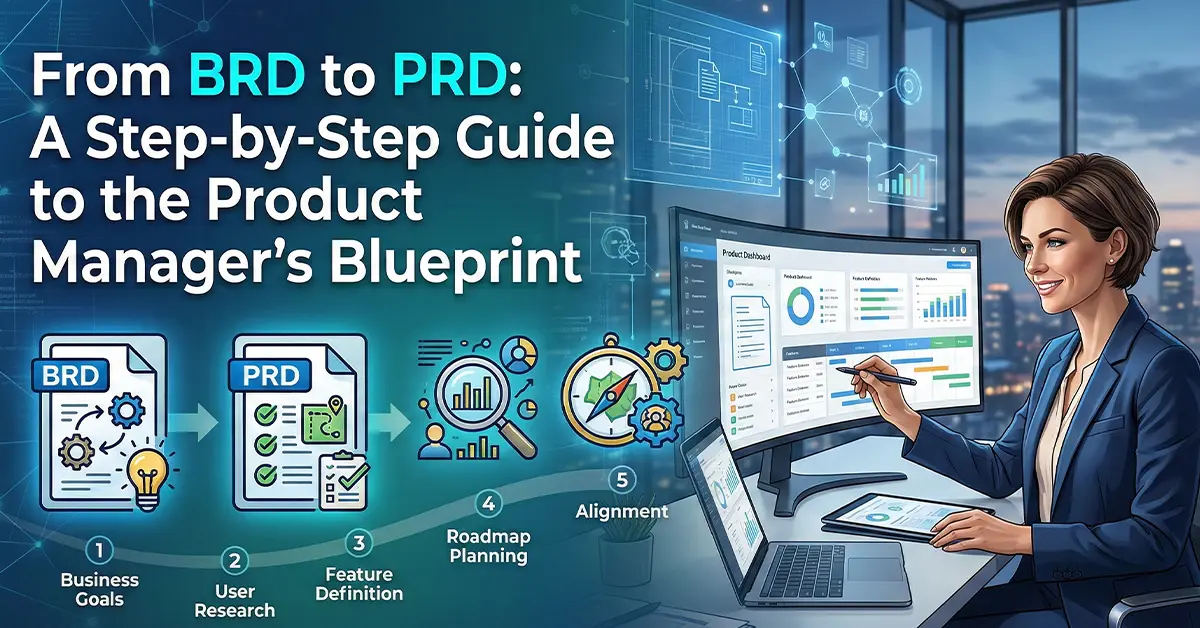
Quick Answer
A PRD (Product Requirements Document) is a living document that translates business goals into specific, user-centred product requirements. Unlike a BRD, which captures what the business wants, a PRD defines the problem to be solved, the success metrics, and the functional requirements engineers need to build the right thing.
In This Article
Introduction
Learning how to write a PRD (Product Requirements Document) is one of the most critical skills a Product Manager can master — and the single fastest way to ensure your team builds the right thing, in the right way, for the right user.
The most expensive mistake any product team can make is building the wrong thing perfectly. If you have been a Product Manager for any length of time, you have lived this. A room full of smart people spends months designing, coding, and validating a feature, only to discover at launch that it does not move the needle. Engineers feel their effort was wasted; stakeholders are frustrated that revenue did not jump. The team blames communication, but the real villain is always documentation. If you are transitioning from a business analyst to product manager role, mastering the leap from a BRD to a PRD is one of the first and most critical skills you will need.
In the past, teams relied on the Business Requirements Document (BRD) — a heavy, formal artifact that lived in a shared folder and rarely reflected the lived reality of the user. To build software that actually works today, you need to master the transition to a Product Requirements Document (PRD). This is not simply about swapping a template. It is about shifting your entire mindset from being a clerk for the business to being an architect for the user.
The Translation Gap: Why BRDs Are Not Enough
A BRD is inherently a business-facing document. It is written in the language of executives and investors, covering market analysis, ROI projections, and regulatory compliance. These are all essential — but they are almost entirely useless to a designer or a developer sitting down to build something.
Consider this example. A BRD contains the requirement: “We need to capture the Gen Z market by making our app more social.” That is a valid business goal, but it is not a product requirement. Give that single line to three different engineers. One will build a chat room, one will build a photo-sharing feed, and one will build a “Share to TikTok” button.
The PRD bridges this gap. It takes that high-level business intent and translates it into functional, buildable reality. If the BRD is what the company wants, the PRD is how we solve the user’s problem so that the company gets what it wants. The transition between the two is the most critical part of a Product Manager’s job. It demands that you act as a detective — uncovering the actual human pain points hidden behind corporate goals.
| Factor | BRD (Business Requirements Document) | PRD (Product Requirements Document) |
|---|---|---|
| Purpose | Captures what the business wants | Defines what to build and why, for the user |
| Audience | Executives, investors, finance | Engineers, designers, QA, PM |
| Written by | Business Analyst / Stakeholders | Product Manager |
| Focus | Business goals, ROI, market analysis | User problems, success metrics, features |
| Language | Business & financial terminology | Functional & technical specifications |
| Lifecycle | Static — written once, rarely updated | Living document — updated throughout sprint cycle |
| Output | Approval to fund a project | A blueprint for the engineering team to build |
| Example goal | “Capture the Gen Z market” | “Reduce abandon rate on recurring transfers by 25%” |
Start with the Problem Statement — The “Why” Is Your Anchor
The worst PRDs always start with a list of features. When your first line is “We need a dashboard,” you have already failed. You have jumped to the solution before proving you understand the problem. To develop product sense, always make the Problem Statement the very first section of your PRD. It must be grounded in data and backed by evidence of why the current state is painful for the user.
If you cannot clearly articulate the pain point, you should not ask the engineering team to build anything. Here is a concrete example using a mobile banking app:
BRD Business Goal:
Increase the number of users who set up recurring transfers.
PRD Problem Statement:
Currently, 65% of users who start the recurring transfer flow abandon it on the “Select Frequency” screen. User interviews reveal that customers fear overdrawing their account if a transfer lands on a day with insufficient funds, and the current UI does not show projected balance.
Notice the shift. The user does not want a recurring transfers feature — they are anxious about their balance. That insight changes everything. The focus moves from building a pretty form to building a balance-projection tool that checks for funds before execution. Inviting your team to solve for user anxiety rather than deliver a feature is the hallmark of great product leadership.
Defining Success: Metrics Over Activities
Once you have a problem, you need to know how you will measure the fix. Most teams get lazy here, listing “Launch Feature X” as their success metric. But launching is an activity, not an outcome. Shipping code is the bare minimum. It is not success. A strong understanding of outcome-driven innovation will help you anchor every PRD to measurable results.
In an Agile PRD, your KPIs must be outcome-oriented. Using our banking example:
- Primary Metric: 25% increase in completed recurring transfer setups within the first 30 days.
- Secondary Metric: Reduction in failed-transfer support tickets.
- Guardrail Metric: The new balance-projection feature must not increase the app’s initial load time by more than 200ms.
These three layers give the team autonomy to make trade-offs. If eliminating a complex design element protects the primary metric, the team can decide that without escalating to the PM for every micro-decision.
These three layers give the team autonomy to make trade-offs. If eliminating a complex design element protects the primary metric, the team can decide that without escalating to the PM for every micro-decision.
The Agile View: The Document as a Living Conversation
There is a common myth that being Agile means you do not need a PRD. The logic goes: we have user stories and Jira boards, so why write a lengthy document? In reality, the more agile your team, the more you need a single source of truth. A well-maintained PRD is central to any serious product roadmap strategy.
The difference is that an Agile PRD is a living document — not a contract signed and filed away. In traditional waterfall processes, the entire PRD was written before a single line of code was drafted. In an Agile environment, the PRD starts as a stub: perhaps just the problem statement and success metrics. You then bring in your Lead Engineer and Designer for a discovery session, and the document evolves.
For instance, your engineer might surface that the balance-projection logic is incredibly complex because of how the legacy database handles real-time queries. At that moment, the PRD changes — you pivot to showing Current Balance instead of Projected Balance for Version 1. The PRD records that decision and the reasoning behind it. Months later, when a stakeholder asks why projected balance was not built, the answer is right there in the document. Want to explore how AI is changing this process? Read our guide on how to write a PRD using Gen AI.
The Core Blueprint: What Actually Goes Inside a PRD
While every company has its own template, a professional PRD needs a specific structural hierarchy. Too short and it is vague; too long and nobody reads it. The goal is a document where the “what” and “why” are crystal clear, but the implementation is left to the experts.
1. User Personas
A user is not a monolith. Are you building for power users who want maximum customisation, or for busy professionals who just want to get something done quickly? Defining personas makes the designer’s job possible and prevents the team from building something that pleases nobody.
2. The User Flow
Do not just list screens. Describe the journey. Where does the user come from? What is the Happy Path where everything works perfectly? More critically, what are the Error States? What happens if the internet drops mid-transaction? What if the user enters an invalid card number? More products break in edge cases than anywhere else, purely because the PM forgot to document what happens when things go wrong.
3. Functional Requirements (with MoSCoW Prioritisation)
This is the technical core of the document. List exactly what the system must do, and prioritise using the MoSCoW method (Must Have, Should Have, Could Have, Won’t Have). Using our banking example:
- Must Have: The system must allow users to edit the transfer amount after it has been scheduled.
- Should Have: The system should send a push notification 24 hours before a transfer happens.
- Won’t Have: The system will not support overseas payments in this version.
4. Non-Functional Requirements
These are the invisible requirements — security, scalability, and performance. If you are building a feature that handles financial data, the PRD must specify the required encryption standards. If hundreds of thousands of users will access the feature on launch day, the PRD must define the load-handling requirements. These guardrails allow engineers to choose the right architecture.
The PM as a Bridge, Not a Dictator
Writing a PRD is a form of structured negotiation. Stakeholders always want more features; engineers always want more time and resources. The PRD is the tool that helps you find the Minimum Viable Product (MVP) that satisfies both parties. This is one of the most important aspects of influencing without authority as a PM — you are not using rank or seniority, you are using a shared document anchored in data.
When a stakeholder requests a feature that was not in the original plan, you do not simply say no. You open the PRD. You point to the Success Metrics and the Problem Statement. You ask: “How does this new request help us solve the specific problem we identified?” If it does not, the conversation becomes easy and objective. It is no longer your opinion versus their opinion — it is the goal versus the distraction.
The PRD also protects the engineering team. It provides clear direction, and there is nothing more demoralising for a developer than shifting requirements. A living, updated PRD means engineers always know what the current priority is. They are not guessing.
Avoiding Document Debt
A PRD can become Document Debt. Decisions made in meetings or over Slack never find their way into the document, and the PRD slowly becomes a stale artefact that no longer reflects the product being built.
The best antidote is to treat the PRD as a participant in every discussion — open it during sprint planning, during backlog grooming, during design reviews. If the team agrees on a change, update the PRD before the meeting ends. If an edge case is discovered, document it immediately. This discipline saves hours of rework and frees up team capacity for better work.
Reality Check: When to Stop Writing
There is such a thing as Analysis Paralysis. You can spend so long perfecting the PRD that you never actually start building. A good-enough PRD that enables the team to start is always better than a perfect one that arrives two weeks late.
Once the Problem Statement is clear, the metrics are defined, and the P0 (Must Have) requirements are documented, the team can begin. You can fill in the P1 and P2 details while engineers set up the infrastructure. Think of the blueprint analogy: the architect’s drawings exist to guide the construction, not to replace it.
The Result: A Unified, Outcome-Focused Team
When you successfully shift from a traditional BRD to an Agile PRD, you will notice a change in how your team talks. You stop hearing “Why are we building this?” or “What does success look like?” Instead, you hear conversations about the best way to hit the target metrics. The role of AI in product management is also accelerating this shift — modern PMs use AI tools to draft, refine, and validate PRDs faster than ever.
The PRD aligns every function. The designer has the user persona. The engineer has the technical requirements. The stakeholders have metrics to monitor. The team functions as a single unit pursuing a single mission.
Once you master this transition, you move from being a feature pusher to a true product leader. You take responsibility for outcomes, not just outputs. If you are looking to formalise these skills and advance your career, explore the structured Product Management Course from Techcanvass — designed to take you from documentation fundamentals all the way to strategic product leadership. You can also explore what it takes to become an AI product manager and the skills for AI product managers that will define the next decade of the role.